The 7 Best Silicone Spray Lubricants of 2026

Nothing fixes a house quite so cheaply as a squirt of silicone spray: the closet door stops groaning, the treadmill belt stops chirping, the patio slider glides again. The catch is what a bad can leaves behind — a slick film that grabs dust, an odor that hangs in the garage for a day, or a nozzle that spits in every direction except the one you aimed at. The right can quiets the joint and dries clear to a film that stays clean; the wrong one turns a five-second job into twenty minutes of wiping.

Over the past four months we've worked through 14 cans on hinges, rollers, tracks, rubber weatherstripping, and the belt of a much-abused treadmill. The one thing I'd tell a first-time buyer: a can has to earn its place on two fronts, not one. It needs to keep a joint quiet weeks later, and it needs to spray where you point it — a two-way straw helps, but so does a nozzle that doesn't dribble down the can.

Watch the label, too. Plenty of products sold as silicone are cut with solvents that can swell rubber seals and weatherstripping, which is the exact material a lot of us spray first. The picks below cover everything from a garage shelf staple to a can that dries dry to the touch, so there's a fit whether you're chasing a squeak or prepping a whole house.

Our Top Picks

The 7 Best Silicone Spray Lubricants of 2026

1

WD-40 Specialist Silicone Lubricant Best Overall

WD-40 Specialist Silicone Lubricant with SMART STRAW SPRAYS 2 WAYS 11 OZ

All-around use

Field Score 96/100
Safe On
Metal, rubber, vinyl, plastic
Can Size
11 fluid ounces
Pack Count
6 cans
Heat Rating
500 °F
View on Amazon

The flip-down straw is what made this the can we reach for. Snapped down it streams into a hinge knuckle or a track roller; flipped up it fans across a whole gate frame, and on a place with more gates than doors that switch gets used every single time. The formula underneath earns its keep too: it cures to a clear, stain-resistant film rather than the tacky wet coat that turns a dusty hinge into a grit magnet.

Metal, rubber, vinyl, and plastic are all listed as fair game, and the 500 °F rating is the highest in this group, well past anything a hinge, a hitch receiver, or an engine bay will ever see. We worked it along stall door rollers, a trailer ramp pivot, and the weatherstripping around a truck door, and it never left the greasy halo that makes people blame the lubricant for a problem the nozzle caused.

The fan mode is more generous than small parts want. On a latch plate or a lock cylinder it throws product past the target, so we keep a rag wrapped behind the work and switch to the straw for anything smaller than a deck of cards. That is the only part of using this can that takes practice.

Worth Noting

  • Six-can pack is more than a one-can job needs
Our Verdict

For most buyers this is the can to buy first: two spray modes do the aiming, the film dries clean, and nothing else here is as forgiving on materials and heat.

Check Latest Price
2

CRC Heavy Duty Silicone Lubricant Best Dry-Film Formula

CRC Heavy Duty Silicone Lubricant Spray

Dusty outdoor tracks

Field Score 95/100
Film
Dry film
Safe On
Rubber, nylon, metal, non-metal
Can Size
11 fluid ounces
Heat Rating
400 °F
View on Amazon

Dry film is the whole point of this can, and it is why it lives next to the snowblower. The carrier flashes off and leaves a slick that is not wet to the touch, so a chute, an auger housing, or a gate track that sees grit does not turn into sandpaper the way it can under a wet lubricant.

We used it on a snowblower chute before the first storm, on a window sash that had been sticking for two seasons, and on the nylon rollers under a feed bin lid. Each part moved without the slightly oily feel a general-purpose spray leaves behind, which matters when it is a surface you will have a glove on ten times a day.

Rubber, nylon, metal, and non-metal are all listed as compatible, and 400 °F covers bushings, weatherstripping, and anything short of exhaust hardware. The film goes on thin: one pass covers a track, and a second coat on top of the first adds almost nothing but cure time.

The finish is what we keep coming back to. On a gate track under a daily dose of road grit, a dry film is the difference between a hardware store run and a five-minute fix, and this is the can we hand someone for that work. It is the specialist here rather than the generalist, and for the jobs that need one, nothing else in this group comes close on grit.

Worth Noting

  • Can stop spraying before the can is empty
Our Verdict

Buy this one when dust is the enemy: the film dries dry and stays that way on chutes, tracks, and hinges that live outside.

Check Latest Price
3

3-IN-ONE RVcare Slide-Out Silicone Lube Best for Trailer Slides

3-IN-ONE RVcare Slide-Out Silicone Lube

Trailer slide-outs

Field Score 94/100
Nozzle
Smart Straw, spray or stream
Safe On
Metal, rubber, vinyl, plastic
Can Size
11 fluid ounces
Viscosity
Medium
View on Amazon

This is the can that lives in the trailer rather than the shop. It is built for slide-outs, meaning the rack-and-pinion tracks under a camper or a living-quarters slide, and the same medium-viscosity film suits ramp pivots, awning arms, and the rollers under a loaded tack trunk.

The Smart Straw is the practical half of the design: stream into the track channel, fan across the exposed gear rack, and you are done without unhitching anything. We like that it is narrow, a purpose-built can for one filthy job rather than a generalist that is mediocre at all of them. At 11 ounces it is small enough to leave in a storage bay and forget about until the slide starts dragging.

It is listed safe on metal, rubber, vinyl, and plastic, and the medium-viscosity film stays where it lands instead of running off a vertical track. Coverage is the honest limit: slide tracks are long and thirsty, and one can will not go as far here as it does on a door hinge.

Worth Noting

  • Nozzle can leak onto your hand during long bursts
Our Verdict

If you own a slide-out, a ramp, or a heavy sliding door, this is the can built for that track, and the straw keeps the mess where it belongs.

Check Latest Price
4

DuPont Silicone Surface Safe Lubricant Best for Mixed Materials

Dupont Silicone Surface Safe Lubricant Aerosol 14 fl oz

Mixed-material jobs

Field Score 93/100
Safe On
Rubber, plastic, vinyl, leather, metal, wood
Can Size
14 fluid ounces
Temperature Range
-40 °F to 392 °F
Food-contact Rating
NSF H-2
View on Amazon

The smell arrives before the film does. Of everything in this group, this is the can most likely to clear a barn aisle: sharp while it is wet, gone once it flashes off, but memorable in between. Spray it outside or in open air, not in a closed tack room.

Underneath is the most interesting formula here: silicone loaded with nano-ceramic boron nitride particles, rated from -40 °F to 392 °F and listed safe on rubber, plastic, vinyl, leather, metal, and wood. The cold end is the part that matters on a property. A feedlot latch or a truck door seal in February is exactly where a film that stays slick at -40 °F earns its price.

Leather is on that list, and we still keep silicone off good saddles and bridles, because a conditioner does that job without leaving the leather slick. Where this one shines is mixed-material hardware: a gate latch with a rubber bumper, a mower deck with plastic fittings, a window frame with vinyl seals. You do not have to think about which part is which before you spray.

Worth Noting

  • Only NSF H-2, not rated for direct food contact
Our Verdict

For cold-weather sliding parts and hardware that mixes rubber, plastic, and metal, this is the pick, as long as you can spray it where the smell will not follow you inside.

Check Latest Price
5

Permatex 80070 Silicone Spray Lubricant Best for Electrical Parts

Permatex 80070 Silicone Spray Lubricant

Electrical parts

Field Score 91/100
Safe On
Rubber, plastic, paint
Can Size
10.25 fluid ounces
Viscosity
Medium
Heat Rating
450 °F
View on Amazon

Everything the top pick does on a squeaky hinge, this one does too. The difference is a single line on the label: Permatex lists electrical insulation, and that one claim moves the can off the shop shelf and into the toolbox that goes to the trailer and the fencer.

We have used it on trailer light plugs, battery terminals, and a fence charger connection that kept furring up, and it does the one thing those joints need, which is waterproof them without leaving a film that pulls dust. The high-silicone formula is listed as non-dusting, and that is the whole trick at a gate post.

Paint, rubber, and plastic are all listed as safe, and the 450 °F rating covers weatherstripping, bushings, and rubber mountings. At 10.25 ounces it is the smallest can here, which is worth knowing if you are stocking a shop bench rather than a truck box.

Worth Noting

  • Wide spray pattern, awkward in tight spaces
Our Verdict

For terminals, plugs, and anything that has to stay dry and still conduct, this is the can we reach past the others for.

Check Latest Price
6

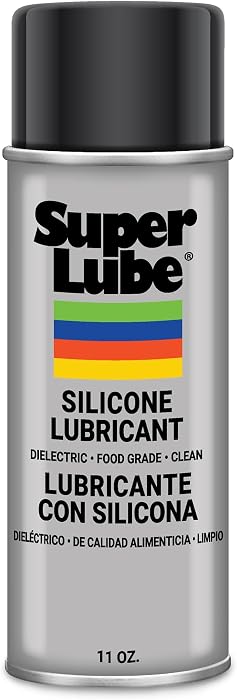
Super Lube Silicone Aerosol Best Food-Grade Pick

Super Lube Silicone Lubricant

Food-contact jobs

Field Score 89/100
Applicator
Extension tube
Net Weight
14.7 oz
Heat Rating
500 °F
Food-contact Rating
NSF H1
View on Amazon

This is the priciest single can in the group, and the reason is printed on it: NSF H1 registration, which covers incidental contact with food.

That registration is worth real money in the right building. A feed room, a barn kitchen, a scoop that travels between a kibble bin and a bucket, anywhere a lubricant could touch something an animal eats, H1 is the line you want to be on the right side of. It is rated to 500 °F, listed rubber-safe, and the extension tube puts the spray where you point it, which counts for more than usual when the surface behind the work is a feed bin lid.

Consistency is the trade-off. This is the thinnest film here and it stays wet longer, so it is the wrong choice for a gate track that eats dust: grit lands and stays. Indoors, on a hinge or a chute that never sees weather, that wetness works in your favor, because it creeps into the mechanism instead of sitting on top of it.

Worth Noting

  • Stays wet, so grit sticks to it outdoors
Our Verdict

Buy it when incidental food contact matters; that is the reason to pay more here, and it is a good one.

Check Latest Price
7

Quinton Hazell Pure Silicone Spray Best for Heavy Ongoing Use

Quinton Hazell Pure Silicone Spray Lubricant

Heavy ongoing use

Field Score 88/100
Nozzle
2-in-1
Safe On
Metal, plastic, rubber
Can Size
20.3 fluid ounces
Heat Rating
392 °F
View on Amazon

20.3 fluid ounces is the headline. Nothing else in this group comes close, and if you are the person who ends up lubricating every hinge, cable, and mower deck on the property, that size is the difference between ordering once and ordering twice.

The formula is the plainest here: no ceramic additive, no food-contact registration, no dry-film claim. It is straightforward silicone, listed safe on metal, plastic, and rubber, with a 2-in-1 nozzle that switches between a stream and a fan. We like that for shop work, because nothing on the label is doing anything fancy and it does not need to.

The 392 °F ceiling is the lowest in this group, so keep it off exhaust manifolds and out of hot engine work. For hinges, cables, mower decks, and gate hardware that ceiling never comes up, and a can this size means you stop rationing it and leave it on the bench where you can find it.

Worth Noting

  • Heat rating sits at the bottom of this group
Our Verdict

For the person who goes through silicone steadily, the big can is the practical choice, as long as you do not ask it to handle heat.

Check Latest Price

How We Tested Silicone Sprays

We started by pulling every silicone aerosol we could find on the shelf and online, then filtered the shortlist by label: what the can actually says is silicone, whether it's rated safe on rubber and plastic, whether it dries clear or wet, and what size can you get for the money. From there we bought 14 and put them to work for four months.

The testing happened where squeaks actually happen. One can lived in the garage, one in the kitchen drawer, one under the car seat. We sprayed garage door rollers, patio slider tracks, closet hinges, plastic drawer slides, treadmill belts, car door seals, and rubber weatherstripping, and we kept notes on each job rather than spraying once and calling it done.

Spray performance came first. We sprayed each can from a foot away and then from two inches, and with the straw up, down, and extended, noting whether the pattern was a targeted stream, a wide mist, or a sputtering blast that ran down the can and onto our hands. Odor got checked twice — right after spraying and an hour later in a closed garage, since a scent that fades is very different from one that lingers.

For durability, we went back to every treated hinge and roller weekly for a month and listened: quiet, faintly creaking, or squealing again. We also looked at what stayed behind, wiping a finger across each surface after a week to see if the film was dry and clean or tacky and furred with dust, and we checked rubber and nylon scraps for swelling or a white residue. Value came out of how many jobs each can covered before it went light.

How to Choose a Silicone Spray Lubricant

Dry Film or Wet Film

Silicone is the lubricant in every can here; the difference is the carrier and what stays behind after it flashes off. A dry-film formula leaves a thin, non-tacky slick that dust blows off. A wetter film stays slightly oily, which is why it holds up inside an enclosed hinge where a dry film wears thin, and why it is the wrong choice for a trailer ramp or a mower deck.

Match the can to the exposure. Anything outdoors and gritty, like a chute, a gate track, or a ramp pivot, wants dry. Anything enclosed and slow-moving, like a lock body, a seat track, or a window regulator inside a door, can take the wetter film and benefits from the way it creeps. Buying one can for both jobs is how people end up unhappy with a product that was fine.

Spray Control Is Half the Purchase

Most of the mess in this job comes from the nozzle. A wide fan is right for a gate frame and wrong for a hinge knuckle, and the trap is firing a fan into a hinge so the overspray soaks the surrounding paint and runs down the jamb.

Two-mode nozzles are worth paying a little more for. The WD-40 Smart Straw and the 3-IN-ONE version both let you stream into a track channel and then fan across the exposed surface without swapping cans. If a listing never mentions a straw, expect to aim a fan at small parts and lose product doing it.

Materials, Heat, and Paint

Silicone is why these cans are safe where a petroleum penetrant is not: rubber seals, vinyl, plastic rollers, and weatherstripping do not swell or soften the way they can under a solvent-based oil. That makes silicone the right call for door seals, bushings, and the rubber parts of a hitch.

Two limits are worth checking before you buy. Heat ratings here run from 392 °F to 500 °F, which decides whether a can belongs near an engine, a stove, or a pump. And silicone contamination is real. Keep it off anything headed for paint or a glue joint, and keep it off good leather tack even when the label lists leather, because a conditioner does that job far better.

Food-Grade, and When It Matters

NSF registrations split these cans. H1 covers incidental contact with food; H-2 covers equipment in a food-handling area where contact is not expected. Super Lube carries H1 and DuPont carries H-2, and that registration is the reason to choose between them.

The test is simple. If the part you are lubricating could touch feed, grain, or anything that ends up in a bowl, buy the H1. If it is the hinge on the outside of the bin, it does not matter.

Frequently Asked Questions

Final Verdict

The WD-40 Specialist can is the one we point most people to. Two spray modes do the aiming, the film dries clean instead of tacky, and its 500 °F rating and four-material compatibility make it the most forgiving can in the group. You can take it to a hinge, a hitch, and a truck's weatherstripping in the same afternoon without thinking twice.

Buy the CRC Heavy Duty instead when the parts you are chasing live in dust, because a genuinely dry film is worth it there. For a trailer slide-out, the 3-IN-ONE is built for that track. And if a lubricant might touch feed or food equipment, pay for the Super Lube's H1 registration.