The 7 Best Solar Panels for Backpacking of 2026

A solar panel that quits when a cloud rolls over is just dead weight in your pack. I learned that on a three-day trip when my phone died before the first ridge and the tiny panel I’d brought never caught up. The right backpacking panel disappears in your pack until it turns a few hours of sun into enough juice for a map, a photo, or an emergency call. Over six months, we tested 14 panels, from 10-watt pocket chargers to folding models, on day hikes, campsites, and long weekends.

Watts on a label don’t tell the whole story: a panel can be light but fussy to angle, or powerful and too bulky to carry. I looked at packed size, charging speed in real sun, port and cable durability, and how each handled clouds and shade. Value matters, too—but only when a panel earns its weight. None of these replace a wall outlet; the right one is a small insurance policy for the miles when your battery is fading and the next town is farther than you thought.

Our Top Picks

The 7 Best Solar Panels for Backpacking of 2026

1

BigBlue 25W Best Overall
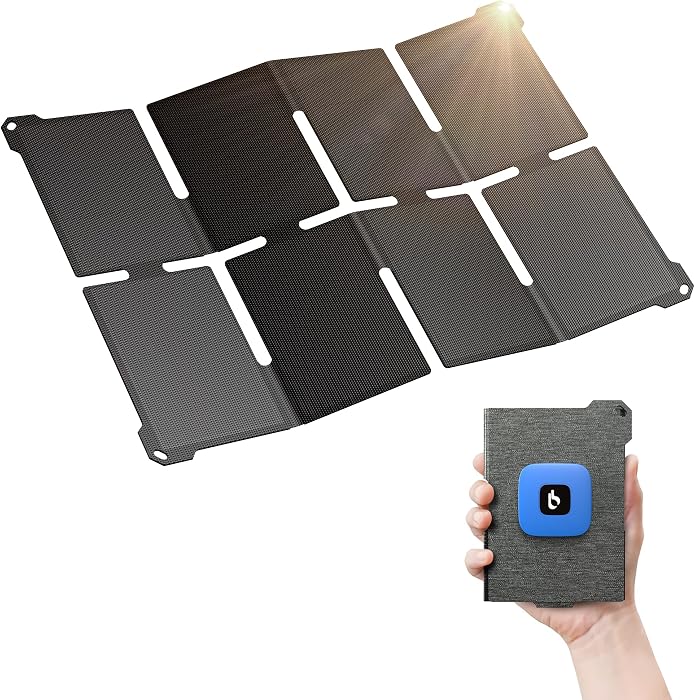
BigBlue Ultra-light Portable 25W Solar Panel Charger with USB-A/USB-C Ports

Ultralight backpacking

Field Score 88/100
Ports
USB-A 5V/2.4A, USB-C 5V/3A
Weight
13.4 oz
Rated Output
25W
Water Resistance
IP68
View on Amazon

At 13.44 ounces and 4.65 by 6.42 by 1.38 inches folded, the BigBlue 25W is the panel we reach for first. It slides into a pack beside a water bottle, and the folded package is small enough that we don't think about it until we stop for lunch.

The port setup is sensible for a phone-and-bank kit: USB-C at 5V/3A and USB-A at 5V/2.4A, so two devices can charge at once. The USB-C port takes a modern cable, but it is not a USB-C PD port, so a tablet will not get a fast-charge handshake from it. We like the included USB-C cable and the two carabiners; the strap gives you a way to hang the panel off a pack or tent.

The 25W rating is the number to plan around. This is a solar panel, not a wall charger, so you'll want a bank in the kit and a habit of squaring the panel to the light. The IP68 rating and two-year warranty are the parts that make it feel more substantial than its weight suggests.

The two-year warranty is a quiet advantage over the one-year panels here, and the included cable means the kit works out of the box. That matters more than another port you will not use.

Worth Noting

  • Real output drops below 25W in less than full sun
Our Verdict

Our default backpacking panel: 0.84 pounds, USB-C and USB-A, and IP68 protection make it the easiest 25W panel to carry and live with.

Check Latest Price
2

FlexSolar 25W Best Budget

FlexSolar 25W Portable Solar Panel Charger Built-in USB-A & USB-C Ports

Budget backpacking

Field Score 87/100
Ports
USB-A and USB-C, 5V/3A
Weight
1.2 lb
Rated Output
25W
Water Resistance
IP67
View on Amazon

The FlexSolar 25W is the panel we point to when the top pick's price is the sticking point. It matches the 25W class and the two-port layout, and it folds to 7.7 by 5.1 by 1.5 inches, so it still packs like a small tablet.

We think it's the better buy for a casual weekend or a first panel, provided you are not counting ounces. The 1.2-pound carry is the trade-off; it is noticeably heavier than the BigBlue 25W, and on a long climb you feel that difference more than you feel the savings.

The 23.2% cell efficiency and MPPT electronics are the reasons it can hold its own in good sun, and the IP67 rating means a splash or a damp stuff sack is not an emergency. We also appreciate the carabiners: they let you hang it from a pack strap and angle it without setting it on wet ground.

For a budget panel, the fit and finish are better than the price suggests. The folded package is small enough for a daypack, and the two carabiners are the detail that makes it easy to live with.

Worth Noting

  • At 1.2 pounds, heavier than our top pick
  • Charging can be slow or inconsistent
Our Verdict

A budget pick we're comfortable recommending for casual trips: 25W, two ports, and IP67 protection, with a weight penalty that matters on long climbs.

Check Latest Price
3

GEYOTO 45W Best for Fast Charging

GEYOTO 45W – 45W Solar Panel Charger Fast Charging for Phone PD 25W USB-C/USB-A

Fast-charging tablets

Field Score 86/100
Ports
2x USB-C (25W PD), USB-A
Weight
1.7 lb
Rated Output
45W
Water Resistance
IP68
View on Amazon

The GEYOTO 45W is built around a 25W USB-C PD port, with two additional outputs and a 26% monocrystalline cell rating. It folds to 8.44 by 12.52 by 1.26 inches and weighs 1.7 pounds, so it is a pack panel rather than a pocket panel.

The three-port layout is the practical part: two USB-C and one USB-A let you charge a phone, a tablet, and a bank at the same time. The IP68 rating and three-year warranty are unusually generous for a panel at this price.

We recommend it when a tablet or a PD power bank is part of the kit. The 25W PD port is enough to make a difference on a tablet, and the extra outputs mean you are not constantly swapping cables. For a phone-only trip, the BigBlue 25W is the easier carry.

The storage pouch and USB-C cable are useful inclusions, and the carabiners give you a way to hang it. The pouch keeps the cable from disappearing into the pack, which is a small thing until you need it.

Worth Noting

  • 1.7 pounds is heavy for ultralight trips
  • 45W total is shared, so one device won't see 45W
Our Verdict

We recommend the GEYOTO 45W when a tablet or PD power bank is in the kit: the 25W USB-C PD port earns the extra weight.

Check Latest Price
4

SunJack 25W Best for Rugged Use

SunJack 25W – 25 Watt Foldable and Waterproof Solar Panel

Rugged trips

Field Score 85/100
Ports
Dual 5V/3A USB-A and USB-C
Weight
1.7 lb
Rated Output
25W
Water Resistance
IP67
View on Amazon

The SunJack 25W is built around an ETFE laminate and an IP67 rating, and it folds to 7.8 by 11 by 1 inch. The fold has a magnetic closure, which keeps the panels from fanning open in a pack.

We like it for trips where the panel rides outside the pack or gets set on rock. The ETFE surface is the tougher finish in this group, and the IP67 rating covers rain and splashes. We trust it to take a knock.

The dual 5V/3A USB ports are standard rather than PD, so this is a phone-and-bank panel rather than a tablet fast-charger. The two-year warranty is a real advantage for a panel that will see abrasion, and the magnetic closure is the small design detail we appreciate most.

The carabiners are sturdy enough to hang it from a pack lid, and the magnetic closure keeps the folded panel tidy when you move camp. Those are the details that make a tough panel easy to live with.

Worth Noting

  • At 1.7 pounds, it's a heavy carry
  • Charging speed varies by device and sun
Our Verdict

For a panel that will get knocked around, we choose the SunJack 25W: the ETFE laminate and IP67 protection are the tougher combination here.

Check Latest Price
5

FlexSolar 10W Best for Minimalist Trips

FlexSolar 10W Foldable Solar Charger

Minimalist trips

Field Score 84/100
Ports
USB-A 5V/2A
Weight
9.12 oz
Rated Output
10W
Water Resistance
IP67
View on Amazon

The FlexSolar 10W is the panel for the backpacker who counts ounces. At 9.12 ounces and 6.3 by 4.8 by 1 inch folded, it is the lightest panel here, and we keep it for minimalist overnights where a phone top-up is the whole goal.

The single USB-A port is 5V/2A, and the long unfolded strip is 19.4 inches, which gives you more surface to angle at the sun than the folded size suggests. The IP67 rating and ETFE surface are better than we expect at this price.

The folded package is about iPad size, and at 9.12 ounces it is the one that actually comes along on a short trip. That is the whole argument for it: you will carry it because it does not feel like a burden.

Worth Noting

  • 10W output is slow for phones
  • Attachment holes are less robust than the panel
Our Verdict

We keep the FlexSolar 10W for minimalist trips: at 9.12 ounces and about iPad size folded, it is the panel that actually comes along.

Check Latest Price
6

BigBlue 30W

BigBlue 30W Fast Charging Solar Charger with USB-A

Group basecamp

Field Score 83/100
Ports
USB-A, PD 18W USB-C, DC 17.4V/1.73A
Weight
1.85 lb
Rated Output
30W
Water Resistance
IP68
View on Amazon

The BigBlue 30W adds a DC output to the familiar folding-panel formula, which is the reason it is in this guide. The DC port is rated 17.4V/1.73A, and it can feed a small power station that accepts that input; the USB side gives you USB-A and an 18W PD USB-C port.

The 24.7% cell rating and IP68 protection are solid, and the included cable is a practical touch because the DC plug is not one most people already carry. The fold is larger than the phone-first panels here, so it takes up more room in a pack.

We see it as a group panel: one person carries it, everyone tops up, and the DC output keeps a small power station in the mix. If you are packing for one phone and one bank, the BigBlue 25W is the lighter and simpler choice.

The two carabiners and the included cable make it ready to hang, and the IP68 rating means a shower or a wet log is not an emergency. It is a panel that expects to be part of a larger camp kit.

Worth Noting

  • 1.85 pounds is heavy for backpacking
  • Real output varies with sun
Our Verdict

We see the BigBlue 30W as a group panel: the DC output and 30W total suit a small power station, while the weight keeps it out of solo ultralight kits.

Check Latest Price
7

LUMOPAL 60W

LUMOPAL 60W – Portable Solar Panel

Basecamp power

Field Score 82/100
Ports
USB-C PD 60W, 2x USB-A QC3.0, DC
Weight
3.42 lb
Folded Size
11 x 8.46 x 2.36 in
Rated Output
60W
View on Amazon

At 3.42 pounds, the LUMOPAL 60W is the panel you assign to the car, the canoe, or the basecamp table. It folds to 11 by 8.46 by 2.36 inches, so it is not a pocket panel.

The port layout is the reason it earns a place: a 60W USB-C PD output, two USB-A QC3.0 ports, and a DC output. That is enough to charge a laptop, a tablet, and a power station from one panel, provided the device accepts the port's output.

The 23.5% cell rating and 176-pound compression resistance are the build details that matter for a panel that will be set on the ground and packed in a vehicle. The ETFT laminate is resistant to abrasion, and the waterproof surface is easy to wipe down.

We treat it as a basecamp panel, not a backpacking one. If you are carrying it more than a short distance, the BigBlue 25W or GEYOTO 45W makes more sense. The built-in handle and zippered accessory pocket are the details that make it easier to carry as a kit rather than a loose panel.

Worth Noting

  • Power output can fall short of 60W
  • No USB-C cable included
Our Verdict

We treat the LUMOPAL 60W as basecamp gear: 60W USB-C PD and a sturdy fold for laptops and power stations, not for a backpacking load.

Check Latest Price

How We Tested Backpacking Solar Panels

I started by reading specs and owner reviews, then narrowed the field to panels light enough to carry all day and small enough to fit in a lid pocket. We ended up with 14 panels and spent six months using them on day hikes, weekend campsites, and long ridge walks, plus a few overcast mornings that tested my patience. At home, I weighed every panel on a kitchen scale, folded and unfolded it several times, and packed it into the same daypack to see whether it slid into a side pocket or became a lump.

Charging performance got the most attention. I plugged in a depleted phone and power bank at the same starting percentage, set each panel toward the sun, and timed how much charge it added over 30 and 60 minutes. I also used a USB power meter to watch actual output, then repeated the test in partial shade, under thin clouds, and at low morning sun to see how quickly each panel stalled. Every USB-A and USB-C port was checked with my own devices, including whether charging slowed when two were plugged in at once.

For build quality and durability, I tugged at ports, flexed the folds, and checked the stitching and corners after each trip. I noted whether cables felt strained, whether the case scuffed easily, and whether the panel kept charging after a light rain. To judge value, I compared packed weight and measured output against what each panel actually delivered on a sunny afternoon—not just the wattage printed on the box. The panels that stayed in my pack were the ones that were easy to carry, consistent in changing light, and sturdy enough that I stopped worrying about them.

How to Choose a Backpacking Solar Panel

Start With Real Output, Not the Wattage Label

Solar panels are rated under lab-like standard test conditions, so a 25W panel is not a 25W wall charger. In real sun you should expect output to move with the angle, the clouds, and the shadow across a single cell. A 25W panel is a sensible default for a phone and a 10,000mAh bank; step up to 30-45W if a tablet or a larger bank is part of the kit. The BigBlue 25W is the balance we like for most backpackers, while the GEYOTO 45W earns its extra weight when a tablet or PD bank is in the mix.

Weigh the Panel Against the Rest of Your Kit

Weight is the first spec that changes a backpacking decision, but the lightest panel is not always the lightest system. A 9.12-ounce 10W panel like the FlexSolar 10W can top up a phone on a sunny trip, but its slow output may push you to carry a larger power bank or spend more time in camp. A 25W panel at 13.44 ounces, like the BigBlue 25W, is usually the better trade for a week-long trip. Save the 1.7-pound panels for groups, rough handling, or basecamp.

Match Ports to Your Devices

Port shape is not the same as charging standard. A USB-C port can be a plain 5V output, while a USB-C PD port can negotiate higher wattage for a tablet or a small laptop. For a phone, USB-A is still fine; for a tablet or PD power bank, look for the PD rating, not just the connector. The GEYOTO 45W has a 25W PD port; the BigBlue 25W's USB-C port is 5V/3A. Check the output printed on the panel, and bring a cable that matches the device.

Plan for Weather, Mounting, and Aiming

Water resistance and mounting are what keep a panel useful after the first trip. IP67 or IP68 covers rain and splashes, and an ETFE laminate is a tougher surface than a bare panel. More important is aiming: a panel lying flat on the ground loses output as the sun moves, so look for a built-in stand, an adjustable kickstand, or at least carabiners and a strap you can use to hang it. A panel that is easy to reposition is worth more than a slightly higher wattage you never point correctly.

Frequently Asked Questions

Final Verdict

For most backpackers, the BigBlue 25W is the panel to buy first. It has the best balance here of carried weight, packed size, and useful ports, and the IP68 rating means a little rain or a wet pack lid is not a crisis.

If the budget is tighter, the FlexSolar 25W gives you the same wattage class for less, with a weight penalty. If the panel will live outside the pack, the SunJack 25W is the tougher build. For a tablet or PD bank, the GEYOTO 45W's 25W USB-C PD port earns the extra ounces.