The 8 Best Stick Welders of 2026

Stick welding is the least glamorous way to join two pieces of steel: drag a flux-coated rod across the plate, watch the slag curl up behind the puddle, and hope the bead underneath is sound. It's also the only common process that shrugs off rust, paint, and wind, which is why it's what people reach for when a gate hinge snaps on a Saturday.

I learned the difference with a borrowed buzz box that dimmed the kitchen lights every time I struck an arc. Over the past six months, my team and I put twelve inverter stick welders through real repair work — trailer gates, fence posts, a mower deck — and the gap between the cheap ones and the good ones showed up fast.

What separates them is unglamorous: a hot start and arc force that actually do something, a readout that tells the truth about your amperage, and enough duty cycle to finish a rod without tripping the thermal cutout. Dual voltage is worth having if you'll ever plug into a 220V outlet, but don't buy amps your circuit can't feed. Every pick below struck an arc on the first tap and held it.

Our Top Picks

The 8 Best Stick Welders of 2026

1

YESWELDER ARC-205DS PRO Best Overall

YESWELDER 205Amp Stick Welder Digital Inverter IGBT ARC Welding Machine

Most home shops

Field Score 94/100
Weight
8.8 lb
Max Output
205A
Input Power
110/220V dual voltage
Arc Controls
Adjustable hot start and arc force
View on Amazon

Two small dials beside the current knob are what set the ARC-205DS PRO apart: hot start and arc force, each adjustable across ten steps instead of fixed at the factory. Hot start throws extra current at a cold rod so it lights instead of sticking, and arc force adds current as you push the rod into the puddle, keeping the arc alive when you dig in. Set them low for 1/16-inch sheet, wind them up for a stubborn restart, and you stop fighting the machine.

That adjustability is why this is the one we recommend first. The ceiling is 205 amps on 220 volts, it also runs on 110, and at 8.8 pounds it sits on a shelf or a cart without complaint. The LED panel is legible with a helmet down, the adapter for a household outlet comes in the box, and the arc held steady at low amperage on thin material, which is where small inverters usually start to sputter. We ran 3/32 and 1/8-inch rods on both voltages and never had to think about the machine.

What it cannot do is defy its circuit. On 110 volts you are working in the same 100-to-120-amp neighborhood as every other dual-voltage box here, and leaning on the dial will trip a 15-amp breaker. The stinger and ground clamp are ordinary — fine to start with, the first parts to replace if you weld often.

Against the ARCCAPTAIN, this one hands you the controls and expects you to use them; against the DEKOPRO it costs a little more and is over two pounds lighter, and the difference you feel is the pair of adjustable dials. For gate hinges, trailer railing, and a mower deck, three knobs cover the whole job and nothing on the front panel needs a manual.

Worth Noting

  • 110-volt output is capped by the circuit
Our Verdict

We recommend the YESWELDER ARC-205DS PRO first: dual voltage, 205 amps on 220 volts, and separate hot start and arc force dials set it apart from everything else here.

Check Latest Price
2

ARCCAPTAIN ARC200 Best for Beginners

ARCCAPTAIN Stick Welder

First-time welders

Field Score 93/100
Weight
11 lb
Controls
Synergic rod-diameter setting
Max Output
200A
Input Power
110/220V dual voltage
View on Amazon

If you have never struck an arc, the synergic control is the feature to look at. Tell the machine the electrode diameter and it matches current and voltage to that rod, which collapses the two decisions a beginner gets wrong — too few amps and the rod sticks, too many and you blow a hole in the sheet — into one. That is the most useful thing a beginner's machine can do, and it is why this one goes to the first-timer.

The rest of the package is sensible rather than flashy: 110 and 220 volts, a 200-amp ceiling on the higher voltage, a large LED you can read without lifting your helmet, adjustable hot start and arc force, and 10-foot leads with a shoulder strap and a brush and hammer. There is a lift TIG mode as well, though nothing in the box is a TIG torch. Two things to know: the machine is listed at about 11 pounds despite the lightweight billing, and 200 amps is a 220-volt figure, so on a household outlet you are in the usual 120-amp territory.

How long it lasts is the part no bench test settles. Compact inverters in this class fail early when they fail at all, so put it through real work in the first month rather than saving it for one big weekend job, and keep the receipt where you will find it. The anti-stick function is the quiet hero of that plan: when a beginner buries the rod, the machine cuts current so the electrode pulls free instead of welding itself to the plate.

Worth Noting

  • 200 amps is a 220-volt ceiling only
Our Verdict

For a first stick welder, the ARCCAPTAIN removes the guesswork: set the rod size and it matches current and voltage to that electrode.

Check Latest Price
3

DEKOPRO MMA-160 Best Complete Setup

DEKOPRO 110/220V MMA Welder

Budget dual voltage

Field Score 92/100
Weight
11.1 lb
Included
Adapter cable, holder, clamp, brush
Max Output
160A
Input Power
110/220V dual voltage
View on Amazon

At 11.11 pounds the DEKOPRO is a bench machine: a gray box with a top handle, a display you can read from a step back, and enough heft that you set it down where you plan to weld rather than carrying it up a ladder. That is less a criticism than a description of what it is — a dual-voltage box built to sit still.

What arrives with it is the argument. The welder, an input adapter cable for 220-volt power, an electrode holder, a ground clamp, and a brush all come together, so the only other purchases are a helmet and electrodes. The arc is easy: 3/32-inch rod lit and held without any cleverness on our part, and the display tells you what the machine thinks it is doing. On 220 volts it will run 1/8-inch 6011 and 7018; on 110 you are back to 3/32-inch and thin material like everything else in this group.

That completeness is why it earns a place. Buy it, add a helmet and a pound of rod, and you are welding — no hunting for an adapter or a better ground clamp before the first bead. It is not the cheapest dual-voltage machine here and it is not the lightest, but nothing else in the box is missing.

Worth Noting

  • Heavy at 11.11 pounds
  • Early failures are the weak spot
Our Verdict

Buy the DEKOPRO for the completeness: dual voltage, 160 amps, and the 220-volt adapter, holder, clamp, and brush all in one box.

Check Latest Price
4

HONE MMA140D Best for 110V Garages

HONE MMA140D – Stick Welder

110V garage work

Field Score 91/100
Weight
9.44 lb
Footprint
9 x 3.9 x 5.6 inches
Duty Cycle
40% at 120A (110V) / 40% at 140A (220V)
Output Current
10 ~ 120A (110V) / 10 ~ 140A (220V)
View on Amazon

The number on the front of the HONE is 140, not 200 and not 250, and in this category that counts as a statement. The listing splits it plainly — 10 to 120 amps on 110 volts, 10 to 140 on 220 — and then does something rarer: it publishes a duty cycle at the top of each range, 40 percent at 120 amps and 40 percent at 140.

We like a machine that tells you what it will actually do. Forty percent duty cycle means four minutes of welding in any ten at full power, which is a real session on gate hinges and trailer railing rather than a spec-sheet formality. The display reads actual welding current instead of a dial position, the small feature we came to rely on, because it tells you when a long extension cord is quietly costing you amps. It is compact at roughly 9 by 4 by 6 inches, it runs 1/16 to 1/8-inch 6011, 6013, and 7018, and it weighs 9.44 pounds.

The ceiling is the trade. A 140-amp machine is a 1/8-inch machine; 5/32-inch rod and 3/8-inch plate belong to the ARC-205DS PRO instead. On 110 volts you are at 120 amps, enough for 3/32-inch rod and thin-wall tubing but not for anything structural. For a cracked bracket, a gate that sagged, or a mower deck on a 120-volt circuit, it does the job without asking for a new outlet.

Worth Noting

  • 140 amps rules out 5/32-inch rod and heavy plate
Our Verdict

If your welding runs off a household outlet, the HONE 140 is the honest choice: 120 amps there, 140 on 220, and a duty cycle stated out loud.

Check Latest Price
5

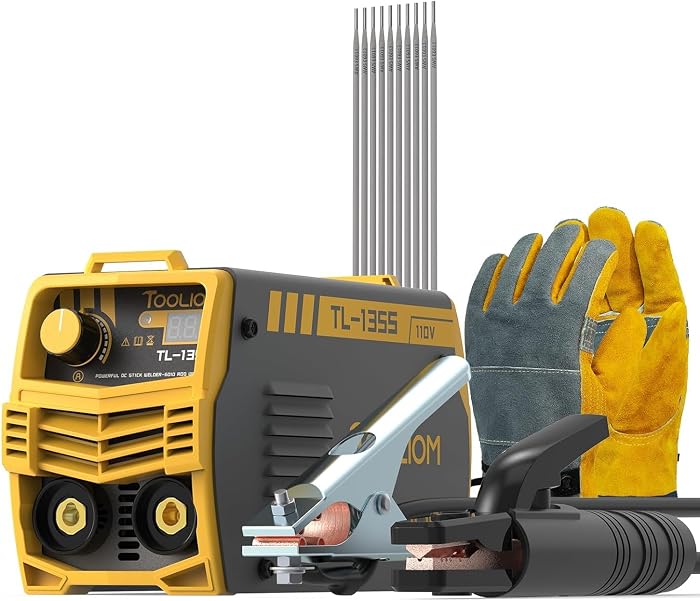
TOOLIOM TL-135S Best Budget Pick

TOOLIOM 135A 110V Mini Stick Welder

Small 110V jobs

Field Score 90/100
Processes
Stick and lift TIG
Max Output
135A
Input Power
110V only
Lift TIG Torch
Sold separately
View on Amazon

110 volts and nothing else. The TL-135S makes no claim to run on 220, tops out at 135 amps, and is built for the garage with one outlet and no plan to add a second. That is the right set of compromises at the bottom of this group's price range: you give up headroom and get a small machine with a shoulder strap, gloves and rods in the box, and an arc that lights easily on 3/32-inch 6013.

It will also run 6011, the rod for dirty and rusty metal, and the anti-stick, arc force, and hot start are built in rather than adjustable. Lift TIG is on the menu, but the torch is sold separately, so treat it as a maybe-later rather than a reason to buy. On thin sheet and light angle it does what a machine this size should; on 1/4-inch plate it runs out of current before you run out of patience, which is a fair trade for a lawn mower deck and a gate hinge.

Worth Noting

  • 110 volts only, capped at 135 amps
  • Lift TIG torch sold separately
Our Verdict

Keep it simple: the TOOLIOM runs 6011 and 6013 on a household outlet, ships with gloves and starter rods, and asks nothing of your wiring.

Check Latest Price
6

Forney Easy Weld 100ST Best All-Metal Build

Forney 298 Easy Weld 100ST 90 Amp Welder

Rugged light-duty work

Field Score 89/100
Weight
13.7 lb
Warranty
12 months
Max Output
90A
Input Power
120V
View on Amazon

The Forney 298 is the only machine here with an all-metal case, and it comes with a 12-month manufacturer warranty behind it. At 13.7 pounds it is the heaviest box in this group and the least powerful, and neither is an accident: this is a small 120-volt welder built like a tool, with 8-foot leads and a cord that goes into any household outlet.

Ninety amps goes further than the number sounds. With 3/32-inch 6011 or 6013 it will join 1/8-inch angle, sheet, and strap without drama, and it suits the light-duty repairs where a 200-amp inverter is overkill and a torch is the wrong tool: a grill, a mudflap bracket, a smoker. It is also the simplest thing here to run. One dial, one outlet, no display to interpret.

We recommend it to the person who wants one small welder for the barn and no surprises. What you give up is capability: 90 amps is a 3/32-inch machine, 1/8-inch 7018 is beyond it, and 220-volt work is out of the question. The 8-foot leads are the other practical limit, shorter than the 10-foot sets on the ARCCAPTAIN and the Hpoouo, which you notice when you are walking around a tractor to reach the far side of the weld.

Worth Noting

  • 90 amps rules out 1/8-inch 7018
  • Heaviest here, with short 8-foot leads
Our Verdict

The Forney is the small 120-volt welder that feels like a tool: an all-metal case, a 12-month warranty, and a 90-amp arc for light repair work.

Check Latest Price
7

HITBOX AT2000 Best for Damp Outdoor Work

HITBOX 200Amp Stick Welder

Damp outdoor work

Field Score 88/100
Weight
8.03 lb
Input Power
110/220V dual voltage
Output Range
20-200A
Safety Feature
VRD
View on Amazon

A voltage reduction device is the reason to look at the HITBOX at all. VRD drops the open-circuit voltage at the stinger when you are not welding, which matters when the work is a damp fence line, a metal stall, or a wet barnyard — places where an idle stinger sitting at full voltage is the last thing you want near your hand. It sits here alongside adjustable hot start, arc force, and anti-stick, and it is the one feature in this group that nothing else carries.

The rest is a compact dual-voltage box: 20 to 200 amps, 110 and 220 volts, lift TIG mode, and a body about 9 inches long that weighs just over 8 pounds. It burns 3/32-inch 6013 cleanly on 110 volts, which is what a household circuit will support, and the LCD is readable without contorting to see it.

Two things to know before you buy. The amp dial is not a precision instrument — the number on screen and the current at the stinger do not always agree, which you will want to account for on thin sheet. And the 200-amp figure needs 220 volts behind it: on 110, 1/8-inch 7018 is a stretch and 3/32-inch 6013 is the comfortable rod.

Where that leaves it: for damp, outdoor, or metal-building work, the VRD is worth more than another fifty amps on the badge, and this is the machine we point to for it. Indoors on dry concrete, the ARC-205DS PRO is the better arc and the one we reach for.

Worth Noting

  • Amp display does not match output exactly
  • No real 7018 headroom on 110 volts
Our Verdict

For wet, outdoor, or metal-building work the HITBOX earns its place: a VRD, dual voltage, and a compact body that goes where the job is.

Check Latest Price
8

Hpoouo Mini ARC-200 Best for Ready-To-Weld Kits

Hpoouo Mini ARC-200 – 200Amp 20PCS Rods Stick Welder

Ready-to-weld kits

Field Score 87/100
Included
20 rods, gloves, two hammers
Dimensions
7.8 x 3.9 x 5.3 inches
Input Power
110V
Output Range
20-200A
View on Amazon

Open the Hpoouo box and you are most of the way to welding: the machine, 20 electrodes, a pair of gloves, two chipping hammers, and a manual. A helmet is the one thing missing, and it is worth buying a proper one rather than the cheapest face shield on the shelf.

The machine itself is a 110-volt inverter with a 20-to-200-amp dial, hot start, arc force, anti-stick, and a footprint of roughly 8 by 4 by 5 inches at 7.79 pounds. It is listed for 6013, 6011, 6010, 7018, and 308 rods from 1/16 to 1/8 inch, which covers everything a beginner is likely to buy.

The parts that will disappoint you first are the leads. They are short and the stinger is the weakest piece in the kit, so plan on replacing both if you keep using it; a set of longer cables turns it into a much more pleasant machine. The 20 rods go quickly, and the 200-amp badge is a 110-volt number you will not reach on a 15-amp circuit — keep the dial under 100 amps on household wiring and it behaves.

Underneath the extras it is a competent little inverter that strikes an arc even when the steel is only roughly clean, and the machine is better than its badge suggests. Our advice: run the twenty rods through it, then buy longer leads before you decide what you think.

Worth Noting

  • Short leads and a weak stinger
  • 200-amp badge unreachable on 110 volts
Our Verdict

Start welding the day the box arrives: the Hpoouo adds 20 rods, gloves, and hammers to a capable little 110-volt machine.

Check Latest Price

How We Picked and Tested Stick Welders

We started by pulling every inverter stick welder we could find in the budget and mid-range tiers, then narrowed the field by the specs that actually change how a machine behaves: IGBT internals, a rod range covering 1/16- to 1/8-inch electrodes, hot start, arc force, and anti-stick controls, and either 110V-only or dual-voltage input. We cut anything with vague amperage claims or no published duty cycle and landed on twelve machines, which we bought at retail.

Testing ran six months, mostly in my garage and on the driveway slab, with a couple of units riding around in a truck bed between jobs. I ran every welder on 110V first, since that's what most people have, then on 220V where it was offered. The first test was simple: strike an arc on cold 1/8-inch mild steel and count the taps it took. I noted whether the rod stuck on restarts, whether hot start helped on a cold plate, and whether the arc held steady or sputtered as I dragged a bead.

Then I cut every coupon in half. Weld strength is hard to judge by eye, so I checked penetration on the cross-section, looked for slag inclusions and undercut, and beat a few joints with a hammer to see where they failed. I ran a clamp meter against each display to see how close the readout came to the real amperage, and I burned rod after rod without stopping to find out when the overload protection kicked in.

Size and ease of use got their own pass. I weighed each machine on a luggage scale, carried it one-handed up a ladder, and handed the controls to a neighbor who had never welded to see how long his setup took. Finally, we tallied what came in the box — holder, clamp, brush, gloves, rods — and checked how the leads, case, and fittings held up after being hauled around and tossed in a truck bed for a few weeks.

How to Choose a Stick Welder

Start With the Outlet, Not the Badge

Nearly every machine here is sold with a large number on the front, and almost none of them can deliver it from a 20-amp household circuit. On 110 volts, expect to work at roughly 100 to 120 amps whatever the badge says. That is why dual-voltage machines earn their keep: the same box becomes a genuinely useful 200-amp welder when it goes onto a 240-volt circuit, which is the difference between repairing a trailer and building one.

If you have a 240-volt outlet in the shop or on the barn panel, buy dual voltage and use it. If you don't, buy for the outlet you have and accept the ceiling. The number that decides whether you trip a breaker is your circuit's amperage, not the sticker.

Match the Output to the Rod in Your Hand

Buy for the thickest rod you will actually run. A 3/32-inch 6013 covers sheet metal, thin-wall tubing, and most learning; 1/8-inch 6011 handles rusty, painted, or dirty steel; 1/8-inch 7018 is the strength rod and wants somewhere around 120 to 140 amps. Roughly speaking, a 140-amp machine is a 1/8-inch machine, and a 200-amp machine on 220 volts will run 5/32-inch rod.

Whatever the listing calls it — stick welder, arc welder, MMA machine — the rod chart is the honest spec. A 250-amp sticker on a 110-volt box is a dial position, not an output, and buying for it is how people end up disappointed in a machine that was never going to reach the top of its own dial.

Read the Duty Cycle Before You Plan a Long Job

Duty cycle is the share of a ten-minute window a machine can weld at a given amperage before it needs to cool. Forty percent at 140 amps means four minutes of arc and six minutes of waiting, chipping, or repositioning. For gate hinges and a mower deck you will rarely notice; over an afternoon of continuous work it is the spec that decides whether you finish.

Cheap inverters often leave the figure off entirely. When a listing publishes it at both voltages, as the HONE does, treat that as a good sign and plan the session around the number rather than the marketing.

Know Which Arc Controls You're Paying For

Hot start gives the rod an initial burst so it lights on cold steel, arc force pushes current back in when you dig the rod into the puddle, and anti-stick cuts current when the rod fuses to the work. Fixed versions of all three are fine. Adjustable ones are better: numbered arc force lets you back off for 1/16-inch sheet and wind up for a restart on 7018.

Synergic control goes a step further and sets current and voltage from the rod diameter, which is the single most useful feature for someone who has never welded. If you already know how you like an arc, spend the money on adjustability instead.

Budget for the Parts That Aren't in the Box

Most machines arrive with a stinger, a ground clamp, and nothing else, and the leads run 8 to 10 feet. Eight feet is short once you are walking around a tractor; longer cables and a better stinger are the usual first purchases, and they change how the machine feels more than a spec upgrade would. Add an arc-rated helmet, gloves, and a chipping hammer.

The rods in a starter kit are there to get you through the first afternoon, not the first month. Price the consumables before you choose between two machines that are otherwise close.

Frequently Asked Questions

Final Verdict

The YESWELDER ARC-205DS PRO is the stick welder we recommend to most people: dual voltage, 205 amps when 220 is available, and separate hot start and arc force dials that let you tune the arc instead of accepting it. If the person welding has never struck an arc, buy the ARCCAPTAIN and let the synergic control set the current from the rod size.

If the machine will live in a barn and come out twice a month, the Forney's metal case and 12-month warranty are worth the premium.