The 5 Best Suet Cakes for Birds of 2026

Suet is bird food the way a lumberjack would design it: rendered fat packed with seeds, hung in a cage, and stripped to the wire within days once a woodpecker finds it. That fat is the entire point in cold weather, when a chickadee burns most of its calories just getting through a long night. It's also why suet is trickier to buy than it looks.

A cheap cake softens and turns rancid in the first warm week of spring, and one padded with seed dust and filler vanishes without doing the birds much good. I've kept feeders outside my kitchen window for years, and I've learned to read a cake through the wrapper: firm, faintly tacky, smelling of peanuts is what you're after. We hung 16 cakes over five months, late winter into June, to see how each held up as the heat came on.

Whether your feeder draws woodpeckers, finches, or one determined squirrel matters as much as the formula itself, so the picks below run from plain high-energy cakes to no-melt and pepper-laced ones.

Our Top Picks

The 5 Best Suet Cakes for Birds of 2026

1

St. Albans Bay Suet Plus 20-Pack Best Overall

ST. ALBANS BAY SUET PLUS High Energy Suet Cakes

All-winter feeding

Field Score 93/100
Cake Size
5 x 5 x 1 in
Suet Blend
Beef suet, corn, sunflower
Cake Weight
11 oz
Cakes Per Pack
20
View on Amazon

Twenty cakes sounds like a lot until the first hard freeze, when a busy feeder can empty one in a day or two. That arithmetic is why this box is our top pick. Each cake is 11 ounces and measures 5 inches square by an inch thick, which is exactly what a standard wire cage wants, so there's no trimming and no wedging a soft cake into place. The wrappers are serrated and tear open cleanly, which matters more than it sounds when you're reloading in gloves with a wind coming across the yard.

The blend earns its place too: rendered beef suet, cracked corn, and black oil sunflower, a broad high-energy formula rather than a specialty mix. Chickadees, titmice, and nuthatches work the cage steadily, woodpeckers treat it as a regular stop, and cardinals and jays clean up what falls. Of everything we hung, this is the cake that drew the widest crowd.

Melt-resistant is the claim, not no-melt. There's no temperature rating printed on the carton, so treat it as a cool-weather cake that tolerates a warm afternoon; in a real heat wave, hang it in shade or switch to a rated no-melt dough. Twenty cakes also take up genuine shelf space, and this is the biggest single outlay in the guide. It's the box for a yard with more than one feeder and a winter's worth of birds to feed.

Worth Noting

  • No stated no-melt temperature rating
  • Biggest upfront outlay and a bulky carton to store
Our Verdict

Our default for most yards: twenty cakes that fit a standard cage, feed the widest mix of birds, and land at the low end on cost per cake.

Check Latest Price
2

C&S Peanut Delight No Melt 12-Pack Best No-Melt Formula

C&S Peanut Delight No Melt Suet Dough

Hot, sunny feeders

Field Score 92/100
Form
No-melt dough
Suet Blend
Peanuts, beef suet, corn, oats
Cake Weight
11.8 oz
Cakes Per Pack
12
View on Amazon

Suet and summer usually don't mix. Rendered fat softens, sags through the cage, and leaves a grease ring on whatever sits below it. C&S's Peanut Delight is built for that specific problem: a no-melt dough rather than a poured cake, one that holds its shape in heat and feels dry instead of tacky in the hand.

That difference is the first thing we noticed. A dough packs into the cage and stays where you put it, and because it's peanut-based it pulls nut-eaters hard — woodpeckers first, then nuthatches, chickadees, and the occasional bluebird. A feeder that sits in full sun all afternoon is exactly where this pack earns its premium over the plain cakes.

Texture is the catch. A fresh box is firm and slightly tacky; a box that has sat in a warehouse arrives dry and crumbly, and a crumbly cake is on the ground by lunch. Squeeze one before you load the cage. If it sheds crumbs, break it into chunks and press them into the wire rather than hanging a whole block, and the birds will work it just the same.

Worth Noting

  • Costs more per cake than the cake-style packs
  • Peanut blend pulls squirrels as well as birds
Our Verdict

Buy this if your feeder hangs in sun or you feed year-round in a warm climate — the no-melt dough stays put where ordinary cakes sag.

Check Latest Price
3

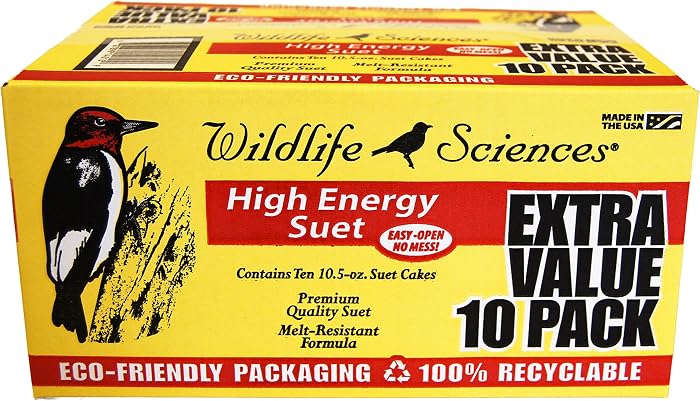
Wildlife Sciences High Energy 10-Pack Best Small Pack

Wildlife Sciences High Energy Suet Cake 10 Pack

First suet order

Field Score 89/100
Cake Size
4.5 x 4.5 x 1 in
Suet Blend
Beef suet, corn, sunflower
Cake Weight
10.5 oz
Cakes Per Pack
10
View on Amazon

Ten cakes is the right size for a first order — enough to find out whether your yard has suet birds without parking a winter's worth of fat in the pantry. Wildlife Sciences pours a 4.5-inch square, half an inch narrower than the 5-inch cakes here, so it drops into a standard cage with a little room to shift and hangs fine either way.

The formula is the familiar broad blend: rendered beef suet, cracked corn, black oil sunflower. Woodpeckers hit it as hard as they hit anything in this guide, and chickadees and nuthatches follow them in. At 10.5 ounces a cake it sits in the middle of the group on weight and in the middle on cost per cake, which is about where a workhorse belongs.

Consistency is where our enthusiasm cools. Cakes from the same box can differ — one dense and dark with seed, the next pale and mostly filler — and the pale ones look and feel different in the hand before they ever reach the cage. Buy this one when you want to test a new feeder location cheaply, or when you keep a single cage going and don't want a twenty-cake carton in the closet.

Worth Noting

  • Cakes vary
Our Verdict

A sensible first box: ten cakes that fit standard cages, draw woodpeckers reliably, and cost less upfront than the big winter packs.

Check Latest Price
4

Heath Woodpecker Suet Cake 12-Pack Best Value

Heath Woodpecker Suet Cake 12-Pack

Budget woodpecker feeding

Field Score 88/100
Cake Size
5.2 in
Suet Blend
Corn, wheat, peanut, almond
Cake Weight
10 oz
Cakes Per Pack
12
View on Amazon

Cheapest per cake of anything in this guide, and by enough of a margin that it changes how you buy suet — by the case, without flinching. Heath's woodpecker cake comes 12 to a case, each one 10 ounces and 5.2 inches across, a wider face than the 5-inch cakes here, which gives a clinging bird more to hold onto.

The blend is built for that job: corn, wheat, peanut parts, and almonds rather than a sunflower-heavy mix. Woodpeckers work it hard, and cardinals, nuthatches, and titmice pick around the edges after they leave. It's poured in Coopersville, Michigan, and sold as a no-melt, all-season cake.

That no-melt label is the one claim we treat loosely. Hung in shade, a cake holds through a warm afternoon; on a sunny post in July these soften faster than the dough-style cakes here, and a soft cake goes over the side. Move the feeder to the north side of a tree from June through August and the problem mostly disappears.

Worth Noting

  • Lighter 10-ounce cakes than the 11-ounce packs
Our Verdict

The budget answer for a woodpecker-heavy yard: the lowest cost per cake here, in a nut-forward blend that keeps a cage busy.

Check Latest Price
5

C&S Hot Pepper Delight 8-Pack Best Squirrel Deterrent

C&S Hot Pepper Delight No Melt Suet Dough

Squirrel-heavy yards

Field Score 87/100
Suet Blend
Hot pepper, beef suet
Cake Weight
11.8 oz
Cakes Per Pack
8
No-melt Rating
Up to 100°F
View on Amazon

A gray squirrel can strip a suet cage before the coffee goes cold, and once a yard has them, plain cakes become an expensive way to feed animals you didn't invite. C&S's Hot Pepper Delight is the pack for that yard: the same no-melt dough as Peanut Delight, with capsaicin added — the compound that puts the burn in a chili pepper.

Birds don't register capsaicin. Mammals do. That asymmetry is the whole idea, and it works on most gray squirrels: woodpeckers and chickadees carry on while a squirrel loses interest after a test bite. It is not a fence, though. An animal already committed to your feeder may push through the burn, and under heavy pressure you still want a baffle or a cage nothing can hang from.

Handling is the part that surprised us. Capsaicin won't hurt the birds, but it will sting your eyes, so wear gloves while you load the cage, keep your hands away from your face, and wash up afterward. The dough holds its shape up to 100°F, which makes this a genuine four-season cake, and the pepper doesn't seem to put birds off — woodpeckers and chickadees work it the same as plain peanut dough.

Worth Noting

  • Most expensive per cake in this guide
Our Verdict

For a yard where squirrels empty the cage, this is the pack that gives the birds a turn — the only pepper cake here, rated to 100°F.

Check Latest Price

How We Tested the Best Suet Cakes

We started by reading ingredient panels instead of the front of the package. Cakes that led with rendered beef fat and named seeds, or that spelled out a no-melt formula, made the shortlist; anything listing grain byproducts first got cut before it ever went outside. We also divided cost by ounce, since multi-packs look like a bargain until you run the math, and bought 16 cakes across that spread to test.

Each cake hung in a cage feeder on a pole outside my kitchen window, with a second round rotated to a hanging feeder under an oak where squirrels patrol. I noted the first species to arrive and counted the days it took birds to find a fresh cake, since some were discovered by lunch and others sat ignored for a week. Rather than eyeball how much was gone, I weighed what was left every third morning and logged it. Melting got its own test: on afternoons that pushed past 85 degrees, I checked whether a cake slumped in the cage, dripped onto the deck, or held its shape through a full day of sun.

Squirrel resistance was cruder. For one week per cake I hung it in an unprotected feeder and photographed the chew marks, and the pepper-coated cakes were the only ones left mostly whole. Rain told us about durability, with some crumbling into the tray after a single storm and others staying a solid block until the last chunk was gone. Texture we judged by hand, tacky and sliceable versus greasy or dusty.

And because what a bird actually digests matters more than how much it eats, I watched whether birds fed in long, steady visits or pecked once and moved on, and whether the crumbs below got cleaned up by ground feeders. Cakes built mostly on fat with a short ingredient list drew steadier traffic over five months than filler-heavy ones, which birds sampled and abandoned.

How to Choose Suet Cakes for Wild Birds

Size, Count, and Feeder Fit

Almost every cake here is built to the same standard: roughly 4.5 to 5 inches square and an inch thick, which is what a wire suet cage holds. The differences sit at the margins — a 5.2-inch cake fills a cage edge to edge while a 4.5-inch one hangs with a little clearance — and in the count. Twenty cakes is a season's supply and a real chunk of shelf space; ten is a test.

Measure the cage you already own before you buy a case, and read the word mini carefully. Mini and tray-style cakes are usually cut for a specific feeder station rather than a standard cage, so check the dimensions instead of assuming the label means a smaller version of the same thing.

Melt Behavior and Where You Hang It

Rendered fat softens as it warms, and a soft cake sags through the cage and drops. No-melt formulas are processed to hold their shape at higher temperatures — one pack here is rated to 100°F — but most melt-resistant cakes carry no temperature number at all, and that's a claim rather than a guarantee.

Placement does as much work as the formula. A cage under eaves or in the shade of a tree stays noticeably cooler than one bolted to a sunny post, and that shade is often the difference between a cake that lasts a week and one that ends up on the deck. If your only hanging spot is full sun, buy a suet dough rather than a poured cake.

What's in the Cake, and Which Birds It Brings

Every cake starts with rendered beef fat and then adds whatever the maker mixes in, and the mix decides your guest list. Suet with cracked corn and black oil sunflower is the broad crowd-pleaser: chickadees, titmice, nuthatches, and woodpeckers. Peanut and almond blends lean toward the clinging birds, woodpeckers first. Berry flavoring is aimed at fruit eaters.

Density matters as much as flavor. A cake stretched with grain filler looks pale and thin next to a dense, seed-flecked one, and it tends to sit in the cage untouched while the good cakes disappear. Read the ingredient list before the marketing copy.

Squirrels, Pepper, and What It Costs

Hot pepper suet leans on capsaicin, which birds don't register and mammals do. It turns away most gray squirrels and not every one: an animal already committed to your feeder may push through the burn. Treat pepper as one tool rather than a fence, and plan on a baffle or a hanging cage if the pressure is heavy.

Pepper also sits at the top of the price range per cake. When plain cakes are vanishing overnight, that premium buys your birds a turn and is easy to justify. When squirrels are only an occasional visitor, spend the difference on a larger box of plain cake instead.

Cost Per Cake, Not Cost Per Box

A twenty-cake carton can cost more at the register and less per cake than a ten-cake box, and the per-cake number is the one that decides value. Divide the box price by the count and compare that figure across packs, then think about how fast your cage empties.

A busy feeder in a cold snap can go through a cake in a day or two, which turns even a bargain box into a few weeks of feeding. Start with the smaller count, learn your yard's rate, and scale up once you know what your birds actually eat.

Frequently Asked Questions

Final Verdict

For most yards the St. Albans Bay Suet Plus 20-pack is the whole answer: twenty 11-ounce cakes that fit a standard cage, a broad suet-corn-sunflower blend that pulls woodpeckers and chickadees alike, and a cost per cake at the low end of this group.

Change one condition and the answer changes with it. If your feeder hangs in full sun or you feed year-round somewhere warm, buy C&S Peanut Delight — the no-melt dough is what keeps a July feeder from turning into a grease slick. If squirrels own the cage, skip both and go to the pepper.