The 8 Best Thermal Monoculars of 2026

A thermal monocular doesn't see in the dark — it sees heat, turning the temperature difference between a deer and the oak behind it into a picture you can read. That's the trick, and it's also why the numbers on the box are easy to misread. Digital zoom gets top billing, but the sensor core and its sensitivity decide whether a shape at 200 yards is a deer or a smudge.

I've spent the past eight months carrying eight of these at dusk — glassing a treeline for coyotes, checking the pasture for whatever's been after the hens, scanning a dark campground for something bumping around the coolers. Somewhere in there, my team and I stopped caring about the marketing and started caring about whether the picture stays clean when you pan, how long it runs on a charge at 30 degrees, and whether your fingers can find the buttons in gloves. Price mattered less than whether the image held up at the range you actually hunt.

Our Top Picks

The 8 Best Thermal Monoculars of 2026

1

TOPDON TS004 Best Overall
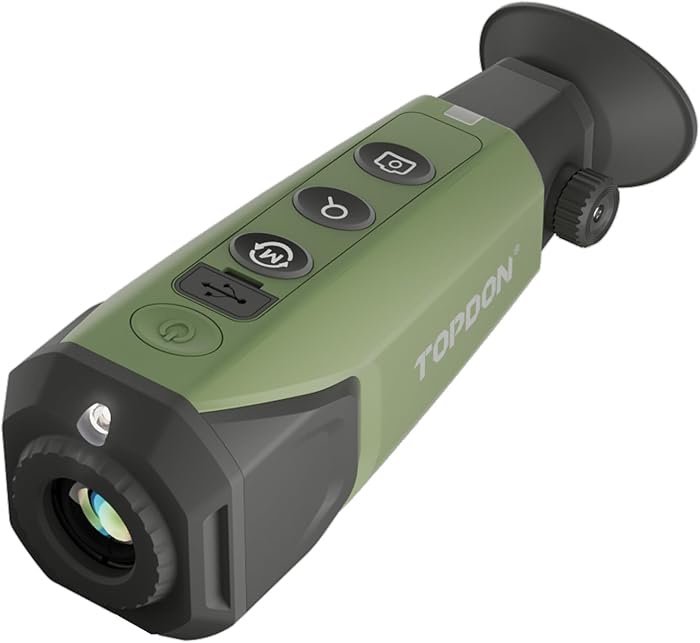
TOPDON TS004 Thermal Imaging Monocular

All-around night hunting

Field Score 86/100
Sensor
256x192
Battery Life
Up to 11 hours
Refresh Rate
50Hz
Detection Range
Up to 410 m
View on Amazon

Eleven hours of rated runtime and a 410-meter detection figure are what put the TS004 at the top of this group. Most thermal monoculars in this class either run dry in half a day or stop being useful past a couple hundred yards, and this one does neither. The 5000mAh cell sits inside an IP67 housing rated for two-meter drops, which is the combination we want in a unit that rides in a truck console and comes out in the rain.

The core is a 256x192 sensor at 50Hz, and the refresh rate is the part you feel. Pan across a fence line with a 25Hz unit and a walking coyote smears into a streak; here the picture holds together while you sweep. Resolution is the honest limit. At 200 yards a deer reads as a clear hot shape, but the 8x digital zoom enlarges pixels instead of revealing new ones, so treat zoom as a way to study something you've already found rather than a way to find it.

Field of view is 13.5 degrees, the narrowest in this guide, and that's the price of the long detection figure: you pan slower and cover ground less quickly than with a wide scanner. Controls sit under one thumb, the five palettes switch without a menu dive, and the TopInfrared app pulls stills and video with audio onto your phone. Brightness is the stingy part. There are two levels and the low one still costs you some dark adaptation, so cupping a hand around the eyepiece does more good than the menu does.

Detection figures are generous on every box in this category. They tell you a warm body is out there, not what it is, and inside 100 yards is where the TS004 earns its keep: enough shape and gait to call a deer from a hog, with the app ready if you want a second opinion from someone back at camp.

Worth Noting

  • Narrow 13.5-degree field of view
  • Low brightness setting still washes out night vision
Our Verdict

For most hunters and landowners who work after dark, we think the TS004 is the one to buy: 256x192 detail, a rated 410-meter reach, and 11 hours of runtime in a rain-proof body.

Check Latest Price
2

RIX Pocket K2 Best for Pocket Carry

RIX Pocket K2 Portable Thermal Monocular for Hunting

Pocket carry

Field Score 85/100
Sensor
256x192
Weight
7.05 oz
Water Rating
IP67
Field Of View
19.4°
View on Amazon

Put the Pocket K2 next to our top pick and the difference shows up in your hand: 200 grams against a unit that anchors your palm. It measures 4.9 by 1.8 by 2.9 inches, which is rangefinder-pocket territory, and the lens cover is integrated so it slides open with one finger instead of coming off and getting lost in the dark.

The 19.4-degree field of view is what we keep coming back to. That's a wider window than the TS004's 13.5 degrees, and for a device you sweep across a treeline it buys more than raw detection range does: you catch movement at the edge of the frame instead of panning past it. The sensor is the same 256x192 core with a sub-25mK noise rating, and the 800x600 OLED display gives the image more contrast than the resolution number suggests.

Where it gives ground is reach and stamina. A 9mm objective and a fixed-focus eyepiece keep the useful picture inside 150 yards, and pushing the 7x digital zoom past that turns an animal into a soft blob. RIX doesn't publish a runtime, so plan on a full charge before every trip and a power bank in the pack. The IP67 body and the five-year warranty are the parts that make it a long-term keeper rather than a seasonal toy.

Worth Noting

  • Runtime isn't published
  • Picture softens past 150 yards
Our Verdict

For a scanner that disappears into a jacket pocket, we hand you the Pocket K2: 200 grams, a 50Hz core, and a wide 19.4-degree window.

Check Latest Price
3

RIX Pocket K3 Best for Identification

RIX Pocket K3 Thermal Monocular for Hunting

Identifying at distance

Field Score 84/100
Lens
15 mm
Sensor
384x288
Weight
7.52 oz
Field Of View
17.5°
View on Amazon

The Pocket K3 is the priciest pick in this guide, and it's the only one here pairing a 384x288 core with a 15mm lens. That combination is the entire argument: more than twice the pixels of the 256x192 units, in a body that still measures 4.9 by 1.8 by 2.9 inches and weighs 7.52 ounces.

Base magnification is 2x with a 17.5-degree horizontal field of view, so you start closer in than on the K2: less ground per sweep, more detail per animal. Electronic image stabilization does real work at that magnification, because hand tremor is what makes a standing animal look like it's moving, and EIS settles the view enough to read posture and gait.

What we appreciate most is that it doesn't force a choice between carrying it and using it. A standard 1/4"-20 thread lets it sit on a window mount or a shooting stick for a long glassing session instead of hanging in the air for twenty minutes, and the cell is a replaceable 18650 charged over USB-C, so a spare is a field swap rather than a wall outlet and a wait.

The eyepiece display is small and the 2x base magnification crops it further, so zoomed views feel like looking through a tight window. And a 384 sensor is still a 384 sensor: past 300 yards you're identifying by shape and behavior rather than by detail, and no amount of image processing changes that.

Worth Noting

  • Small display gets cramped when zoomed
  • Detail fades past 300 yards
Our Verdict

We reach for the Pocket K3 when identification matters more than reach: a 384x288 core and stabilization that let you read an animal at distance.

Check Latest Price
4

MiLESEEY TNV10 Pro Best for All-Night Scanning

MiLESEEY TNV10PRO Thermal Monocular for hunting320x240 Resolution

All-night scanning

Field Score 83/100
Lens
13 mm
Sensor
320x240
Battery Life
Up to 12 hours
Built-in Storage
32 GB
View on Amazon

Twelve hours is the headline, and the hardware backs the claim: a 4500mAh cell paired with a 30/60-minute auto-off, the kind of runtime that carries you from dusk to first light without a power bank in your pocket. What we didn't expect at this price is a true 320x240 sensor. MiLESEEY is explicit that it isn't super-resolution upscaling, and against the 256x192 units the extra pixels show up as cleaner edges around a standing animal rather than a bright smudge with legs.

The 13mm lens and 50Hz refresh match the top pick's numbers, and five palettes cover white-hot, black-hot, and iron-red. UHD mode adds contrast rather than detail, which helps in flat, warm conditions when everything wants to look the same, and video saves as MP4 at 400x300 to 32GB of internal memory, enough to review a track or a treeline later without hunting for a card.

Two things to know before you buy. The hotspot tracking, which should box the warmest object in frame, can sit there doing nothing even with the setting switched on. And the body is sealed to IP65 rather than IP67, fine in rain but not fine if it goes into a creek. Neither is a dealbreaker here, but don't buy it for the tracking box.

Worth Noting

  • Hotspot tracking can fail to engage
  • IP65 sealing instead of IP67
Our Verdict

For all-night glassing, we point you to the TNV10 Pro: a true 320x240 core, 12 hours of runtime, and 32GB of built-in storage.

Check Latest Price
5

GOYOJO G210 Best Budget

GOYOJO G210 Thermal Monocular

First thermal buy

Field Score 82/100
Lens
10 mm
Sensor
256x192
Battery
Replaceable, 6+ hours
Refresh Rate
25Hz
View on Amazon

On price alone the G210 is the easiest entry point in this guide, and cheap thermal usually means a compromised spec sheet. It's worth being precise about which corners GOYOJO cut, because the one that matters, the sensor, is intact.

That sensor is a 256x192 core on a 12-micron pitch, the same resolution as our top pick, with six palettes and an app that mirrors the screen to your phone. The 17.5-degree field of view is wider than the TS004's, so it sweeps easily, and the lens is a 10mm unit, shorter than the top pick's 13mm, which shows up as a picture that turns vague sooner.

Two specs tell you where the money went. Refresh is 25Hz, so a trotting coyote smears across the frame in a way it doesn't on a 50Hz unit, and the body is rated IP65 rather than IP67. The batteries, though, are replaceable and rated for six-plus hours each, and that's a genuine advantage over sealed units: a fresh set costs less than a power brick and takes ten seconds in the dark. For a truck gun or a barn scanner, we take that trade.

Worth Noting

  • 25Hz refresh smears moving game
  • IP65 sealing, not IP67
Our Verdict

The G210 is the cheapest way we found into a real 256x192 thermal core, and its swap-in batteries suit a first-time night hunter.

Check Latest Price
6

ATN BlazeSeeker 207 Best for Recording and Zoom

ATN BlazeSeeker 207 Thermal 256x192 1-8.8X 12μm 35mK 50Hz Hunting

Recording and zoom

Field Score 81/100
Zoom
1-8.8x
Sensor
256x192
Weight
9.6 oz
Detection Range
Up to 345 m
View on Amazon

Scanning a field before first light is half a recording job. You see something, and you want to show the guy at camp or check it against the trail camera. The BlazeSeeker is built around that: five palettes, stills and video onto a microSD card up to 256GB, and an app that runs the settings and the shutter from your phone instead of making you poke at a menu in the dark.

The 1-8.8x zoom range is the widest in this guide, and we appreciate that it starts at 1x. You get the full field first and zoom in after, rather than being locked into a magnified view you have to fight. At 9.6 ounces and 5.9 inches long it slips into a jacket pocket, and the three-year manufacturer warranty is more coverage than most of this group offers.

Image quality is the compromise. At 256x192 with a 35mK noise figure, detail holds up at scanning distances but softens past about 100 yards, and the top of the zoom range adds size without adding information. If you mainly want to watch animals rather than record them, the wider, cleaner picture from the Pocket K2 goes further for similar money.

Worth Noting

  • Picture softens past about 100 yards
Our Verdict

The BlazeSeeker 207 is the one we bring when we want to show someone what we saw: 8.8x zoom and a card slot for up to 256GB.

Check Latest Price
7

FLIR Breach PTQ136 Best for Helmet Mounting

Flir Breach PTQ136 Thermal Monocular

Helmet mounting

Field Score 79/100
Sensor
320x256
Weight
7.36 oz
Refresh Rate
60Hz
Field Of View
24°
View on Amazon

The Breach is the only unit in this guide built to be worn rather than held. A mini-rail on a 7.36-ounce body lets it sit on a helmet in front of your non-dominant eye and keep both hands free for a rifle, a gate, or a dog on a leash, which is the whole reason to buy a purpose-built helmet thermal instead of a pocket scanner.

The core is FLIR's 320x256 Boson at 12 microns, running at 60Hz, the fastest refresh here. That matters more than usual when you're turning your head rather than panning a device, and the 24-degree field of view is the widest in this group, noticeably more scene per glance than the 13.5-degree TS004. Seven palettes, onboard video and stills, and a digital compass round it out.

Power is the sore spot. It runs on a single CR123A, which is easy to find on a shelf but expensive to feed, and the battery meter doesn't correct for the higher voltage of rechargeable cells, so the gauge reads wrong exactly when you're trying to make one last. Carry spares. A handful of CR123As weighs almost nothing.

What we keep coming back to is the size and the field of view together. At six inches long it disappears into a pocket when it comes off the helmet, and 4x digital zoom is enough to confirm what the wide view found. Sensitivity, not pixel count, is what makes this image usable, so don't measure it against the 384 units on resolution alone.

Worth Noting

  • Relies on a single CR123A cell
  • Battery gauge misreads rechargeables
Our Verdict

We keep the Breach for helmet work: 7.36 ounces, the widest 24-degree field of view in this guide, and a mini-rail that lets it run hands-free.

Check Latest Price
8

ATN OTS XLT Best for Ranging and Reach

ATN OTS XLT Thermal Monocular w/ 50Hz Thermal Sensor

Ranging and reach

Field Score 77/100
Lens
25 mm
Zoom
2-8x
Battery Life
10+ hours
Field Of View
22.5°
View on Amazon

ATN's OTS XLT looks strong on paper: a 25mm objective, the longest lens in this guide, plus a built-in rangefinder and a 2-8x zoom for a little more than the compact scanners. What holds it back is consistency, and that is the whole story with this one.

When it works, the reach is the point. A 25mm lens with a 22.5-degree field of view gives you a longer look across open ground than the 13mm and 10mm units manage, and the smart rangefinder saves you pulling out a separate device to judge distance on the same animal. The 2-8x range covers a wide sweep and a closer look without changing hardware.

Battery is rated at 10-plus hours and the body is light enough to carry all day, so the concept holds up. Runtime is simply the least predictable thing about this one, so plan on a spare or a power bank until you know your own unit, and buy from somewhere with an easy return.

We rank it where we do because a thermal that won't start is worse than no thermal at all, and units that arrive unable to power on are the failure that matters here. The counterargument is narrow but real: if a rangefinder in the same eyepiece is what you want, nothing else on this page has one, and buying from a seller with a simple return takes most of the risk out.

Worth Noting

  • Runtime varies between units
Our Verdict

The OTS XLT is the only unit here with a rangefinder built in, and its 25mm lens is the longest reach in this guide.

Check Latest Price

How We Tested These Thermal Monoculars After Dark

We started with spec sheets for roughly 30 models and narrowed to eight, which we then lived with over eight months. The filters were mostly the things that decide the picture after sunset: core resolution, thermal sensitivity, refresh rate, and whether the body is rated for weather. Everything else — zoom, palette counts, app extras — we treated as a claim to check rather than a reason to buy.

Most of our testing happened in the two hours after sunset, which is when these get used. In a pasture we taped hand warmers to fence posts at 50, 100, 200, and 300 yards and noted at which post each unit stopped showing an animal-shaped body and started showing a glowing dot with no legs. We panned slowly across a treeline to see whether the image smeared, and recorded clips to compare fine detail afterward. Display brightness got checked twice — once at dusk and again at full dark — to see which screens washed out in twilight and which left us seeing spots.

Battery life we measured instead of reading: full charge, recording on, a 30-degree night, until each one died. Every unit also spent a night in the bed of a truck, got rained on, and — for those claiming a high water rating — took a five-minute dunk in a bucket. Gloves stayed on for the button checks, because a monocular you can't run with cold hands stays at home. We paired every Wi-Fi model to a phone to see how long setup took and whether the link held once we walked away from it.

At the end we lined all eight up on the same treeline at 200 yards, cheapest to priciest, so image quality and value were judged side by side rather than from memory.

How to Choose a Thermal Monocular

Resolution Is About Identification, Not Detection

Every thermal spots heat at distance; the question is what you can tell about it. A 256x192 core shows a warm body at 300 yards, but working out whether that body is a deer, a hog, or a calf usually happens inside 100 to 150 yards. Move up to 320x240 or 384x288 and that identification distance stretches, which is exactly what you pay for on the Pocket K3. Digital zoom doesn't help you here: it enlarges pixels instead of revealing new ones, so an 8x view of a grainy image is still grainy.

Decide your identification distance before you shop. If you glass field edges and shoot inside 150 yards, a 256 sensor does the job and leaves money for batteries. If you routinely judge animals at 250 yards and beyond, resolution is the spec to spend on, not zoom.

Match Lens and Field of View to Your Ground

A longer lens reaches further and charges you for it with a narrower view. The TS004's 13mm lens is rated to 410 meters but shows 13.5 degrees at a time; the FLIR Breach gives you 24 degrees and a much shorter reach. Tight timber where animals appear and vanish rewards the wide view, while a long field line rewards patience and magnification.

Treat published detection range as a spotting figure rather than an identifying one. We halve it when deciding whether a unit suits a job: a thermal that detects at 400 meters identifies at roughly half that in decent conditions, and less on a warm evening when animals and ground drift toward the same temperature.

Refresh Rate and the View Through the Eyepiece

Refresh rate is what separates a scanner that feels smooth from one that smears. At 25Hz a trotting animal drags a tail across the frame as you pan; 50Hz cleans that up, and the Breach's 60Hz is smoother again. If you mostly watch stationary animals from a truck, 25Hz is workable. If you sweep constantly, which is what scanning is, the step to 50Hz buys a picture you can trust.

Budget a hand to shade the eyepiece as well. Even dim displays cost you some dark adaptation, and the darkest setting on several of these units is still bright enough to matter on a moonless night.

Power, Sealing, and How You'll Carry It

Sealed batteries buy runtime; replaceable ones buy independence. An 11- or 12-hour internal cell covers a full night and charges over USB, but when it dies you're tethered to a power bank. The GOYOJO's swap-in cells give you six hours at a time and ten seconds to change, which is the better bet for a unit that lives in a truck. On sealing, IP67 survives a dunking and IP65 handles rain only, a real difference if you hunt from a boat or cross creeks.

Weight matters last but still matters. Under 8 ounces rides in a pocket without a thought, and anything with a 1/4"-20 thread can sit on a window mount or shooting stick instead of hanging in your hand for an hour.

Frequently Asked Questions

Final Verdict

Start with the TOPDON TS004. It's the most complete handheld here, with enough resolution to sort deer from hogs inside 100 yards, 11 hours of power, and an IP67 body, and nothing else in this group balances those three as well.

Step to the RIX Pocket K2 if the unit has to live in a pocket, the MiLESEEY TNV10 Pro if you glass until first light, or the Pocket K3 if identifying an animal at 300 yards matters more than anything else. For hands-free helmet work, the FLIR Breach is the only real answer on this page.