The 6 Best Weight Gain Supplements for Horses of 2026

A hard keeper will teach you to read a feed tag. I've stood in the aisle watching a horse push his grain around and leave the expensive part at the bottom of his bucket. That's the gap weight gain supplements fill: extra calories in a form he'll finish, so you aren't doubling the grain and hoping.

Calories come in very different packages. A dense fat powder adds a lot without a big scoop, an oil pours easily but turns tacky in a cold barn, and a meal topper can smell good enough to win over a fussy eater. Over the past five months my team and I have fed 12 of them twice a day, and the difference between a supplement that works and one that sits in the bucket is mostly palatability and consistency.

And one caution: no supplement outruns poor hay or a sore tooth. Fix those first, then pick for the horse in front of you — the picky senior, the thin youngster off the track, the pony who gains on air. The picks below earned their spots in our feed rooms.

Our Top Picks

The 6 Best Weight Gain Supplements for Horses of 2026

1

Manna Pro Weight Accelerator Best Overall
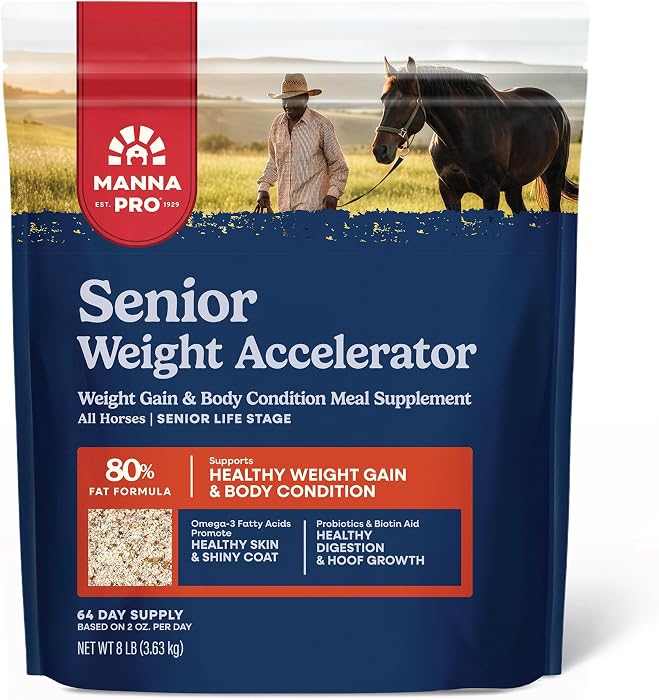
Manna Pro Weight Accelerator Horse Supplement

Aging hard keepers

Field Score 93/100
Bag Size
8 lb
Starch Level
Controlled
Formulated For
Senior horses
Omega-3 Source
Flaxseed
View on Amazon

Aging is usually what turns a horse into a hard keeper: teeth wear down, the gut gets less efficient, and the ration that held weight at eight stops holding it at eighteen. Manna Pro built Weight Accelerator for that horse, and it's why this is the bag we point most people toward first. The pellet is soft enough for an older mouth to chew, and the formula pairs a high fat and calorie level with flaxseed-derived omega-3s, probiotics, biotin, and controlled starch, so you're buying calories and the gut, hoof and coat support an aging body tends to need at the same time.

What settled it for us is how consistently it works on the horses that are hardest to put weight on. Older geldings and mules come back into condition on it, hold their weight through a bad winter, and pick up the shine and mane growth that usually goes missing first. Picky eaters are the real test of any topper, and this one passes more often than not. There's a coconut-and-banana smell to the bag that seems to help, and horses that turn their noses up at powders generally clean this up.

Feeding is about as easy as it gets: a scoop over dampened feed. Because it's a pellet and not a powder, it clings to the ration instead of sifting down to the bottom of the bucket, which matters for the slow eater who leaves the fines behind. We also appreciated not having to buy a separate omega-3 or biotin product, since one scoop covers ground that otherwise takes two or three.

Worth Noting

  • Senior-specific formula skews toward older horses
Our Verdict

Our default for the aging hard keeper: senior-friendly calories with probiotics, biotin and omega-3s in a pellet that even picky horses clean up.

Check Latest Price
2

Manna Pro Cool Calories 100 Best for Horses in Work

Manna Pro Cool Calories 100 Horse Supplement

Horses in work

Field Score 92/100
Form
Dry fat
Bag Size
8 lb
Fat Content
99%
View on Amazon

Ninety-nine percent fat is the entire pitch, and for the right horse it's a strong one. Cool Calories 100 is a dry fat rather than a fortified formula: concentrated calories carrying more than twice the energy of the same weight of carbohydrate, with fatty acids for coat condition and not much else in the bag. For a horse that can't physically eat more, that density is the point, because you're adding calories without adding bulk to the bucket.

Where it earns its spot is the horse with a job. The off-track thoroughbred, the mare who drops weight every time the training calendar ramps up, the gelding who burns off everything you put in front of him: that's the profile this suits, and it's the least expensive of our picks. Results on it are about as consistent as anything in this group, and horses eat it without a fight.

The catch is temperament. Fat is dense energy, and some horses come up sharp on it even when it's introduced gradually, so the cool energy claim on the label doesn't hold for every animal. Start below the label dose, hold there for a couple of weeks, and judge the horse rather than the bag. If he's already hot, Manna Pro's fortified pellet is the gentler first step.

Worth Noting

  • Some horses get hot even when introduced slowly
Our Verdict

For a horse in work that needs calories without more feed volume, this is our pick — just bring him onto it slowly.

Check Latest Price
3

Horse Guard Super Weight Gain Best With Probiotics

Horse Guard Super Weight Gain 10 lb

Digestive support

Field Score 91/100
Base
Full-fat extruded soy
Bag Size
10 lb
Servings
About 20
Vitamin E
1,500 IU per dose
View on Amazon

Ten pounds sounds generous until you read the serving count: about 20 servings for a 1,000-pound horse, which at the full dose works out to roughly three weeks per bag. That's the first number we check with this one, because it turns a supplement into a monthly bill rather than a one-time purchase.

What the money buys is the most complete formula in this group. Full-fat extruded soybeans supply the calories and the raw material for topline, and Horse Guard adds probiotics, prebiotics, yeast, methionine and 1,500 IU of vitamin E per dose, so a gut-health package and a vitamin-mineral top-up arrive in the same scoop.

For a rescue, a senior, or a horse whose ribs stay visible no matter how much hay goes in front of him, that's exactly the combination we want: calories only help if the hindgut can use them. It's easy to live with, too. The granule mixes into damp feed without turning to paste, horses eat it readily, and it doesn't fire them up the way a straight high-fat ration can. That last part matters if you're feeding a horse who gets silly on extra energy, because you're adding condition without adding a project.

Worth Noting

  • About 20 servings per bag, so it runs out fast
Our Verdict

Our pick when the weight problem starts in the gut: calories, probiotics and vitamin E in one scoop, at roughly a bag a month.

Check Latest Price
4

Farnam Weight Builder Best Long-Term Supply

Farnam Weight Builder Weight Support Supplement for Horses

Long-term feeding

Field Score 90/100
Supply
90 days
Weight
22.5 lb
Fat Content
50%
Omega-3 Source
Flaxseed and rice bran
View on Amazon

A 22.5-pound bucket built to last 90 days is a different proposition from a bag you reorder every few weeks, and for a one-horse barn it's the smarter buy: one purchase, one scoop at four ounces a day, no running out in the middle of a cold snap. Farnam's Weight Builder is the only pick here sold as a season's supply, and that convenience is worth more than it sounds in February.

The formula is 50% fat with omega-3s from flaxseed meal and heat-stabilized rice bran, and there's no sugar added. We appreciate that more than the fat number itself, because you're adding calories without adding sugar and so you're not trading weight for a horse who's harder to handle. The alfalfa-flavored powder mixes into damp feed easily, and the guaranteed analysis is printed per four-ounce serving, which makes adjusting the dose straightforward.

Compare it with the fat-only picks and the trade-off is concentration. At 50% fat you're feeding more volume for the same calories than you would with a 99% fat product, so this is a maintenance and slow-gain tool rather than an emergency one. For a horse who needs serious condition quickly, a more concentrated fat source does the job with less in the bucket.

Worth Noting

  • Biggest single purchase of our picks
Our Verdict

Buy it if you want to set the bucket down in November and not think about weight again until spring: 50% fat, no added sugar, one long supply.

Check Latest Price
5

DAC Oil Best for Coat and Shine

DAC Oil Gallon Jug Horse Weight Gain Calorie Fat Fatty Acid Coat Skin Health

Coat and shine

Field Score 89/100
Form
Liquid
Volume
1 gallon
Added Vitamin
Vitamin E
View on Amazon

DAC Oil sits on the coat and skin shelf rather than with the weight building supplements, and that's the honest way to read it. It's a liquid oil in a gallon jug with vitamin E added, and what it does best is what that shelf promises: shine, hoof quality, and a softer coat on a horse who's been looking dull. Calories come along for the ride because oil is fat, but this isn't the product to lean on when a horse is genuinely thin.

Where it fits is the horse who's a notch low and already eating well, or one whose coat needs help after a rough winter. A liquid coats the feed more completely than a powder does, and a gallon lasts because the dose is measured in ounces rather than scoops. The smell is the sticking point. It's a fish oil and it's pungent, and a horse who picks through his grain will pick around the oil for a day or two before giving in.

Our honest read: buy it for coat and hooves and treat any weight gain as a bonus. If the ribs are still visible after a few weeks of it, the answer is a concentrated formula such as Farnam's 50% fat powder or Manna Pro's fat-only supplement, not more oil. This is the pick for a horse who needs a finishing touch.

Worth Noting

  • Pungent fish-oil smell; some horses pick at it
Our Verdict

A coat-and-condition oil that adds calories on the side: good for shine and hooves, not the tool for a seriously underweight horse.

Check Latest Price
6

PetAg Dyne High Calorie Best for Off-Feed Horses

PetAg Dyne High Calorie Liquid Nutritional Supplement for Livestock

Off-feed horses

Field Score 88/100
Form
Liquid
Volume
1 gallon
Formula
High-fat, low-volume
View on Amazon

There's a problem a scoop of powder can't solve: the horse who's off his feed, stressed by travel and showing, or coming back from a week of not eating properly. Dyne is built for that gap. It's a high-fat liquid with added vitamins that goes over the top of the grain, so the calories arrive in a form he can't sort out and leave behind.

Low volume is the real selling point here rather than a marketing line. The dose is small, so a gallon covers a lot of feeding, and you're not asking a horse with a poor appetite to eat a bigger bucket. We like the flexibility most: over the top for a horse who needs convincing, stirred in for one who eats normally, and easy to dial back as condition comes up. It's the pick here for a show string, a trailer ride, or the week after a vet visit.

One thing to know before you order: this is a livestock product, labeled for cattle, goats, sheep and swine at weaning and older, with horses served alongside that list rather than at the center of it. Follow the label and get your vet's read before using it on a horse who's genuinely unwell. For the hard keeper who simply needs more calories every day, one of the dry formulas is easier to build into a routine.

Worth Noting

  • Labeled for livestock generally, not horses specifically
  • Heavy jug, messier to dose than a scoop
Our Verdict

Our pick for the horse who won't eat a powder or needs calories while he's off feed: low-volume liquid you pour over the grain.

Check Latest Price

How We Chose and Tested the Best Weight Gain Supplements for Horses

We started by pulling every bag, jug, and tub we could find, then read the guaranteed analysis and the feeding directions rather than the front of the label. Anything without a clear serving size, or with a calorie load so thin we'd be feeding half the bag to see a change, came off the list. That left 12 supplements, which we fed over five months at a boarding barn and two private farms.

Every supplement went into the same routine: morning and evening feed, mixed into soaked beet pulp for one gelding and plain grain for the rest. We timed how long it took to measure and mix, watched whether each horse ate it first or left it ringed around the bucket, and noted any that turned up a nose after a week. Powders got checked for clumping and how well they blended into wet feed; the oil jugs got checked for drips and whether the dose poured clean in cold weather.

Every two weeks I ran my hands over ribs, spine, loin, and tailhead and scored body condition, then took a weight tape reading — the tape lies less than my eye does. We also recorded coat bloom, appetite, and manure consistency, since a supplement that puts on weight while wrecking a horse's digestion isn't one we'd recommend. To compare value, we weighed each scoop on a kitchen scale and figured cost per day at the label serving rather than cost per bag.

How to Choose a Weight Gain Supplement for Horses

Find the reason he's thin before you buy anything

The supplement aisle is the wrong first stop for a horse that has dropped condition. Teeth are the usual culprit in older horses, and a horse that can't chew long-stem hay properly is losing calories he never gets to use. Parasites, ulcers, and low-grade pain do the same thing. Have a vet or dentist rule those out, and make sure he has free-choice forage, before you spend anything on a bucket. A supplement fixes a calorie shortfall; it doesn't fix a horse that can't chew or won't eat.

Decide between plain calories and a fortified formula

Once the horse is healthy and simply needs more energy, the question becomes what you're buying. A straight fat source, like Manna Pro Cool Calories at 99% fat, delivers calories and little else, which suits a young horse in work with a good diet underneath him. A fortified weight builder adds probiotics, biotin, vitamin E, or a vitamin-mineral package alongside the calories, and that's the better fit for seniors, rescues, and horses whose appetite or digestion is part of the problem.

Do the math per day, not per bag

A bigger bag isn't automatically the better deal. Two picks here make the point: Horse Guard's 10-pound bag holds about 20 servings for a 1,000-pound horse, while Farnam's 22.5-pound bucket is built to last 90 days at four ounces a day. Divide the servings by how long you'll actually be feeding and weigh that against the price on the shelf. If two horses are on it, double the number before you decide, because a weight gain supplement is a monthly bill rather than a one-time purchase.

Palatability decides whether any of it works

The best formula on the shelf is money in the bedding if your horse won't eat it. Powders sift to the bottom of a damp bucket, pellets and granules cling to the ration, and oils coat every bit of it and smell strong enough that a suspicious horse will pick around them. Whatever you choose, start with a small dose and work up over a week or so, and split it across two feeds rather than one. A horse that cleans up half a dose twice a day beats one that leaves a full dose behind.

Watch the sugar, the starch, and the horse that gets hot

Calories come with consequences. High-fat rations can make a sharp horse sharper, so a 'cool energy' claim on the label doesn't guarantee a quiet horse; some animals come up hot on fat even at modest doses. If your horse has a metabolic condition, look for a formula that states controlled starch or no added sugar, and get your vet's input before adding fat to a restricted diet. For a laid-back horse with no such history, the sugar question matters much less than calories per dollar.

Frequently Asked Questions

Final Verdict

Manna Pro Weight Accelerator is the bag we point most people toward first, because it suits the horse most people are actually feeding: an aging hard keeper who needs calories and a little help with everything else, in a pellet that gets eaten. If your horse is young, in work, and simply burning more than he takes in, Cool Calories delivers the same calories with nothing but fat. If you want one purchase to carry a single horse through the winter, Farnam's 90-day bucket is the one that stops the reordering.