The 8 Best Wire Cutters of 2026

Every wire cutter is two wedges closing on each other, and the angle where they meet decides almost everything else. A thin flush cutter slices copper and craft wire clean, but that same edge chips the first time you hand it a coat hanger. A heavier diagonal cutter will chew through hard wire all afternoon and leave a small pinch mark doing it. Most of us buy the wrong one first.

I keep a scuffed pair in the kitchen drawer for floral wire and zip ties, and I've watched a cheap pair beat an expensive one on soft wire because the jaws met evenly. We spent five months with 15 cutters — four-inch nippers, angled heads, spring-loaded snips, full-size high-leverage pliers — and the good ones separated themselves around the fiftieth cut.

Here's what the listings leave out: the spring that reopens the jaws is the first part to fail on a cheap pair, and a cutter you have to pry open one-handed is one you stop reaching for. The picks below are sorted by the job they're actually good at.

Our Top Picks

The 8 Best Wire Cutters of 2026

1

Klein D248-9ST Diagonal Cutters Best Overall

Klein Tools D248-9ST Ironworkers Diagonal Cutters

Fence and tie wire

Field Score 98/100
Material
Custom US-made tool steel
Head Design
Angled head
Cutting Edge
Short jaws, beveled edges
Overall Length
9 inches
View on Amazon

Nine inches of handle is the whole argument. On a hay bale or a rebar tie, a 6-inch cutter often turns the job into a two-handed squeeze; the long handles and high-leverage joint on the D248-9ST let us finish the same cut with one pull and far less grunt. That's why it's the pair we reach for first whenever the wire is heavier than a zip tie.

The jaws are shorter than the tool suggests, and that's deliberate: short jaws with beveled cutting edges get the cut close to a knot, a clip, or a post instead of leaving a long tail to chase. The angled head buys clearance where you need it, inside a post hole or tight against a panel, and the hooked handle gives your little finger somewhere to sit when your other hand is pulling wire taut.

What it won't do is cut flush. Beveled edges shear a shallow V, so every cut leaves a short, sharp tail. On a tie you're going to bend and twist, that's nothing; on a zip tie against a cable jacket or a floral stem in a wreath, it's exactly the burr you were trying to avoid. Flush work belongs to the Hakko and the IGAN on this list.

What we appreciate most is how little the tool asks of you: steel handles under plastic grips, a joint that needs nothing beyond a drop of oil now and then, and an edge that arrives ready to work. Through a run of tie wire and fencing odds and ends, our pair's jaws have stayed tight and even.

Worth Noting

  • Long handles are awkward to carry in a pouch
Our Verdict

If your wire is fence ties, baling wire, or a stray nail, buy this one: the 9-inch handles do work a compact cutter can't, and the short jaws still get in close.

Check Latest Price
2

Knipex 74 22 200 Diagonal Cutter Best for All-Day Cutting

KNIPEX 74 22 200 Comfort Grip High Leverage Angled Diagonal Cutter

Daily heavy cutting

Field Score 97/100
Handles
Comfort grip
Standard
DIN ISO 5749
Cutting Effort
20% less than conventional cutters of the same length
Overall Length
8 inches
View on Amazon

Twenty percent less effort than a conventional diagonal cutter of the same length is Knipex's claim for the 74 22 200, and it comes from matching the cutting-edge angle to the transmission ratio rather than from bolting on a longer handle. The result is a cutter that severs wire in one squeeze instead of making you lean into it.

For anyone cutting wire by the hour, an electrician working MC cable, a fencing crew, a shop that runs through a spool in a week, we think the premium is the right call. The axle is forged on rather than pressed in, which is what lets Knipex rate the tool for tough, continuous use, and the comfort grips are the other half of the all-day argument.

It's still an 8-inch diagonal, so the cut is beveled and leaves a small tail, and the angled head is shaped for reaching into panels and conduit rather than for trimming a zip tie flat. If your wire work is occasional, the Channellock or the WORKPRO covers most of it.

Worth Noting

  • Highest price of the cutters here
Our Verdict

For crews and tradespeople cutting tough wire all day, this is the pair worth the money: less effort per cut, a forged axle, and grips that hold up through a long session.

Check Latest Price
3

Channellock 337 Diagonal Pliers Best All-Around 7-Inch

Channellock Diagonal Cutting Plier 337

All-round toolbox duty

Field Score 96/100
Origin
Made in the USA
Material
High carbon steel
Warranty
Limited lifetime
Overall Length
7 inches
View on Amazon

Between the Klein's 9-inch heft and the compact craft cutters, the Channellock 337 sits where most wire work actually happens: a 7-inch diagonal that walks through number 6 ground wire and still drops into a drawer. It's the pair of dikes to own if you want one cutter and no ceremony.

The recipe is old-fashioned in the best way: high carbon steel, a polished finish that wipes clean, a cutting edge ground for clean shearing, and a limited lifetime warranty. The handles are long enough to lean on without turning the tool into a two-hander, and the joint on ours is still tight after a mix of ground wire and general repairs around the place.

Two things to know before you buy. The cut is a shear, not a flush trim, so zip ties and floral wire come away with a small tail. And the edge is workmanlike rather than surgical: it bites and cuts cleanly, but on a long evening of 20-gauge craft wire you'll want the smaller flush cutters instead. What you get back is leverage and a comfortable grip for stubborn ties.

Worth Noting

  • Not flush cutting; leaves a small wire tail
Our Verdict

Our pick for one dependable cutter in the toolbox: a US-made 7-inch diagonal that handles ground wire and barn repairs, as long as you don't need flush cuts.

Check Latest Price
4

WORKPRO 6-Inch Wire Cutters Best Value

WORKPRO 6” Wire Cutters Heavy Duty CRV Steel

Budget heavy-duty work

Field Score 95/100
Handles
Bi-material, anti-slip
Hardness
48 HRC body, 65 HRC edge
Material
50CrV steel
Overall Length
6 inches
View on Amazon

Sixty-five on the Rockwell C scale is a serious number for a cutting edge, and WORKPRO gets there with a high-frequency hardening pass over a 50CrV steel body heat treated to 48 HRC. The practical payoff is an edge that runs all the way down to the bottom of the blades, so a thin wire seats and cuts instead of sliding past the corner.

For the money it's the best heavy-duty value here, and the grips carry more of that than the spec sheet suggests: bi-material, slightly soft, and comfortable over a long stretch of cutting. It handles artificial flower stems, zip ties, and wire a size up from what you'd expect from a 6-inch cutter.

Two housekeeping notes. The blackened finish wants a wipe-down and dry storage; leave it damp in a toolbox and you'll find a bloom of rust on the flanks. And 6 inches of handle is 6 inches, so on a fat tie wire you'll feel the difference beside the Klein or the Knipex. Neither changes the job it's good at: a hard, sharp, inexpensive cutter that doesn't mind being the second pair in the truck.

Worth Noting

  • Six-inch handles give up leverage on thick wire
Our Verdict

The best value here for weekly wire work: a hardened edge, comfortable grips, and a price that makes a second pair an easy call.

Check Latest Price
5

Hakko CHP-170 Micro Cutters Best for Fine Flush Cuts

Hakko CHP-170 Micro Cutters

Fine flush cuts

Field Score 94/100
Jaw
8 mm flush cut
Material
Heat-treated carbon steel
Pack Count
2 cutters
Cutting Capacity
Up to 16 AWG (1.3 mm) soft wire
View on Amazon

Sixteen gauge is the ceiling. The CHP-170 is a micro soft-wire cutter, with an 8 mm jaw, a 21-degree angled head, and flush-cutting edges, rated for copper and similar soft wire up to 16 AWG. Zip ties, component leads, 24-gauge craft wire, and small hookup wire are all squarely in range; anything that belongs on a fence is firmly out of it.

Where it earns its keep is the finish of the cut. The flush face meets the flat side of the opposite jaw so the wire parts at the surface instead of leaving a spike, which is the difference between a zip tie you can run a hand along and one that opens a finger. The spring return reopens the jaws between cuts, the grips are ESD-safe, and there are two cutters in the pack.

That pair is why we rate it so highly for bench and craft work: one lives in the electronics drawer, one rides in the tool roll, and neither goes missing for a month at a time. It's also our pick for anyone trimming artificial flowers or jewelry wire in quantity, where a flat end matters more than raw cutting power.

Worth Noting

  • Rated only to 16 AWG soft wire
  • Hardened edge can chip on staples or hard wire
Our Verdict

Our pick for fine, flat cuts: two spring-loaded micro cutters that leave zip ties and component leads clean, as long as your wire stays at 16 gauge or smaller.

Check Latest Price
6

IGAN P6 Wire Cutters Best Two-Pack for Craft and Floral Wire

IGAN P6 Wire Cutters – P6 Wire Cutters (Pack of 2)

Craft and floral

Field Score 93/100
Material
Chrome vanadium steel
Cutting Edge
13/16 inch flush edge
Overall Length
6 inches
Cutting Capacity
Up to 12 AWG
View on Amazon

Two cutters in the pack is the pitch, and with a 13/16-inch cutting edge and a 12 AWG rating, the IGAN P6 covers noticeably more wire than the micro flush cutters do, including the heavier floral stems and craft wire that stall a 16-gauge tool.

The long edge is the useful part. A bundle of stems or a coil of jewelry wire seats in one bite instead of two, the joint is tight with no wobble, and the flush face really does leave a flat cut on soft wire. The spring is on the stiff side, which keeps the jaws open and ready but takes some hand strength to work through a long session.

Where it makes sense: a wreath maker, a floral department, a jewelry bench that goes through a spool of soft craft wire a month. Where it doesn't: baling wire, fence ties, or anything a magnet sticks to that isn't already soft.

Worth Noting

  • Edge is soft and can fail on harder wire
Our Verdict

For craft and floral work, buy the two-pack: a long flush edge that handles stems and jewelry wire, plus a spare that stays where you left it.

Check Latest Price
7

BOOSDEN 6.5-Inch Wire Cutter Best for Cheap Soft-Wire Spares

BOOSDEN 6.5-Inch Wire Cutter – Wire Cutter 6.5 inch Cutting Pliers Diagonal Cutter Metal Snipper

Cheap soft-wire spares

Field Score 92/100
Handles
Rubber, non-insulated
Material
High carbon steel
Cutting Edge
High-frequency hardened
Overall Length
6.5 inches
View on Amazon

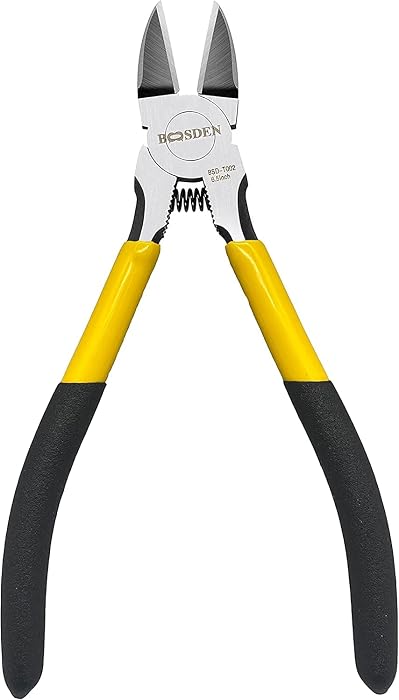
It's the least expensive cutter on this list by a wide margin, and the BOOSDEN is honest about what that buys: a 6.5-inch high carbon steel frame, high-frequency hardened blades, a rubber grip, and a spring.

For floral stems, bow making, screen wire, and guitar strings it works. The spring lets you cut one-handed, holding the stem, squeezing, and letting the offcut drop, which is the motion wreath making and arranging ask for over and over, and the rubber handle is comfortable for a tool in this bracket.

Set it beside the IGAN and the differences are plain: the BOOSDEN's blade is shorter, its maker lists soft copper, plastic, and aluminum wire rather than a gauge, and there's no lifetime warranty behind it. It's also the one that won't sting if it walks off a craft table or disappears into a drawer for a season.

Buy three. One for the kitchen drawer, one for the craft box, one for the tack room shelf. That's the role it fills, a cutter you don't have to think about for the light wire that turns up everywhere and never warrants the good pair.

Worth Noting

  • Soft steel marks on harder wire
Our Verdict

Buy a few: the cheapest cutter here is the one to keep in the kitchen drawer, the craft box, and the tack room for soft wire and stems.

Check Latest Price
8

Engineer NS-04 Mini Nippers Best for Electronics and PCB

ENGINEER NS-04 4.75" Precision Mini Nippers

Electronics and PCB

Field Score 91/100
Grip
ESD-safe thermoplastic elastomer
Material
Heat-treated carbon steel
Jaw Opening
Adjustable
Overall Length
4.75 inches
View on Amazon

A 4.75-inch nipper looks like a toy beside a 9-inch diagonal, right up until you're trying to cut a component lead in a spot where the big cutter won't fit. That's the NS-04's territory: circuit boards, small electronics, tight wiring, and flush trims where a raised edge would be felt.

The blades are heat-treated carbon steel with a flush face, and the grips are ESD-safe thermoplastic elastomer, which is a real consideration if you work around boards. The detail we like best is the angle opening adjuster, which sets how wide the jaws open when the grips are released; dial it down for repetitive fine cuts and the tool stops wasting motion between them.

It's a specialist and it says so. There's no wire gauge on the spec sheet, and the maker describes it for component leads, copper wire, and soft lead wire, which is the honest scope for a nipper this size. Both it and the Hakko cut flush; the Engineer adds the adjustable opening and ESD grips, while the Hakko gives you two cutters and a stated 16 AWG ceiling.

If your wire work happens at a bench with a magnifier and a soldering iron, this is the most precise cutter here, and the adjustable jaw is the reason to pay for it.

Worth Noting

  • Short handles give little leverage on heavier wire
Our Verdict

For bench work on boards and small electronics, this is the precise one: flush cuts, ESD-safe grips, and an adjustable jaw opening that speeds up repetitive trimming.

Check Latest Price

How We Tested Wire Cutters

We started with a long list of cutters that specified a jaw hardness, had a head shape suited to a defined job, and didn't rely on a molded grip that could spin on the handle. From there we filtered by price so the shortlist ran from a four-inch micro nipper for circuit boards up to a nine-inch cutter built for lean-on-it leverage, which left 15 pairs. We bought them at retail and used them for five months.

Testing happened where cutters actually live rather than on a bench: a garage workbench, a craft table buried in floral wire, and an electronics mat where we trimmed component leads off boards. On soft wire we made fifty back-to-back cuts through 12-, 16-, and 22-gauge copper and noted the point at which the edge started leaving a burr instead of a clean slice. On hard wire we cut coat hangers and small nails and watched for nicks in the bevel and jaws that stopped meeting flush.

To judge flush cutting, we snipped zip ties tight against a plastic panel and ran a thumb along the end to feel for a spike. We opened and closed each pair a hundred times to see whether the spring still snapped the jaws back and whether the pivot developed play. Grips got judged with bare hands and with gloves, since a soft handle that feels great for ten cuts can turn slippery by fifty.

Every pair was dropped on concrete from waist height and left on a damp sill for two weeks to see what rusted or seized. Two things decided most of them: whether the jaws met evenly along their full length, which we checked by holding each pair up to a light, and whether the edge was thin enough to slice rather than crush. Cutters that failed either test got set aside no matter what they cost.

How to Choose Wire Cutters

Flush Cuts and Beveled Cuts Do Different Jobs

A flush cutter's edge meets the flat face of the opposite jaw, so the wire parts at the surface with no spike left behind. That is what you want on a zip tie against a cable jacket, a floral stem in a wreath, or a component lead on a board. A beveled diagonal cuts on a shear instead, which is faster and stronger but leaves a short sharp tail.

The trap is buying flush for hard wire. Those edges are thin and hard, and staples, spring wire, and anything high-tensile will chip them. We keep both kinds on hand: a flush pair for finishing work, a diagonal for everything structural.

Handle Length Is Leverage You Can Feel

Every extra inch of handle is force you don't have to supply with your forearm. A 7- to 9-inch diagonal leans into a stiff tie wire with a single pull, while a 5- or 6-inch cutter is the one that fits a pouch and works above your head. High-leverage designs move the joint closer to the jaw for more power at the same length.

The trade-off is real. A long pair of dikes is awkward in a crowded toolbox, and a short pair makes you work on anything much heavier than craft wire. Match the length to the heaviest wire you cut in a typical week, not the lightest.

Read the Rating, Not the Name

Wire cutters are sold with a gauge or a material, and both matter. The Hakko here is rated to 16 AWG soft wire, the IGAN claims 12 AWG, and the Klein is described for soft annealed tie wire. That word soft is doing the work: hard-drawn, spring-tempered, and high-tensile wire behave like a different material and will damage an edge rated for copper.

If a listing gives no gauge or material at all, treat the tool as a light-duty craft cutter and buy it for that. A cutter with no stated capacity is not a cutter that can do everything.

Springs, Grips, and the Long Session

A spring return reopens the jaws between cuts, which saves a surprising amount of hand work over a hundred repetitions and lets you cut one-handed while the other hand holds the wire. Grip material matters more as a session gets longer: rubber and bi-material handles cushion the squeeze, and ESD-safe grips matter at an electronics bench.

Fit is the last check. A thick handle in a small hand is tiring no matter how good the steel is, and a short handle on a heavy wire is the same problem in reverse.

Frequently Asked Questions

Final Verdict

The Klein D248-9ST is the cutter to buy first. Nine inches of handle turn a bale of wire into a one-pull job, and the short jaws still cut close to a knot, which is the combination most properties actually need.

If wire is your trade rather than your weekend, the Knipex buys you less effort per cut. If your wire lives on a bench or a wreath form, start with the Hakko pair instead.