The 5 Best Women's Work Boots of 2026

Somewhere around hour nine of a shift, your feet start filing complaints. A good work boot is the difference between finishing strong and limping to the car, and most of us buy them without much thought. The right pair protects your toes, keeps water out on a wet morning, and doesn't demand three weeks of bandages before it stops hurting.

Weight and break-in are where shoppers get surprised. The steel toe never softens; the leather around it does. Waterproof membranes keep rain out but hold heat in, which you notice fast indoors. Over the past six months, my team and I put 12 pairs through real shifts — warehouse concrete, kitchen lines, wet loading docks — noting fit, comfort, and how each held up.

One thing I wish someone had told me sooner: sizing, not toughness, is the top reason work boots get returned. Many are built on a men's last, so the box size won't match your sneakers. The picks below were chosen for what they actually fix — long shifts, greasy floors, days you never sit down.

Our Top Picks

The 5 Best Women's Work Boots of 2026

1

Timberland PRO Direct Attach 6-Inch Best Overall

Timberland PRO Women’s Direct Attach 6 Inch Steel Safety Toe Insulated

Outdoor industrial work

Field Score 92/100
Insulation
Insulated
Safety Toe
Steel
Shaft Height
6 inches
Waterproofing
Waterproof
View on Amazon

Six inches of shaft, a steel safety toe, a waterproof upper, and insulation: the Direct Attach is the most protective boot in this group, and that combination is why it's our top pick. It's the only one here that pairs a safety toe with a waterproof, insulated build, which is exactly the pairing that matters when the job puts you outdoors in November instead of on a line indoors.

The toe box is the good surprise. Steel caps usually announce themselves on every step, but this one sits far enough forward that your toes still have somewhere to go, and the only part that needs settling is the padding around the collar — a few short wears with thick socks takes care of that. Waterproofing is the feature you notice least until you need it, and a wet sock in February ends a shift early.

Fit is where to slow down. The length runs generous on some feet and the forefoot runs narrow on others, which makes ordering online a coin flip. Buy from somewhere with easy returns, and try them on with the wool socks you'll actually work in before you commit to a full week.

Durability is the payoff. These have the strongest durability showing in this group — winters of muck, grit, and concrete without the seams letting go first — and the classic Timberland profile means they don't look like safety gear when you stop at the feed store on the way home.

Worth Noting

  • Noticeable weight on long shifts
Our Verdict

For cold, wet, safety-toe work, the Direct Attach is the boot we recommend: a steel toe that leaves your toes room, a waterproof upper, and insulation that earns its keep in winter.

Check Latest Price
2

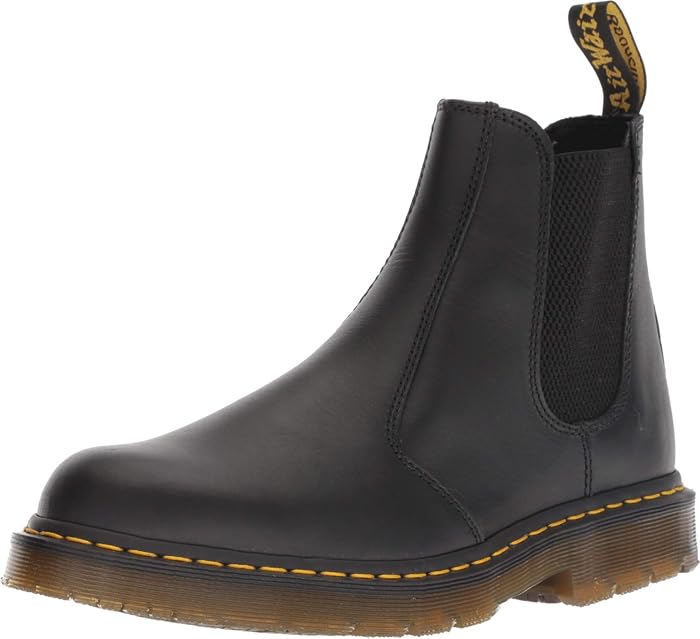
Dr. Martens Work 2976 Chelsea Best Slip-Resistant Pull-On

Dr. Martens Work 2976 Slip Resistant Chelsea Boots

Wet service floors

Field Score 91/100
Upper
Leather
Sizing
Unisex
Closure
Pull-on Chelsea
Slip Resistance
Slip-resistant outsole
View on Amazon

No laces to untie at the end of a shift, and nothing to soak up grease: the 2976 is a Chelsea, which sounds like a small thing until you're peeling boots off at the back door with wet hands.

The grip is the reason it earns a spot here. Slip resistance is what this boot was built for, and it holds on wet tile, around fryers and mop buckets, rather than only on dry concrete. We appreciate that the sole is quiet about it — no giant lugs to catch on a rubber mat or hold onto yesterday's spill.

Getting to the comfortable part takes patience. These are stiff out of the box and the leather presses across the instep for the first week or two, with high arches feeling it first. Thick socks and short wears speed that up, and once they give, they carry a ten-hour shift on hard floors without complaint.

The other thing worth knowing is that they don't read as safety gear. Black leather, clean Chelsea lines, a sole you can barely see from above — they don't look out of place off the clock either.

Worth Noting

  • Sizing runs large; buy down a full size
  • Sole and leather wear at the flex point
Our Verdict

If your shift happens on wet tile and you don't need a safety toe, the 2976 is worth the break-in: a pull-on boot with grip that holds up in kitchens and behind a mop bucket.

Check Latest Price
3

Skechers Rotund Darragh Best Value Safety Toe

Skechers Women's Rotund Darragh Work Lace-Up Safety Toe Boots

Wide-footed indoor work

Field Score 89/100
Closure
Lace-up
Outsole
Slip resistant
Safety Toe
Steel
Electrical Hazard
EH rated
View on Amazon

You can spend a lot on a steel toe. The Darragh is the least expensive way to get one in this group, and it's electrical-hazard rated on top of that — more protection than the price suggests.

Fit is its strongest card. The toe box is genuinely wide, so thick socks and wiggling toes aren't mutually exclusive, and the memory foam footbed is comfortable from the first hour rather than after a week of breaking in. For anyone whose forefoot has been squeezed by women's work boots before, that's the reason to start here. The lace-up closure helps too: you can snug the instep without crushing the toe box, which is how a wide boot stays put on a narrow ankle.

Where we hold back is the weather. Water resistance comes and goes on these — a puddle is fine, a wet snowbank or a rainy commute is not, and a full shift in a wet cooler will find the seams. Indoors, on concrete, with a safety toe required, none of that reaches you.

Worth Noting

  • Seams and grommets are the first to fail
Our Verdict

The least expensive way to get a steel toe here, and the roomiest: if your forefoot needs space and the budget is tight, the Darragh is the pair to try first.

Check Latest Price
4

SHULOOK Non Slip Work Boot Best Budget Pick

SHULOOK Non Slip Work Boot – Non Slip Work Boots for Women Food Service Kitchen Restaurant Shoes

Food service shifts

Field Score 88/100
Height
Mid-top ankle
Waterproofing
Waterproof
Slip Resistance
Non-slip outsole
View on Amazon

Light is the word. These feel closer to a sneaker on your foot than the leather boots here do, and after ten hours behind a line that difference is most of the review.

Slip resistance is the reason to buy them. On wet, greasy floors they hold — the tread is clearly where the money went — and the mid-top cut keeps splashes out without the height and heat of a full work boot. Waterproofing handles puddles and spray; standing in a wet cooler for an entire shift is a harder test.

The trade-off is lifespan. A synthetic upper at this price breaks down faster than leather, and five days a week on concrete will wear through a pair well before a leather boot needs anything done to it. For a first kitchen job, a second pair in the rotation, or a shop where boots get destroyed anyway, that's a fair trade rather than a flaw.

Sizing is friendly, which isn't a given in this category: they run true to size without an added insole, and the cut is wide enough for thicker feet. That's rare at the bottom of the price range, where boots often run short in the toe.

Worth Noting

  • Shorter service life than a leather boot
  • The upper creases early
Our Verdict

We send food-service workers here first: light on your feet, genuinely grippy on a greasy line, and inexpensive enough to replace without wincing.

Check Latest Price
5

Ariat Delilah Round Toe

ARIAT Women's Delilah Round Toe Work Boot

Barns, stables, town

Field Score 87/100
Shaft
Mid-calf
Upper
Leather
Toe Shape
Round
View on Amazon

There's no safety toe here, and that's the first thing to be clear about: the Delilah is a work boot in the barn sense, not the job-site sense. What it is instead is a light leather boot that goes from the stable aisle to town without looking like you came straight from either.

The leather is the right weight — supple enough that there's no real break-in, thick enough to shrug off brush and stirrup leathers. They're comfortable through a full day on your feet, and the round toe leaves room across the ball, which is where women's boots most often pinch.

As a barn-and-town boot it's hard to argue with, and it costs less than our top pick. The leather ages into a worn look rather than a ragged one, which is most of the reason a pair like this stays in service for years.

Worth Noting

  • Roomy shaft sits loose on slim calves
Our Verdict

A light, good-looking leather boot for barns and long days on your feet — buy it for that, and keep a safety-toe pair for the job site.

Check Latest Price

How We Chose and Tested the Best Work Boots for Women

To build the shortlist, I started with the brands that turn up on job sites and in commercial kitchens, then read through hundreds of reviews hunting for the complaints that repeat: soles splitting at the toe, boots that never stop rubbing, sizes that run a full step off. From there I filtered by safety-toe rating, slip-resistant outsoles, and whether each boot genuinely comes in women's sizes and wide widths, and pulled 12 pairs across a range of prices.

Each pair went to a tester whose workweek matched it — warehouse shifts on concrete, a hot kitchen line, retail floors, a barn and a muddy yard — plus the wet commutes in between. Everyone wore their boots for full shifts over six months and kept notes on hot spots, heel slip, and how their feet felt at hour eight compared with hour one.

We weighed every boot on a kitchen scale before the first wear and again a month in, and counted the days until a pair stopped needing a bandage stop. For water resistance, we stood each boot in a shallow basin for five minutes with a paper towel packed into the toe and checked the seams for damp. Slip resistance was judged on greasy wet tile and on a rainy loading dock. We tracked fit by comparing each boot with the tester's sneaker size and checking toe room at the end of a shift, when feet swell. Quality and durability came down to what survived six months of wear — stitching, welt seams, sole separation, scuffs — and value was whether a pair still looked and felt worth its price at the end.

How to Choose Women's Work Boots

Start With the Toe

A work boot and a safety toe are two different things. Several boots here have no protective cap at all, and if your employer requires rated toe protection, a soft-toe boot doesn't satisfy it no matter how tough the leather is. Look for a stated steel or composite toe before anything else. If you do need one, size it with the socks you'll actually work in — the cap eats room in front, and a boot that felt fine over thin socks at the store can bruise your toes by Thursday.

Match the Outsole to Your Floor

Slip resistance is specific to a surface. A deep, mud-shedding lug is what you want in a barn aisle or on wet grass, and it's the wrong sole for greasy tile, where a flatter siped rubber with a stated slip rating grips better. Shop for the worst floor you stand on in a week rather than the average one. No outsole is equally good on wet tile, wet gravel, and dry concrete, so the choice is always a trade — usually against tread life or cushioning.

Waterproofing and Insulation Are Outdoor Features

A waterproof membrane keeps weather out and, to a degree, sweat in. In a hot kitchen that's a real cost, because your feet end up damp in a different way. Pay for waterproofing when the job is outdoors or in wet coolers, and pay for insulation only if you're standing in cold — an insulated boot on an indoor concrete floor becomes a foot sauna by the second hour. For three-season work, unlined leather you treat now and then is often the more comfortable choice.

Fit, Break-In, and the Sock You'll Wear

Leather gives a little; a synthetic upper barely moves. Try boots at the end of the day when your feet are largest, wear work socks, and expect a week or two of short wears before stiff leather stops pressing across the instep. Sizing isn't consistent between makers, or even between models from one maker, so treat the number on the box as a starting point. Check the width across the ball of your foot first — that's where women's work boots most often run narrow.

Weight, Height, and How You Get Them Off

A six-inch shaft supports the ankle and charges you for it in weight and heat; a low-cut boot is cooler and offers nothing over the ankle. Laces let you tune the fit over the instep and lock the heel in place, which matters on uneven ground. A pull-on Chelsea gets you out the door in seconds and rinses clean far more easily in food service. On a ten-hour shift, a heavy boot is a decision you feel at hour eight.

Frequently Asked Questions

Final Verdict

For most women doing safety-toe work outdoors, the Timberland PRO Direct Attach is the boot to buy: the steel cap, waterproofing, and insulation cover the worst of a winter job site, and it has the strongest durability showing in this group. If your shift happens on wet tile rather than gravel and no cap is required, the Dr. Martens 2976 grips better and comes off at the door when the shift ends.