The 7 Best Wood Stove Fans of 2026

A wood stove sends a lot of heat straight up, which is why the sofa can be toasty while the far side of the room stays cold. A heat-powered fan sits on the stovetop, spins up when the surface gets hot, and pushes warm air out into the room instead of letting it pool near the ceiling. I’ve heated with wood long enough to be skeptical of free airflow, but after running 14 fans over the past six months—on wood stoves, a pellet insert, and a gas stove—the good ones clearly earn their place.

The differences show up fast: some fans move real air and stay whisper-quiet, while others rattle, stall, or barely push heat past the stove’s edge. Size and shape matter for fit—clearance under a flue pipe, a curved or enameled top, and a broad base can all make or break compatibility. I also weighed value, because a fan should heat the room faster or disappear into the background if it costs more. The picks below cover different rooms, stove types, and budgets.

Our Top Picks

The 7 Best Wood Stove Fans of 2026

1

Miaton 6-Blade Stove Fan Best Overall

Miaton 6-Blade Stove Fan – Wood Stove Fan Heat Powered

Everyday wood stoves

Field Score 90/100
Blades
6
Height
7.3 in.
Airflow
150 CFM
Noise Level
25 dB
View on Amazon

Six and a third inches deep and about seven and a third tall, this is one of the smaller footprints in this guide, and that was the first thing we noticed on a stove top that also has to hold a kettle. The Miaton leaves you room. What it does not do is announce itself: six anodized aluminum blades, a 150 CFM rating, and a listed 25 dB that, in our time with it, disappeared under the sound of the fire. It is the fan we point most people to first, because it handles the ordinary job without asking premium money.

Placement does more for this fan than any control does. Set it on the flat plate beside the flue instead of in front of it, and the rising column of heat feeds the blades; ours was turning while the stove was still catching. From a chair across the room we could feel the difference at the far end within the first hour of a fire, not a breeze but a slow drift of warm air where a cold layer had been sitting. The included magnetic thermometer is the other small thing we appreciated, because it tells you when the stove is in the band the fan wants and takes the guesswork out of why it is idling.

The honest limit is volume. Six blades and a 150 CFM claim put it near the top of this set on paper, but what reaches you is a gentle push, and in a big open room it will not shove heat down a hallway the way a plug-in fan would. Its body is small enough that some buyers open the box and wonder whether they ordered the wrong size. For a living room, a cabin main room, or a workshop where the stove sits in the same space you do, that trade is exactly the right one.

Worth Noting

  • Gentle airflow that will not cross a large room
Our Verdict

This is the fan we tell most people to buy: quiet at any stove temperature, small enough to leave the kettle on, and steady through our testing.

Check Latest Price
2

Ecofan AirMax Best Premium

Ecofan AirMax Heat Powered Stove Fan

Large open rooms

Field Score 89/100
Blades
2
Height
11.75 in.
Airflow
175 CFM
Warranty
2 years
View on Amazon

The AirMax costs several times what the budget fans here do, and it is worth being blunt about that before anything else. What the money buys is a 175 CFM rating from just two broad aluminum blades, a nickel finish that looks like it belongs on a stove rather than beside one, and a two-year manufacturer warranty, the longest coverage in this guide alongside the GALAFIRE's.

Three pounds of body and a stance just under a foot tall give it a presence the small fans do not have, and the two-blade geometry moves a wide, soft column of air rather than a narrow jet, which is the kind of thing you notice at the cool end of an open-plan room. It is also the most consistent performer in this set on heat distribution and on quiet operation at full heat. So while we recognize the price is the objection, the case for it holds in a big room heated by a single stove.

The practical catch is height. At 11.75 inches it needs clear air above it, so measure from the stove top to the mantel, shelf, or cabinet overhang before you commit. In a small room the extra airflow mostly goes unnoticed and the premium is hard to defend, which is where the UltrAir, from the same maker, makes more sense.

Worth Noting

  • Needs about a foot of clearance above the stove
  • Premium price is hard to justify in a small room
Our Verdict

Buy it if your stove heats one big open room and you want the airflow, finish, and two-year coverage that justify the premium price.

Check Latest Price
3

Ecofan UltrAir Best for Small Stoves

Ecofan UltrAir Heat Powered Stove Fan

Small stoves and inserts

Field Score 88/100
Blades
2
Weight
1.7 lb
Airflow
125 CFM
Warranty
2 years
View on Amazon

Same maker, same two-blade layout, and a step down in airflow from the AirMax: the UltrAir is the Ecofan for a stove that does not have a big room to heat or a wide top plate to spare. It stands 10.5 inches tall and weighs 1.7 pounds, so it takes less of the stovetop and lifts off easily for cleaning. Its 125 CFM rating is mid-pack here, since the Miaton and the GALAFIRE both claim more, but the two-year warranty matches the AirMax's.

Where it earns its keep is fit. It sits on narrow insert ledges and the tops of small stoves where a taller fan would foul the door or a shelf, and it starts moving soon after the stove warms. Quiet is the strongest thing about it in use, a nearly silent two-blade spin you stop hearing long before the fire dies down, and heat distribution reads just as well as the AirMax's, which is the argument for it over a cheap fan with twice the blades.

The reservation is value. This is premium money for mid-pack airflow, and price is the most contested thing about it, a fair complaint when two budget picks here claim more CFM for a fraction of the cost. What those fans do not offer is the build quality or the two-year coverage. If your stove is small, or the fan has to live on a narrow ledge, compactness is the whole argument, and it is a good one.

Worth Noting

  • Premium price for mid-pack airflow
  • Two blades throw a narrow stream
Our Verdict

Choose it when the stove is small or the ledge is narrow; the UltrAir gives up airflow, not quietness or build.

Check Latest Price
4

Tomersun 8-Blade Stove Fan Best Budget

Tomersun Wood Stove Fan 8 Blade Heat Powered

Tight budgets

Field Score 87/100
Blades
8
Height
6.5 in.
Noise Level
25 dB
Thermometer
Included
View on Amazon

Eight blades on a fan that stands 6.5 inches tall sounds like a contradiction, and in a way it is: the blade tips overlap to fit, which is how the Tomersun moves a useful amount of air from a body you can park beside a kettle. Blade count is the number sellers lead with and the one that matters least, since area and pitch do the real work, but here the result is a fan that costs less than anything else in this guide and still ships with a magnetic stove thermometer. That combination is why it is our budget pick.

Nothing about it feels like a compromise in use. It is rated at 25 dB and lives up to it, the blades start turning early in a fire, and the whole thing runs on stove heat with no cord, no batteries, and nothing to plug in. The short body slides under a shelf that would stop the Ecofan AirMax, and it is light enough to move between a stove and a workshop heater without a second thought.

What to watch is balance. Those overlapping blades are thin, and a fan that shakes is usually one that arrived slightly out of true, so check it in the first week while a return is still easy. Its stated sweet spot of 392 F to 482 F is also a narrower band than the fan will survive in, which means a roaring, fast-burning stove is where it does its least efficient work.

Worth Noting

  • Modest airflow despite eight blades
  • Happiest in a 392 to 482 F band
Our Verdict

For a first heat-powered fan or a second one for the workshop, it does the job for the least money in this guide and includes the thermometer.

Check Latest Price
5

GALAFIRE N429 Best for Low Clearance

GALAFIRE N429 – 4-Blades Heat Powered Wood Stove Fan + Magnetic Thermometer

Low-clearance stovetops

Field Score 86/100
Blades
4
Airflow
220 CFM
Warranty
2 years
Starts At
122 °F
View on Amazon

Most fans here do not say when they start; the GALAFIRE N429 does, and the number is the lowest in this set at 122 F. On a stove that cycles, hot when you feed it and cooler an hour later, that matters more than a big airflow claim, because a fan still turning through the shoulder seasons and the overnight burn is doing useful work when a fussier one has stopped. Height is the other half of the pitch: 7.44 inches, which slips under a low mantel or a shelf that would block a taller fan.

Four anodized aluminum blades and a 220 CFM rating, the highest claim in this guide, make it the sleeper of the group. Ours came up to speed on a modest fire, and the stream it throws is narrow enough to aim, so putting it at one end of the top plate pushes warm air along the room instead of straight up. The two-year warranty matches Ecofan's, the magnetic thermometer is in the box, and it costs a good deal less than either Ecofan.

The catch is scale. A 7.44-inch body with four blades moves a directed ribbon of air, not the wide wash the AirMax produces, and in a large room you will want it pointed at the seat you actually use. Push it into a corner of a big space and you will barely notice it is running. Give it heat and a target, and it earns its price.

Worth Noting

  • Narrow stream needs aiming at where you sit
  • Small body suits small-to-mid rooms
Our Verdict

Our pick for a cold stove that cycles: it starts at 122 F, stands under eight inches, and carries a two-year warranty.

Check Latest Price
6

BLFIRE Dual-Motor Stove Fan Best for Cabins and Heaters

BLFIRE Dual-Motor Stove Fan – Wood Stove Fan Heat Powered

Cabins and Buddy heaters

Field Score 85/100
Height
8.5 in.
Motors
Dual
Noise Level
20 dB
Thermometer
Included
View on Amazon

Two motors in a fan 8.5 inches tall is the unusual thing here, and it is the reason the BLFIRE pushes more air than its size suggests. Two motors share the work instead of one, so heat moves off the top plate faster than it does from the single-motor fans at this height. It is rated at 20 dB, the quietest figure in this guide, and a bracket in the box lets it sit on a portable heater as well as a stove top.

On a stove it behaves the way we want a stove fan to behave: it starts on a modest fire, stays quiet enough to forget, and the temperature-sensing module at the base lifts the front when the plate gets too hot, the same protection the pricier fans use. Small size is the other thing we liked. At just over six inches wide it leaves most of the top plate free, which is more than the Ecofan AirMax can say.

We like it most for a hunting shack, an ice-fishing shelter, or a cabin where the heat source changes with the season, and that versatility is why it made the list. What keeps it out of the top spot is scale: 8.5 inches of body needs clear air above it, and the airflow is still gentle by the standards of a plug-in fan. If you split your winter between a stove and a propane heater, it is the most useful fan here.

Worth Noting

  • Airflow still gentle for two motors
  • 8.5-inch body needs clearance above
Our Verdict

Best for a cabin where the heat source changes: two motors, a Buddy heater bracket, and the lowest noise rating here.

Check Latest Price
7

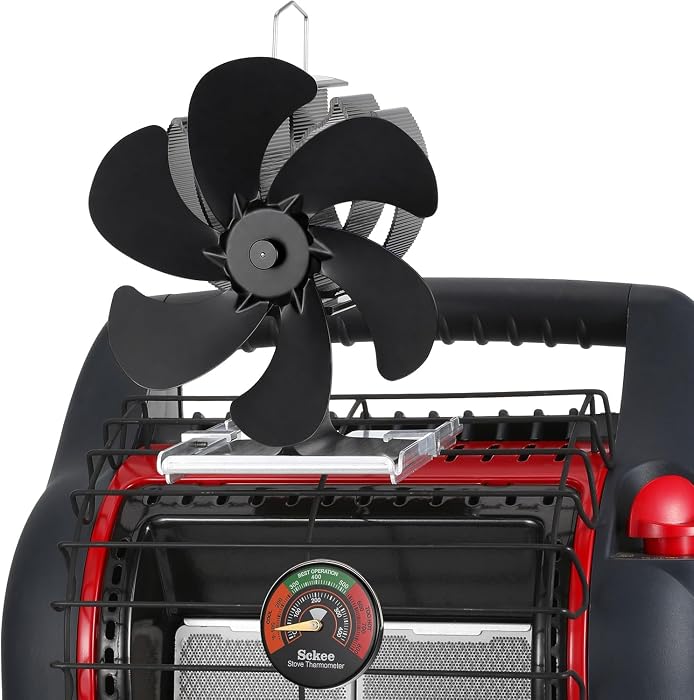
Sckee Buddy Heater Fan Best for Blinds and Shacks

Sckee Buddy Heater Fan – Wood Stove Fan Compatible for Buddy Heater

Blinds and shacks

Field Score 84/100
Height
7 in.
Mounting
Buddy heater bracket
Noise Level
24 dB
Overheat Cutoff
644 °F
View on Amazon

If your heat comes from a Mr. Heater Buddy instead of a wood stove, most of this list is the wrong shape, because a stove-top fan slides around on the rounded top of a portable propane heater. The Sckee solves that with a bracket that screws to the heater's metal plate and holds the fan above the element, and the whole thing goes together in a minute or two. A magnetic thermometer and an overheat cutoff rated at 644 F come with it.

At 7 inches tall and 4 inches wide it is a small fan, and it moves air like one: enough to break up the layer of heat that pools over a Buddy heater and push it out into a blind, a tent, or an ice shack, not enough to warm a living room from a stove in the next room. It is quiet at a listed 24 dB, and the bracket holds it steady enough that it stays put when the heater cycles on and off.

On a wood stove it works, but it gives away airflow to the bigger fans here, since a 4-inch-wide body and one small set of blades can only do so much, and the bracket becomes one more piece to keep track of when you move it between heater and stove. The tray and brackets are also light-gauge, which is fine for a fan that rides in a truck box and less impressive next to the cast Ecofan.

None of that changes what it is for. For a deer stand, a fish house, or a cabin running a Buddy heater through a cold snap, having a fan that stays put and starts on its own is worth more than any airflow figure, and the price sits in line with the plain stove fans here. The stove performance is a bonus; the mount is the purchase.

Worth Noting

  • Airflow suits tents and blinds, not living rooms
  • Bracket is extra hardware to keep track of
Our Verdict

Buy it for the bracket: if a Buddy heater is your heat, this is the fan that stays put and starts itself.

Check Latest Price

What We Looked For in Wood Stove Fans

To build the shortlist, I read through owner reviews and spec sheets, filtered out fans that were too tall for a typical firebox clearance or too wide for a curved top, and compared claimed airflow, blade count, included thermometers, and mounting options. Then I brought home 14 fans and ran them for six months—through morning reloads, evening fires, damped-down overnight burns, and a few cool-weather starts on a wood stove, a pellet insert, and a gas stove.

Each fan got the same routine. I set it on a cold stove, lit a fire, and timed how long it took to start spinning and how much air it moved at three feet and six feet from the stove, using a handheld anemometer and a paper-towel flutter test. I checked heat distribution with thermometers at the hearth, the sofa, and the far wall, and noted whether the room warmed evenly or just the immediate zone. For noise, I listened at the stove and from a chair across the room, noting bearing whine, blade tick, and motor hum during quiet evening burns.

Compatibility was mostly about fit: flat steel, curved cast iron, enameled tops, low flue clearances, and bracket-mounted setups. I flagged bases that rocked, fans that blocked the loading door, and models that needed more clearance than the listing suggested. To judge value, I compared how often each fan needed repositioning, how quickly it responded after a reload, and whether its speed stayed steady through a burn. Blade count and claimed CFM were never the whole story—the fans that worked best kept moving air quietly without fiddling.

How to Choose a Wood Stove Fan

Start With Your Stove's Temperature, Not the Blade Count

A thermoelectric fan makes its own electricity from the difference between the hot base and the cooler air above it, so the start temperature tells you more than anything printed on the box. A fan rated to begin at 122 F, like the GALAFIRE N429, keeps turning through a cool, cycling burn; one that needs a hotter plate sits idle through the first hour of every fire.

Watch the upper end too. If you routinely run the stove hard, choose a fan with a bimetallic base that lifts the fan off the plate before the module overheats, and give it a thermometer so you can see where you are.

What an Airflow Rating Really Tells You

Ratings in this group run from 125 to 220 CFM, and they are seller figures. They are useful for ranking one fan against another and close to useless for predicting a breeze. Blade count is the least informative number on the page; blade area and pitch move air, which is why the two-blade Ecofans claim as much as fans with six or eight.

What you will actually feel is a gentle current a foot or so from the blades: enough to break up a cold layer near the floor, not enough to replace a ceiling fan. Hold your hand there on the first fire. If the blades spin and you feel nothing, you are looking at decoration.

Height, Footprint, and the Top of Your Stove

The stove top doubles as a shelf, and a fan that eats it is a fan you will resent. Height runs from 6.5 inches on the Tomersun to nearly a foot on the Ecofan AirMax, so measure from the plate to the mantel or shelf above before ordering, and check the fan clears the flue collar and the door swing.

Set it on the flat plate beside the flue rather than on the pipe or directly in front of it, and leave a few inches behind the blades so the rising column of heat can feed them. On a curved or ridged top, a fan with a wide flat base sits more steadily than a narrow one.

Overheat Protection and Warranty

These fans die of heat and bearings, roughly in that order. A bimetallic strip that lifts the base when the plate gets too hot is the single most useful piece of insurance you can pay for, and a magnetic thermometer is the cheap accessory that tells you when to back off the fire.

Coverage is the other tell. Two years is the number to look for, and it is what the Ecofans and the GALAFIRE carry. On a stove you run daily through a cold winter, that difference is worth more than a few dollars saved at checkout.

When the Heat Source Is a Buddy Heater

A stove-top fan relies on a flat plate, and a portable propane heater does not have one, so a bracket model is the practical answer for a blind, a tent, or an ice shack. The Sckee's plate screws to the heater and holds the fan above the element, and the BLFIRE ships with a bracket of its own.

Expect less air than a stove-top fan delivers. The point in a small space is keeping heat from pooling at the ceiling and pushing it back down where you are sitting, and a 7-inch fan does that job well.

Frequently Asked Questions

Final Verdict

The Miaton 6-Blade is the fan we recommend to most wood stove owners. It is quiet enough to forget about, small enough to leave the kettle on the stove, and it has run without complaint through our testing, which is more than a lot of this category manages.

If your stove heats one large open room and you want the extra airflow and the two-year coverage, the Ecofan AirMax is worth the premium. And if your heat comes from a Buddy heater rather than a stove, skip both and buy the Sckee for its bracket.