The 6 Best Youth Air Rifles of 2026

A good youth air rifle is a teaching tool that happens to be fun. It gives a young shooter a supervised way to learn sight picture, breathing, and trigger control before moving up to anything bigger. The best ones are not miniature adult rifles: they are lighter, simpler, and sized so a kid can reach the lever, pump, or break barrel without wrestling it.

I spent six months shooting 10 youth air rifles with my team, mostly at paper targets and cans in a backyard with a backstop. We noted what separates a rifle a kid wants to shoot again from one that gets left in the closet: accuracy at 10 to 15 yards, how easy it is to cock and load, and whether the stock and sights hold up.

Power gets attention, but control matters more: an easy-to-cock rifle that shoots accurately gets used more than a harder-hitting one that makes a kid flinch. We also noted what came in the box, since missing sights or ammo hurt value. The picks below kept earning a second turn.

Our Top Picks

The 6 Best Youth Air Rifles of 2026

1

Daisy Buck Best Overall

Daisy Buck Youth .177 BB Air Rifle

Young, small shooters

Field Score 93/100
Weight
2.2 lb
Velocity
350 fps
BB Capacity
400 rounds
Overall Length
30.75 in
View on Amazon

Thirty and three-quarter inches is the number that decides this one. Put a full-length lever rifle in a seven-year-old's hands and the buttstock ends up tucked under their arm, so they hold the gun out in front of them like a pool cue and never learn what a real sight picture feels like. The Buck is the same Daisy lever action cut down for smaller shooters, and at 2.2 pounds it doesn't wear them out halfway through an afternoon. Fit is the whole reason we reach for it first.

The action does the teaching. Every shot costs a full, deliberate stroke of the lever, and with 400 BBs in the reservoir a kid spends the session working on the fundamentals instead of reloading. At 350 fps the BBs are quick enough to knock cans off a stump and slow enough that a stray shot into the backstop doesn't rattle anybody. Steel BBs are also the cheapest ammunition in shooting, which matters when your shooter wants to empty the gun twice before dinner.

What you notice picking it up is the material: a wood stock on a metal frame rather than a molded plastic shell, which is the difference between a first rifle and a first toy. Buy a big container of BBs with it and a target that catches what you shoot. Over a summer, the ammunition will cost more than the gun did.

Worth Noting

  • Fixed sights leave nothing to adjust
Our Verdict

We hand the Buck to young beginners before anything else here: at 30.75 inches and 2.2 pounds, it's the one a small shooter can shoulder and work without help.

Check Latest Price
2

Daisy Red Ryder 1938 Best Full-Size Classic

Daisy Red Ryder 1938 .177 BB Rifle

Older kids, teens

Field Score 92/100
Weight
1.9 lb
Velocity
350 fps
BB Capacity
650 rounds
Overall Length
36 in
View on Amazon

Six hundred and fifty BBs in the reservoir is why this one still gets shot more than anything else on the rack. That's 250 more than the Buck, and at 350 fps an afternoon disappears into a paper target and a row of cans — you refill this rifle a couple of times, not a couple of dozen. The stained hardwood stock and forearm are what people remember, and the ramped rear sight adjusts, which the Buck's does not.

What we keep coming back to is how much rifle the money buys: something that feels like a rifle in the shoulder, weighs only 1.9 pounds, and has barely changed in decades because it didn't need to. The lever is the same simple, one-stroke-per-shot mechanism a kid already knows from a smaller gun, and the wood makes the whole thing feel like an upgrade rather than a hand-me-down.

The action is the part to check. These are assembled to a price, and a rough one shows up as a lever that binds partway through the stroke or a gun that stops cocking after a few hundred BBs. Work the lever through ten full strokes before you wrap it up as a gift, and exchange it rather than living with it if it grinds.

Worth Noting

  • 36-inch length is a stretch for young kids
Our Verdict

For the kid who has outgrown a small rifle, the Red Ryder brings 650 BBs between refills, a hardwood stock, and an adjustable rear sight.

Check Latest Price
3

Umarex Marlin Lever Action Best Low-Power Pick

Umarex Marlin Lever Action Rifle .177 Caliber BB Gun Air Rifle

Short backyards

Field Score 89/100
Action
Lever
Velocity
Up to 300 fps
Rear Sight
Adjustable
BB Capacity
650 rounds
View on Amazon

Three hundred feet per second is the lowest velocity on this page, and for a first rifle that's exactly the number we want. A BB at 300 fps still tips a soda can and cuts a clean hole in paper at 15 yards, but it arrives with less energy, so a bounce off a target frame has less behind it and the report is quiet enough for a suburban backyard. Pair that with a 650-round reservoir and you have a gun a kid can shoot all afternoon without either of you thinking about the noise.

The lever has a big loop, the rear sight adjusts, and there's a manual safety — small things that add up to a rifle that behaves like a proper gun rather than a toy. The stock is polymer finished to look like walnut, which we don't mind at all: it shrugs off rain and the occasional knock against a fence post, and it keeps the weight down where a kid can manage it.

Keep it inside 15 yards. Past that the BBs start to drop and drift, and a kid who can't see where the last shot went loses interest fast. Set a can at 10 yards, let them learn the hold, and walk it back a few steps at a time — this rifle is at its best when the target is close and the shooting is frequent.

Worth Noting

  • Lever can be stiff, especially when new
Our Verdict

If your shooting lane is short and your shooter is small, the Marlin's 300 fps and 650-round reservoir make it the gentlest plinker in this group.

Check Latest Price
4

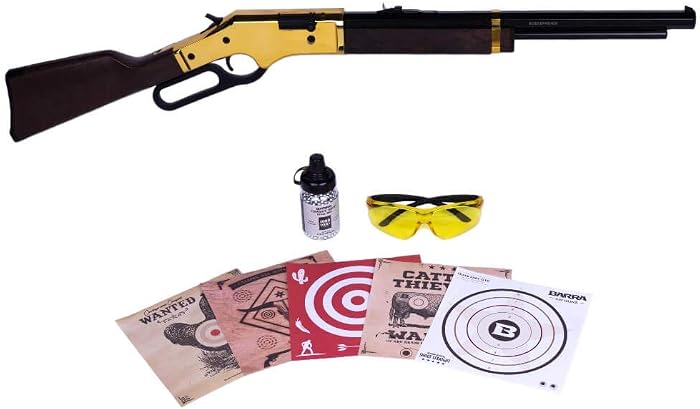
Barra 1866 Rosie Kit Best Safety Kit

Barra Air Guns 1866 Cowboy Rifle .177 Caliber BB Gun Kit for Kids and Youth

Safety-first beginners

Field Score 88/100
Weight
4.1 lb
Included
Glasses, 1,000 BBs, targets
Velocity
350 fps
BB Capacity
50 rounds
View on Amazon

The feature a kid will notice last is the one we care about most: an automatic safety that re-engages after every shot. That means a rifle set down on the bench, or passed between an adult and a child, isn't ready to fire until someone deliberately takes it off safe. For a family teaching a first gun, that single design decision is worth more than any specification on the box.

The kit handles the rest of the shopping — safety glasses, 1,000 BBs, and five paper targets — and the rifle runs on a single stroke of a long lever at 350 fps, so there are no CO2 cartridges and no ten-stroke pumping routine. It shoots .177 BBs or pellets, the hammer safety gives you a second deliberate step, and the shorter junior stock is sized so an adult and a kid can shoot the same model.

Where it earns its place with us is the handoff. This is the rifle we want in the middle of a lesson, when the gun is being traded back and forth every few minutes. At 4.1 pounds it has real heft, which reads as steady on a bench rest rather than tiring, and the gold-toned finish is the thing a kid will grab first off the shelf.

Worth Noting

  • 50-round reservoir needs frequent refills
  • Lever is plastic, not metal
Our Verdict

The Rosie kit is the one to buy when the adult wants every safety net in place: auto-safety, glasses, BBs, and targets all come in the box.

Check Latest Price
5

Crosman M4-177 Best for Style-Minded Teens

Crosman M4-177 Tactical Style Variable Pump .177-Caliber Pellet/BB Air Rifle

Style-minded teens

Field Score 85/100
Kit
BBs, pellets, targets, glasses
Ammo
.177 BBs or pellets
Velocity
350 to 700 fps
Overall Length
39.5 in
View on Amazon

Some kids are finished with cowboy rifles long before they're finished being kids, and this is the one that meets them there. The M4-177 is a convincing stand-in for the rifle they've seen in every movie and video game, and the pistol grip, carry handle, and adjustable-length stock make it feel like equipment rather than a toy — which, to a 13-year-old, is most of the appeal.

The pump is the real feature. Three strokes gets you a soft shot for an indoor hallway, ten gets you 700 fps, and the difference between them is something a kid can feel immediately — it's the clearest lesson in cause and effect any air rifle offers. We think that makes it the right step-up gun for a teenager who already knows the basics, especially since it runs .177 pellets as well as BBs and ships with ammo, targets, and safety glasses.

Inside 15 yards it does everything a backyard shooter asks of it. Past that, budget BBs wander, so plan on pellets and a rest if your kid wants to chase smaller groups. Check the carry handle and the stock for wobble when it comes out of the box; a loose one is easier to exchange than to fix.

Worth Noting

  • Pumping to 10 strokes takes effort
  • Mostly plastic construction
Our Verdict

A teenager who has moved past cowboy guns gets an AR-style silhouette, adjustable 350-to-700 fps power, and a starter kit in one box here.

Check Latest Price
6

Umarex Ruger Explorer Best for Teens Shooting Pellets

Umarex Ruger Explorer Youth Break Barrel .177 Caliber Pellet Gun Air Rifle

Teens shooting pellets

Field Score 84/100
Ammo
.177 pellets
Action
Break barrel
Sights
Fiber optic
Velocity
Up to 495 fps
View on Amazon

No lever, no pump, no CO2: the Explorer is a break-barrel spring rifle, and that changes the whole ritual. You fold the barrel down once, it takes a single firm stroke to cock, and then you're shooting one pellet at a time. Kids who have been spraying BBs at cans will find the pace maddening for about ten minutes, and then they'll start trying to hit things.

It is built for smaller shooters — a shorter, lighter package than an adult break barrel, with a rubber recoil pad and fiber optic sights that pick up light as the afternoon fades. At up to 495 fps with .177 pellets it carries further and straighter than a BB ever will, so a 20-yard target is realistic rather than optimistic, and the all-weather synthetic stock means a muddy afternoon doesn't matter.

Where it lands for us is as a graduation gift. This is the rifle we point at an 11- or 12-year-old who has already spent a season with a lever gun and wants to hit things further out; it asks more of the shooter in every way, and for the right kid that's the whole appeal. Watch them on the first cocking stroke — the face they make tells you whether they're ready for it.

Worth Noting

  • Break-barrel cocking takes real strength
  • No BB option, so ammo costs more
Our Verdict

An older kid ready to shoot single pellets instead of BBs will get the most out of the Explorer's break-barrel action, fiber optic sights, and 495 fps.

Check Latest Price

How We Tested Youth Air Rifles

We started by pulling youth air rifles from major retailers and narrowing the field by stock size, cocking style, sight setup, and whether each gun shoots BBs, pellets, or both. We cut anything that looked like a scaled-down adult rifle with controls a kid would struggle to reach, then bought 10 models to test over six months.

Most of our shooting happened on Saturday afternoons in a backyard with a cardboard backstop, paper targets, and a few soda cans, with a 10-year-old and a 13-year-old taking turns under adult supervision. We shot from a bench at 10, 15, and 20 yards, then repeated the same strings standing to see how weight and stock length affected steadiness. We timed how long a first-timer needed to load, cock, and get back on target, and noted where they fumbled with the lever, pump, or break barrel.

Fun and accuracy do not always line up, so after each session we asked the kids which rifle they wanted to shoot again; that vote carried as much weight as group size. We also kept a log of misfeeds, hard cocking strokes, and loose screws, and ran each rifle over a chronograph to compare power without pretending the highest number wins. After six months, we checked wood and polymer stocks for dings and cracks, sights for lost zero, and seals for leaks, and inventoried what came in the box so a stripped-down package did not get credit for being a bargain.

How to Choose a Youth Air Rifle

Fit Comes Before Power

Nothing ruins a first rifle faster than a stock that is too long. If a kid has to crane their neck forward to find the sights, or reach for the lever with their fingertips, they will start shooting from the hip — literally — and that habit is hard to undo. Set the buttstock in the shoulder pocket and check that the shooting hand lands on the grip and the trigger without a stretch.

Length is the number to compare, not velocity. Our top pick runs 30.75 inches for exactly this reason, while the Red Ryder's 36 inches suits a preteen or a small adult. Weight matters too: anything past about four pounds gets heavy by the third box of BBs.

Lever, Pump, or Break Barrel

Three mechanisms cover almost every youth rifle. A lever action cocks with one stroke and feeds from a reservoir of 400 to 650 BBs, which is why it remains the classic first BB gun: cheap ammunition, quick shooting, and a deliberate step before every shot. A multi-pump builds power with each stroke, so one rifle can be soft indoors and hard-hitting outside, at the cost of a lot of pumping. A break barrel takes one firm stroke, fires a single pellet, and suits an older kid who wants to hit small things at 20 yards.

Match the effort to the shooter rather than to the spec sheet. A seven-year-old can work a lever; a break barrel is a job for a strong eleven-year-old.

BBs or Pellets

Steel BBs are the cheapest way to shoot and the easiest for a kid to handle, but they are light, they bounce, and they hold accuracy to roughly 15 yards. Pellets are slower, dearer, and far more precise, and they want a rifled barrel. Most youth rifles shoot one or the other, and only a handful shoot both — buy the ammunition the gun is built for and don't assume the box does either.

Safety Gear and a Backstop

The non-negotiables are eye protection for everyone in the shooting area, a backstop that actually stops what you shoot, and an adult within arm's reach for the first several sessions. A cardboard box packed with old magazines behind the target does more than a thin fence line. Skip steel cans and other hard targets at first: BBs come back off them, and a kid's first ricochet is a lesson you don't need to teach twice.

Care, Storage, and How Long They Last

These are inexpensive rifles, and the parts that fail are the action and the seals. Don't dry-fire one — a spring gun with nothing in the barrel takes the impact itself — and don't store it cocked. Keep it unloaded and uncocked with the BBs somewhere else entirely. Do that and a lever gun can survive a childhood; skip it and a single season is optimistic.

Frequently Asked Questions

Final Verdict

The Daisy Buck is our pick because it solves the problem most families actually have: a first rifle small enough that a young shooter can hold it properly and work it alone. Everything else on this list is a way of answering a different version of that question.

If your kid has already outgrown a short stock, the Red Ryder gives you the same action with a longer rifle and 250 more BBs in the tube. If you want the rifle and every accessory in one box, the Barra Rosie kit is the safety-first choice.