The 8 Best Camping Water Containers of 2026

Water is the heaviest thing you'll pack, and the container is a trade-off no listing explains. Rigid jugs stand square in a truck bed and pour like a pitcher, but they eat a third of your trunk; collapsible bags fold into a glovebox, then slump into a puddle once full. I've spent six months with 12 of them, from rigid cubes to bags that roll up smaller than a T-shirt.

Nobody tells a first-time buyer that the spigot matters more than the gallon count. A stiff valve you have to hold open while balancing a cup makes every refill a two-person job, and a cap that doesn't seal will baptize your sleeping bag on the drive up. Taste matters too: cheap plastic leaves water tasting like a garden hose, and once a jug picks up an odor it never lets go.

Ours went to campsites and tailgates, then sat full on a garage shelf for weeks, because that's what most of these do between trips. The picks below held their seal, poured without a fight, and never asked for a second set of hands.

Our Top Picks

The 8 Best Camping Water Containers of 2026

1

Reliance Aqua-Tainer 7 Gallon Best Overall

Reliance Products Aqua-Tainer 7 Gallon Rigid Water Container

Car camping base

Field Score 95/100
Capacity
7 gallons
Dimensions
15.3 x 11.3 x 15.3 inches
Dispensing
Hideaway spigot with screw vent
Stacks When Empty
Yes
View on Amazon

The spigot is what earns the Aqua-Tainer its place here. Set the jug at the edge of a picnic table or a tailgate, crack the vent screw, and water runs in a steady stream — no lifting, no glugging, no tipping a heavy jug over a cook pot in the dark. The spigot itself hides behind a cap that reverses for travel, so nothing snaps off on the drive in.

Seven gallons is a serious amount of water: a long weekend for two people, or most of a week for one careful camper. The rectangular shell stacks when empty, so a pair of them lives in a garage corner without a shelf, and the wide fill opening makes a refill from a hose or a campground spigot quick. It also does not leave a plastic note in the water, which is not a given in this group.

What you have to respect is sunlight. Polyethylene goes brittle under ultraviolet light, and a jug left full on a trailer or in an open truck bed for a season is the jug that cracks — Reliance says as much on the container itself. Keep it shaded or in the garage between trips and it behaves like the workhorse it is.

Worth Noting

  • Heavy to move once it is full
Our Verdict

For car camping and storm prep, this is the jug we reach for: seven gallons, a spigot that lets it sit on a table, and a shell that stacks when empty.

Check Latest Price
2

Scepter 5 Gallon Water Can Best Heavy-Duty Jug

Scepter Portable Plastic Military Style Food Grade 5 Gal Water Jug Container

Truck and trail

Field Score 93/100
Spout
Reversible pour spout
Capacity
5 gallons (20 liters)
Dimensions
13.38 x 7.5 x 18.88 inches
Empty Weight
3 lb
View on Amazon

Where the Aqua-Tainer stays put and gets drawn from, this one is built to ride — in a truck bed, a boat locker, an RV bay, or strapped to a UTV. The military-can shape, the food-grade polyethylene, and a cap that holds when the jug is on its side are the whole point.

We think the trade is worth it: you give up two gallons and the tap, and you get a container you can lay down for a day without a towel under it. The 7.5-inch width slides behind a seat or into a footwell, the carry handle sits where your hand wants it, and five gallons still covers the better part of a week for one person.

The spout reverses into the jug for storage and pours well into a bottle or an RV inlet, though it is a pour spout rather than a tap. Give it a rinse and a day of air before the first fill, too — the plastic can smell new for a while.

Worth Noting

  • Fill level is hard to read
Our Verdict

When the water rides in a truck bed, a boat, or a trailer, this is the jug we hand over: food-grade plastic, a cap that stays shut, and a spout you can reverse.

Check Latest Price
3

YOSN 5 Gallon Water Jug Best All-In-One Kit

YOSN 5 Gallon Water Jug – 5 Gallon Water Jug

First-time campers

Field Score 92/100
Capacity
5 gallons
Included
Spigot, brush, storage bag, extension tube, 1.3-gallon bag
Dimensions
7 x 12.6 inches
Empty Weight
2.2 lb
View on Amazon

Open the box and the kit is the story: a five-gallon jug, an adjustable spigot, a sponge brush on a handle, a stickable storage bag, an extension tube, and a 1.3-gallon collapsible bag for overflow. That is an unusual amount of gear at this size, and it means a first trip does not start with a second order for a faucet and a bottle brush.

The jug underneath is a two-handle five-gallon in food-grade PE that weighs 2.2 pounds empty. Seven inches wide and 12.6 inches tall, it slides into a campervan cabinet or behind a truck seat, and the mouth is wide enough for a hand and the brush. The dual handles do make a full jug easier to move than a single loop would.

Where it wins us over is completeness — the spigot, the brush, and the spare bag are exactly what people end up buying after their first trip. The body is thick PE and the spigot threads on snugly, and the extension tube reaches a basin or a second jug without lifting a full five gallons.

Worth Noting

  • Hose and small fittings feel light-duty
Our Verdict

Five gallons, a spigot, a brush, and a spare bag in one box — this is the jug we suggest to anyone starting from zero.

Check Latest Price
4

COOZMENT 3.2 Gallon Water Jug Best for Tight Spaces

COOZMENT 3.2 Gallon/5 Gallon Water Containers with Spigot

Tight storage

Field Score 91/100
Mouth
4-inch opening with brush
Capacity
3.2 gallons
Dimensions
7.5 x 13.7 inches
Empty Weight
1.9 lb
View on Amazon

The first thing we check on any jug is where it will live, and at 7.5 inches wide this one slides into slots a five-gallon will not touch: a campervan cabinet, the space behind a truck seat, a shelf in a gear closet. At 3.2 gallons it comes in around 27 pounds full, a weight most people can lift out of a vehicle without asking for help.

The rest of the design earns its keep. The 4-inch mouth is wide enough for a hand and for the brush that comes with it, the spigot sits opposite the fill cap so you can top up and draw from the same jug without spinning it around, and the two handles sit where the weight is. Sealing is the fussy part: the silicone ring has to sit square in the cap, and a cap threaded on crooked will weep. Check it before you fill, not after.

Worth Noting

  • Costs as much as the bigger jugs here
Our Verdict

Seven and a half inches wide is the whole argument: this is the jug for a campervan cabinet, a Jeep footwell, or anyone who cannot lift five gallons.

Check Latest Price
5

Stanley Adventure Fast Flow 2 Gallon Best for Cold Water

Stanley Adventure Fast Flow Water Jug

Cold drinks

Field Score 90/100
Spigot
High-flow with ice catch
Capacity
2 gallons
Insulation
Double-wall foam
Cold Retention
13 hours cold, iced up to 2 days
View on Amazon

Two gallons, a foamed lid, and double-wall insulation rated for 13 hours cold and up to two days with ice. What that buys you is water still worth drinking at the end of a hot afternoon — at a show, in a truck cab, on the shady side of a trailer — without dragging a cooler along.

Where this jug earns its spot is the shape of the day it suits: a cooler is overkill, a plain jug goes warm, and you want cold water within reach. The spigot is high-flow, with an ice catch behind it so cubes do not jam the works and end up in your cup, and it unscrews for cleaning. The lid latches down, which matters when the jug rides in a truck bed.

The limit is capacity. Two gallons is a day for a small group rather than a weekend for a family, and with ice in it this is not a jug you carry far from the vehicle. As a cold-drink container for basecamp, tailgates, and work days outdoors, nothing else here does the job.

Worth Noting

  • Spout can drip when the jug is not upright
Our Verdict

Cold water without a cooler: this is the jug we pack for a hot day at camp, a tailgate, or the back of a truck at a show.

Check Latest Price
6

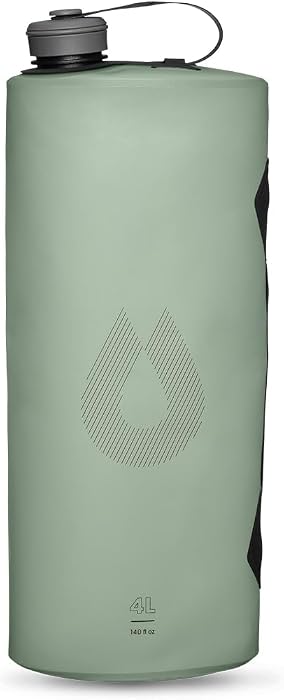
HydraPak Seeker 4L Best for Backpacking

HydraPak Seeker Collapsible Camping Water Storage (4L

Backpacking trips

Field Score 89/100
Opening
42 mm, filter compatible
Capacity
4 liters
Material
TPU, BPA and PVC free
Empty Weight
3.67 oz
View on Amazon

Empty, the Seeker weighs about four ounces and rolls into a bundle the size of a fist; the stuff sack comes with it. We noticed that most on the second day of a trip, when the water is gone and the bag is flat in the bottom of a pack instead of being a hard shell you are stuck carrying.

The 42mm opening takes most threaded backcountry filters directly, so water can come out of a stream through a filter screwed straight onto the bag. The lash points and low handle let you tie it to a pack, a saddle, or a tree, and it is rated for hot water up to 140°F, which covers dishwater and a warm drink on a cold morning.

The trade is taste. TPU can leave a plastic note in the water and this bag is no exception; a rinse with a little baking soda and a full air-dry with the cap off before the first trip makes a real difference. If you are sensitive to it, a rigid jug will taste cleaner. For weight and packed size, nothing else in this group comes close.

Worth Noting

  • Water can pick up a plastic taste
Our Verdict

For backpacking, horseback, or any trip where ounces count, this is the four-liter bag we carry: light, packable, and ready for a filter.

Check Latest Price
7

MSR Dromedary 10L

MSR Dromedary Bag Water Reservoir

Basecamp supply

Field Score 88/100
Shell
1,000-denier exterior
Capacity
10 liters
Dimensions
12 x 23 inches
Empty Weight
9.6 oz
View on Amazon

The Dromedary's shell is 1,000-denier fabric laminated with a food-grade lining — the same order of tough as a good duffel, and the reason this is the bag here you do not have to baby. It can be set down on rock, tossed in a truck, and frozen without splitting.

Ten liters is a basecamp number rather than a day-hike one: enough to keep a group in drinking and cooking water for a day or two, at about nine and a half ounces empty. It hangs from a tree or a frame, sits on a table, and takes up less room in a vehicle than a rigid jug of the same capacity.

Pouring is straightforward — a wide screw cap for filling and a small flip spout for topping off a bottle or a basin. There is no tap on the bag itself, so at camp it either hangs or gets tipped, which is the one place a rigid jug with a spigot is genuinely easier.

At this size you are carrying about 22 pounds when it is full, so it is camp equipment, not backpacking equipment. For a hunting camp, a horse-packing trip, or a long stay where water gets hauled once and drawn all week, it is the bag that takes the abuse.

Worth Noting

  • Cap sits in a tall collar and is hard to grip
  • Costs more than any jug here
Our Verdict

Ten liters in a bag you can drag across granite: this is the basecamp reservoir for groups, horse trips, and long stays.

Check Latest Price
8

SUPANT Collapsible 5L Bags (4-Pack)

SUPANT Collapsible Emergency Water Jug Container Bag

Spare capacity

Field Score 87/100
Mouth
1.4 inches
Capacity
4 x 5 liters
Freezable
Yes
Bags Included
4
View on Amazon

Four bags, five liters each, a bit over five gallons in total. Empty, they flatten into a drawer or a glovebox; full, they are soft enough to wedge into gaps a rigid jug cannot use. There is no spigot and no base to speak of — these are for carrying and storing water, not for setting up as a camp tap.

Where they earn their keep is the jobs a jug cannot do: frozen as blocks in a cooler, filled with drink mix, kept in the truck as backup, or handed out so everyone carries their own. The 1.4-inch mouth fills from a tap or a filter, and the screw cap seals flat.

They also take a rinse and an air-dry rather than a scrub. The mouth is 1.4 inches, so a bottle brush will not reach the corners, and a bag put away damp is a bag that tastes of it next time — stand them open for a full day before they go back in the drawer.

We treat them as consumables rather than heirloom gear: buy a set, use them hard, expect to retire one eventually, and test a new bag on its side overnight before it rides next to a sleeping bag.

Worth Noting

  • Seams and caps can weep over time
Our Verdict

Buy these as spare capacity, not as your main jug: four soft bags that fold flat and cost less than any single container here.

Check Latest Price

How We Tested Camping Water Containers

The shortlist started with every container that surfaced in camping, tailgate, and emergency-prep searches. We cut anything with a pattern of cracked lids, stripped spigots, or complaints about water going stale, then filtered what remained by material (food-grade, BPA-free), mouth width, capacity, and whether it packed flat or stood rigid. That left 12 containers spanning roughly 3 to 7 gallons, all bought at retail so no brand got a head start, and the spread in price made value its own question: did the extras actually earn their keep?

Testing looked like a normal Saturday. We filled each one at a utility sink, capped it, tipped it on its side in the trunk, and drove 40 minutes to a trailhead with a dry towel underneath to catch anything that escaped. We timed how long a full container took to drain through its spigot, noted whether the stream came out steady or sputtered, and tried pouring one-handed from the tailgate. Back home they sat full on a garage shelf for weeks, where we checked for bulging seams and weeping caps.

Every container got loaded to the top, shoved off a tailgate onto grass, and dragged across pavement by its handle to see whether the seams held. We left water sitting for a week in a hot car and then tasted it, which is where cheap plastic gives itself away, and sniffed each one before refilling. On a 90-degree afternoon we packed the insulated option with ice and checked how much survived until dinner, since that's the one place a heavier jug justifies its weight.

How to Choose a Camping Water Container

Match the Container to the Carry

The first fork is whether the container rides or walks. A rigid water jug lives in a vehicle, a camper, or a wall tent and does its best work sitting still; a collapsible bag goes into a pack and disappears when it is empty. Water is heavy — a gallon is a little over eight pounds — so a full five-gallon jug is over 40 pounds and a full seven-gallon one is close to 60. Choose the capacity you can move when it is full, not the one that reads best on the listing. Five or seven gallons suits most couples car camping; four liters is a backpacker's day.

Leaks Start at Threads and Spigots

Leaks almost always begin at a thread, an O-ring, or a spigot seat rather than in the body of the container. Before a trip, fill a new jug halfway, lay it on its side on a towel for an hour, and look around the cap and the spigot. A silicone ring seated crooked, or a cap threaded on over grit, will weep; a quarter turn past snug is enough.

Travel with rigid jugs upright, and if one has to ride on its side, pick a container whose cap is made for it, like the Scepter's.

Decide How You'll Get Water Out

A tap lets a full jug stay where it is: set it on a table or a tailgate with the spigot over the edge and fill bottles one-handed. A pour spout means lifting, which is fine at two gallons and less fine at seven. A wide screw cap is for filling other containers, attaching a filter, or pouring into a pot. The trap with taps is real — a jug whose spigot sits a few inches back from the edge pours onto the table, so check where the spigot points before you fill it.

Rigid or Collapsible: Buy One of Each

These are not competing designs so much as different jobs. A rigid jug is the basecamp supply: it stands, stacks, and takes a tap. A collapsible bag is the spare: it adds capacity on the way out and folds away on the way home, and it is the only kind worth carrying on foot. Most well-sorted camps end up with one rigid jug and a soft bag or two, and the soft ones do what the jug cannot, like freezing into cooler blocks.

Sun, Heat, and Taste

Polyethylene does not like ultraviolet light. Left in direct sun for a season, the plastic goes chalky and brittle, and a brittle jug cracks — Reliance prints that warning on its own container. Store jugs in the shade or in the garage between trips, and do not leave a full one strapped to a trailer for months. Taste is the other thing to check early: rinse anything new, air it with the cap off, and if a soft bag leaves a plastic note in the water, keep it for washing water instead.

Frequently Asked Questions

Final Verdict

For most campers the Reliance Aqua-Tainer is the container to buy first. Seven gallons, a spigot that lets it sit on a table while you fill bottles, and a shape that stacks out of the way between trips — it covers car camping and storm prep with one purchase. Store it in the shade and the plastic holds up.

If your water rides in a truck bed or a boat locker, take the Scepter instead; it lies on its side without a towel under it. Carrying water on your back rather than in a vehicle? Start with the HydraPak Seeker.