The 8 Best Straw Water Filters of 2026

The boil-water notice is the thing nobody plans for — a text from the utility, a sign taped to the elevator, and suddenly the tap is off limits. A straw filter is cheap insurance against that day, and it earns its keep long before: on a trail, in a hotel with dubious plumbing, in a go-bag. You stop rationing clean water and stop guessing whether the source in front of you is safe.

I keep one in my daypack and one in the glovebox. Over four months, my team put 16 of them through the kind of use they're actually bought for. Pore size matters most — 0.1 micron is the number to look for, since that's what reliably strains out protozoan cysts and most bacteria. Capacity claims are worth a glance, but flow rate and a housing that survives a stuffed pack matter more. Multi-packs are common for a reason; these are cheap enough to stash one everywhere.

Below are the ones that kept flowing and packed small — the best straw filter is the one that's actually with you.

Our Top Picks

The 8 Best Straw Water Filters of 2026

1

LifeStraw Personal Best Overall

LifeStraw Personal Water Filter for Hiking

Families and trail groups

Field Score 98/100
Weight
1.6 oz
Removal
99.999999% of bacteria, 99.999% of parasites
Pack Size
5 filters
Filter Life
4,000 liters (1,000 gallons)
View on Amazon

Five filters arrive in one box, and that is as much of the argument as any single specification. At 1.6 ounces each and rated for 4,000 liters, they let you put one in the hiking pack, one in the truck's glovebox, one in the kitchen drawer, and two in the emergency tote without doing any arithmetic about it. The rated shelf life is five years, so the ones you stow should still be good when you finally reach for them.

What we keep coming back to is how little there is to get wrong. No cap to lose, no battery to check, no cartridge to seat — you pull the cap off, drop the end in the water, and drink. In camp we have handed one to someone who had never used a filter and watched them get water on the first pull, which is more than we can say for most gear we test.

The design has one real cost: you pull, you do not sip. Suction is how the water comes up, and it gets harder as silt loads the membrane. Blowing back through the mouthpiece clears it, and that trick is worth knowing before your first silty creek rather than after. Because the mouthpiece is the whole interface, there are no threads for a bottle, so filling a container means filtering into your mouth first — this one is for drinking at the source.

The detail that surprises people is what comes with it: every purchase funds a year of safe drinking water for a schoolchild, per LifeStraw. Buying a five-pack does that five times over. It is a strange thing to feel good about while standing ankle-deep in a creek, but we will take it.

Worth Noting

  • Sip-only, with no bottle or hose threads
  • More filters than a solo hiker needs
Our Verdict

The one we point most people to: five light, foolproof filters that need no setup, no charging, and no instructions beyond putting one in the water.

Check Latest Price
2

Sawyer MINI Best for Bottle and Pack Setups

Sawyer Products SP105 MINI Water Filtration System

Bottle and pack setups

Field Score 97/100
Weight
2 oz
Pore Size
0.1 micron absolute
In The Box
Filter, 16-ounce pouch, straw, cleaning plunger
Filter Life
100,000 gallons
View on Amazon

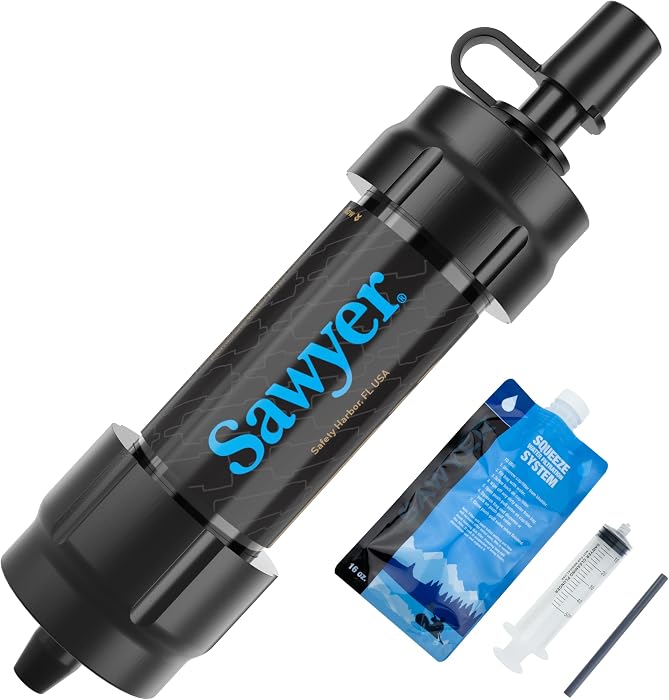
Where the LifeStraw asks you to suck, the Sawyer MINI asks you to squeeze. The threads on the business end match a standard 28 mm soda or water bottle, so you fill the bottle from the creek, screw the filter on top, and press water into your mouth or into a second bottle. It also drops inline on a hydration pack hose, and there is a plain straw in the box if you want to drink straight from the source. Of everything here, this is the one we take when we are carrying a bottle anyway.

The numbers back it up. The hollow-fiber membrane is rated 0.1 micron absolute, the filter is rated for 100,000 gallons, and a cleaning plunger comes in the box so you can backflush rather than replace. The TDS ceiling of 1,500 ppm is the highest in this group, which matters on hard, mineral-heavy water rather than the silty stuff.

Two things to know before you commit. The included pouch is a 16-ounce squeeze bag, so the kit is bottle-and-bag first and straw second. And the o-ring at the threaded end is the part that gives — hand-tight is the setting, and over-tightening is what pops it. That is a small habit, not a flaw, but it is the sort of thing you learn at the wrong moment otherwise.

Worth Noting

  • Needs a bottle or pouch to be at its best
  • 16-ounce squeeze pouch is small for two people
Our Verdict

For people who prefer squeezing to sucking: it screws onto a standard soda bottle, and nothing else here comes close on rated filter life.

Check Latest Price
3

LifeStraw Peak Series Best for Fast Flow

LifeStraw Peak Series

Filling bottles fast

Field Score 96/100
Weight
7.36 ounces for two
Mounting
Threaded cap for bottles and gravity hoses
Flow Rate
2.5 liters per minute
Filter Life
4,000 liters each
View on Amazon

Sucking is the part of straw filtering nobody enjoys, and the Peak Series is LifeStraw's answer to it. The membrane is re-engineered to pass 2.5 liters a minute and to shed sand and silt rather than load up on them, and the removable bottom cap is threaded so a bottle of creek water screws on and gets squeezed through instead of pulled.

That screw-on mode is why we rate this above the original straw for anything involving other people. One person can fill bottles for the group while everyone else eats, and the same threaded base accepts a standard gravity hose, which turns it into a slow but hands-free setup at camp. You get two filters of 4,000 liters each, and the pair weighs 7.36 ounces — better than twice the weight of a bare straw per filter. We think that is worth carrying once you are filtering for more than yourself.

Two things to keep an eye on. The bottom cap is the part that takes abuse, so it is the piece to look after. And the carry case is sold separately, which stings a little on the LifeStraw you are most likely to throw in a bag and forget about.

Worth Noting

  • Carry case sold separately
  • Over twice the weight of a bare straw
Our Verdict

Our pick for anyone who dreads the sucking: screw a bottle onto the threaded base and squeeze instead, at 2.5 liters a minute.

Check Latest Price
4

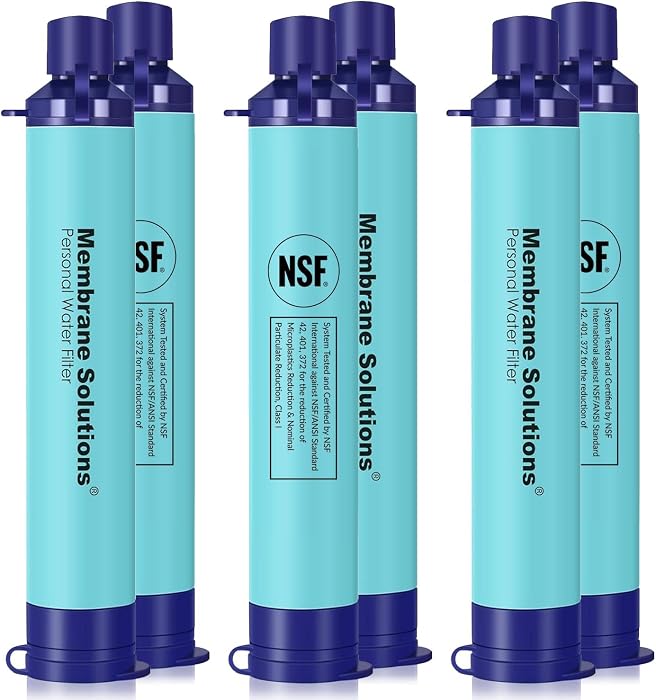
Membrane Solutions S1 Best Certified Multi-Pack

Membrane Solutions Personal Water Filter Straw S1

Certified household kits

Field Score 95/100
Flow Rate
500 milliliters per minute
Pack Size
6 filters
Filter Life
5,000 liters each
Certification
NSF/ANSI 42, 372, 401
View on Amazon

Three separate NSF/ANSI certifications — 42, 372, and 401 — plus a published test report number make this the most independently vetted straw in this group. It is worth being precise about what that covers: chlorine and taste reduction under 42, lead-free materials under 372, and emerging-compound screening under 401. The bacteria and parasite removal figures are a separate claim, so do not read the NSF marks as pathogen certification. What we take from it is that the materials and the taste side have been checked by somebody other than the seller, which is rarer on this shelf than it should be.

The five-stage stack runs a coarse screen, two layers of PP cotton, coconut-shell activated carbon, then the hollow-fiber membrane. Pore size is 0.1 micron, capacity is 5,000 liters per straw, flow is a stated 500 milliliters a minute, and both ends are cut for 28 mm bottles. Six straws, 2 ounces each, about seven inches long.

The cotton and carbon are what make the difference day to day, because they catch fine grit before it reaches the membrane and should keep it from loading up as fast on silty water. It also means there is more inside to keep wet between trips, so backflush and air-dry before it goes back in the bag.

Worth Noting

  • Six is more than a solo hiker needs
  • Stated flow is well below the Peak Series
Our Verdict

Six NSF-certified straws with a carbon stage — the pack we point families to when they want one in every bag and better-tasting water.

Check Latest Price
5

Practical Survival Straw Best for Long-Term Storage

Practical Survival Reusable Emergency Water Filter Straws

Long-term storage

Field Score 94/100
Length
8 inches
Weight
2 oz
Shelf Life
No expiration date
Filter Life
1,800 gallons each
View on Amazon

Most filters carry a date. This one is sold on the absence of one — no expiration, 1,800 gallons per straw, and a maker's estimate of up to ten years of drinking water for one person. For a kit that lives in a truck box or a cabin cupboard and gets checked once a year, that is the entire feature, and it is the reason this one is on the list.

The rest is straightforward. Two ounces, eight inches long, five to a box, and a flushing plunger for each straw so you can push clean water back through the membrane after a gritty pull. It is a hollow-fiber membrane with the usual bacteria and parasite rating, and it will not do anything about dissolved chemicals.

Five in one box changes how you store them. One in the truck, one in the boat bag, one in the cabin drawer, one in the range bag, and one for whoever shows up unprepared — none of them needing to be swapped out on a schedule or remembered at the start of every season.

That is the case for it over a fancier single straw. Nothing here is the lightest or the fastest, but a filter you never have to think about until the day you need it is worth more in a truck box than a better filter you left at home.

Worth Noting

  • Eight inches long, so it lives in a pack, not a pocket
  • 500 ppm TDS ceiling is on the low side here
Our Verdict

Our pick for a bag that sits untouched for years: no expiration date, 1,800 gallons a straw, and five of them to spread around.

Check Latest Price
6

Waterdrop Filter Straw Best for Single-Trip Use

Waterdrop Water Filter Straw

Single-trip use

Field Score 93/100
Backwash
Built in at both ends
Flow Rate
700 milliliters per minute
Pore Size
0.1 micron
Filter Life
1,400 gallons (5,300 liters)
View on Amazon

Backwashing is the feature that decides whether a straw survives a season. Both ends of this Waterdrop come apart, and the body connects to a water bag or bottle at either end, so you can push clean water backward through the membrane instead of coaxing it through the mouthpiece. That is the difference between a filter you use hard and a filter you baby.

The rest of the specification sheet is solid: a 0.1-micron hollow-fiber membrane, a coconut-shell carbon stage for taste and chlorine, 1,400 gallons of capacity, a stated 700 milliliters a minute, and 28 mm threads. It is a single straw, so there is no spare in the box when one goes into the daypack.

The number we keep coming back to is the shelf life: 12 months. Whatever the maker means by it, a straw with a one-year window is a poor candidate for the bag you build and forget about and a good candidate for the pack you are actually carrying. Buy it for the trip, not the apocalypse.

That is how we have ended up treating it — a straw that lives in the daypack from spring through fall and gets backflushed in the sink afterward. On that schedule, the carbon and the threading are worth more than any capacity figure on the page.

Worth Noting

  • Sold as a single straw only
  • 30-day limited warranty
Our Verdict

The single straw we recommend for a trip you are taking this season rather than a stash you are building: real backwashing and a carbon stage.

Check Latest Price
7

Timain 2-Pack

Timain 2 Pack 4-Stage Filtration

Base camp

Field Score 92/100
Weight
3 oz
Pack Size
2 filters
In The Box
Two silicone hoses and a cord
Filter Life
1,000 gallons each
View on Amazon

Two silicone hoses and a seven-core umbrella cord are what separate this kit from a pair of plain straws. The hose pushes onto the mouthpiece so you can reach the bottom of a bottle, a pot, or a hydration bladder without tipping it, and the cord lets the whole thing hang off a branch while it drains.

The filter itself is a four-stage stack — mesh, ultrafiltration membrane, activated carbon — with 1,000 gallons of capacity per straw and threads for standard 28 mm bottles. Three ounces and about nine inches, so it is heavier and longer than the bare straws here, and it drinks with noticeably less pull than the sip-only designs.

Where it makes sense for us is base camp: the hose and cord turn a straw into something you rig once and leave hanging, and two filters mean one can stay set up while the other goes into a daypack. The trade is more parts to rinse and keep track of, which is the price of the setup.

Worth Noting

  • Heavier and longer at 3 ounces and 9 inches
Our Verdict

The camp-kit straw: two filters, two silicone hoses, and a cord that lets you hang the whole thing, for filtering at a table rather than a creek bank.

Check Latest Price
8

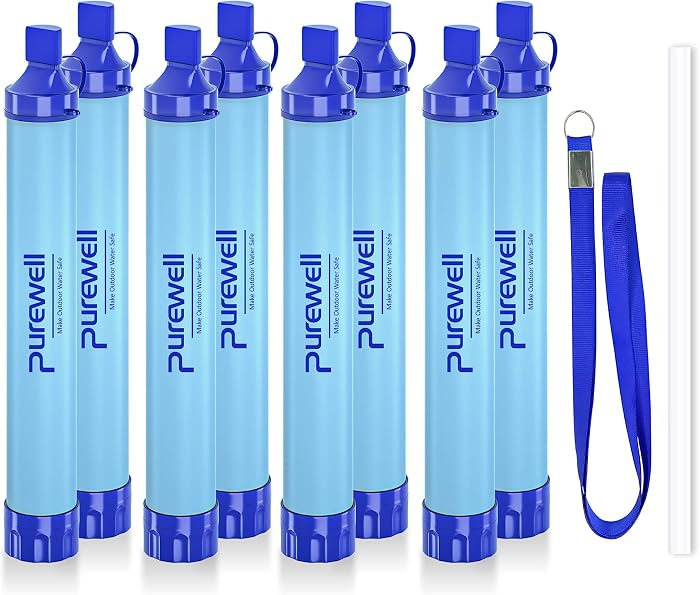
Purewell 8-Pack Best for Groups and Clubs

Purewell Outdoor Water Filter Personal Water Filtration Straw Emergency

Groups and clubs

Field Score 91/100
Flow Rate
550 milliliters per minute
Pack Size
8 filters
Filter Life
1,500 liters (396 gallons) each
Hose Length
8.7 inches
View on Amazon

Eight filters in one box is a group purchase, not a personal one. The 8.7-inch hose is the part that earns it: you can drink from a bottle or a pot standing up, or from a container set on a rock, instead of lying at the water's edge with your face in the creek.

Each straw runs a five-stage stack that puts coconut-shell carbon ahead of the hollow-fiber membrane, at a stated 550 milliliters a minute, with threads for standard water bottles. The bodies are food-grade plastic, BPA-free, and the set is the only one here that outfits eight people from one order.

One figure deserves a raised eyebrow: Purewell quotes a 0.01-micron pore size, ten times finer than the 0.1 micron most of this group uses. We treat that as the maker's number rather than a reason to trust it more. The SGS and TÜV certification with a test report reference is the part that can be checked, and that is what we would go by.

What we like about it for a group is the hand-off. A filter per person means no queue at the water source and no shared mouthpieces, which matters more on a scout trip than any line on a specification sheet.

Worth Noting

  • Shortest filter life here at 1,500 liters a straw
Our Verdict

Our pick for a group: eight filters and a long hose, so a troop or a big family can drink without kneeling at the bank.

Check Latest Price

How We Tested the Best Straw Water Filters

We started by pulling every straw-style filter we could find that published a micron rating, then cut anything that couldn't name its pore size or back up its certification on the packaging. That took the field down to 16 units. Price mattered, but so did pack size — several finalists come in multi-packs, so we tracked cost per filter rather than cost per box.

Testing ran four months and happened where these things actually live: clipped to a hip belt on day hikes, in a rental car on a weekend trip, in a go-bag that sat in a hot trunk through the summer. On the trail we filled from a silty creek and from a lake edge with visible algae. In the kitchen we stirred potting soil into a bucket of tap water so every filter met the same mess, and timed how long each took to fill a 16-ounce bottle — plus how hard we had to lean into the pull when a filter started to load up.

After every outing we backflushed according to the maker's instructions and re-timed the flow to see how much came back. Durability got the crude treatment: dropped from waist height onto pavement, buried at the bottom of a pack under a full water bottle, and left overnight in a freezing car. We weighed each one dry for portability, checked whether caps and bite valves stayed put in a pocket, and read every label against the certification it claimed rather than trusting the front of the box.

The units that spent all summer in the trunk got used last, which gave us a read on emergency storage — we looked for cracked housings, stiff mouthpieces, and any off taste in the first liter through.

How to Choose a Straw Water Filter

What a Straw Filter Removes, and What It Doesn't

Every pick here runs water through a hollow-fiber membrane with pores around 0.1 micron, small enough to stop bacteria and protozoa such as Giardia and Cryptosporidium along with grit and microplastics. None of them claims to stop viruses, which are smaller than the pores, and none removes dissolved chemicals — pesticides, fuel, heavy metals, salt. That is the line to hold: these are backcountry and emergency filters for water that looks and smells reasonable.

If the water may carry viruses, filter it and then boil it, or use a purifier rated for viruses. Skip it entirely for seawater and chemical spills. A useful hedge on a muddy source is a cloth prefilter: pour through a bandana first and the membrane has far less work to do.

Sipping, Squeezing, or Hanging: Match the Mount to Your Trip

Direct sipping is the simplest mode and the most tiring, because you pull water through the membrane with your mouth and the effort climbs as the filter loads. Threads change the job. A 28 mm threaded base, standard on soda and water bottles, lets you screw a full bottle on and squeeze — faster, and much easier on the jaw — or hang it and let gravity work. If you plan to fill bottles for more than one person, buy for the threads; the Sawyer MINI and the LifeStraw Peak Series are the two here built around them.

A sip-only straw still has a place. At 1.6 to 2 ounces, the LifeStraw Personal disappears into a pack and needs no bottle, bag, or hose to work, which is exactly what you want when you are drinking straight from a spring on the move.

Flow Rate, Clogs, and Backwashing

Stated flow rates here run from about 500 milliliters a minute to 2.5 liters a minute, and the gap widens in the field: a silty creek loads the membrane fast and flow drops until you clear it. Backflushing is the fix. Push clean water backward through the membrane with a plunger, a syringe, or by reversing the connections, and practice it at home before you are squatting at a creek with a filter that will not pass water.

Sediment settles, so give it a chance to: let a bottle of creek water stand for a few minutes and draw from the top. A straw with a built-in backwash, like the Waterdrop, is easier to keep going across a long trip than one that needs a separate tool you left in the truck.

Capacity, Shelf Life, and How Many to Buy

Rated filter life in this group runs from 1,500 liters to a 100,000-gallon figure on the Sawyer MINI, and for most people even the smallest number is years of trips. The date matters more than the volume. Some straws carry a shelf life as short as 12 months, which makes them poor candidates for a bag you build and forget, while others are sold with no expiration date at all. Read that line before anything goes into a truck box.

Then buy the count that matches your household. A five- or six-pack costs less per filter than a single straw and lets you seed a pack, a vehicle, and a kitchen drawer at once. A solo hiker with one pack can buy one and skip the spares entirely.

Frequently Asked Questions

Final Verdict

Buy the LifeStraw Personal five-pack if you want the simplest thing that works: five filters, 1.6 ounces each, five years of shelf life, and nothing to charge, assemble, or remember. It is the one we hand to people who do not want to think about water treatment at all, and the school-water program attached to each purchase makes buying five feel less like stocking up.

The moment you plan to fill bottles rather than drink from the source, the answer changes. The Sawyer MINI threads onto a soda bottle and outlasts everything here by a wide margin; the LifeStraw Peak Series does the same squeeze-and-go trick at 2.5 liters a minute for about twice the weight.