The 8 Best Water Filters for Backpacking of 2026

Every backpacking water filter asks the same trade: the lighter and simpler it is, the more work your water becomes. A straw weighs almost nothing, but it puts you on your stomach at the creek. A pump is fast and satisfying, but it adds weight and parts that can be lost or broken. And then there's the failure nobody plans for — the filter that seeps into your sleeping bag overnight or splits a pouch on day two of a trip.

My team and I have carried 12 of these over the past six months — straws, squeeze setups, pumps, gravity bags, and press-style bottles — on day hikes, quick overnights, and one long, wet weekend. Weight gets the most attention online, but the ones I kept reaching for were the ones I could fill from with cold, tired hands without spilling. Value deserves a second look too: a cheap filter that clogs on silty water after a few trips costs more than one that keeps flowing. Here's what earned a permanent spot in my pack.

Our Top Picks

The 8 Best Water Filters for Backpacking of 2026

1

Sawyer Squeeze SP129 Best Overall

Sawyer Products SP129 Squeeze Water Filtration System w/Two 32-Oz Squeeze

All-around backpacking

Field Score 98/100
Included
Two 32-oz pouches, straw, inline adapter
Flow Rate
1.7 L/min
Filtration
0.1 micron absolute
Filter Weight
2.5 oz (71 g)
View on Amazon

Three ways to use one filter is what puts the Sawyer Squeeze ahead of everything else here. Squeeze a pouch into a bottle, hang it from a branch at camp and let gravity work, or plumb it inline into a hydration pack. Most filters on this list lock you into one of those. The hollow-fiber membrane is 0.1 micron absolute and rated to 100,000 gallons, which is more water than a thru-hike will ever push through it.

For the way most of us actually collect water, the pouch is the important part. A 32-ounce bag scoops from a pool or a small waterfall, threads onto the filter, and squeezes at a pace that keeps bottles moving without much hand cramping. Sawyer lists the flow at 1.7 liters a minute with a clean membrane. Empty, the bags roll flat enough to disappear into a pack's lid pocket.

At camp we hang it: fill the bag, screw the filter on, set it above a bottle, and walk away to put the tent up. That hands-off stretch is where a gravity setup earns its place over a straw, and the Squeeze does it with the same 2.5 ounces you were already carrying. The inline adapter matters if you hike with a bladder and want to top it up without unpacking.

The container is the part that wears out. Seams and corners on soft pouches give up long before the membrane does, so we treat a hard 28 mm bottle as part of the kit and one spare pouch as insurance. Thread the filter on by hand rather than cranking it down; cross-threaded or over-tightened, the housing is what cracks.

Worth Noting

  • Backflushing becomes routine as the membrane loads
  • No virus or dissolved-chemical removal
Our Verdict

We make the Sawyer Squeeze our top pick because it fills bottles, hangs as gravity, and runs inline, all from a 2.5-ounce 0.1-micron filter rated to 100,000 gallons.

Check Latest Price
2

LifeStraw Personal Best Ultralight Straw

LifeStraw Personal Water Filter for Hiking

Ultralight backup

Field Score 97/100
Type
Filter straw
Removes
Bacteria, parasites, microplastics
Filtration
0.2 micron hollow fiber
Filter Weight
1.62 oz
View on Amazon

This is the filter most people picture when they hear backpacking water filter, and the design is still the simplest object here: a 0.2-micron hollow-fiber tube with no bottle, no batteries, and nothing to assemble. One end goes in the creek and you drink.

Simple is not the same as sufficient for a whole trip. It cannot fill a bottle, a bladder, or a cooking pot, and drinking at the source usually means crouching at the edge of the water with one hand in the mud. We carry one anyway, because the filter already in your pack beats the one at home when the spring you counted on turns out to be a trickle.

The other half of the appeal is that there is nothing much to fail: no seams, no hose, no o-rings. When it loads up, you blow back through it and keep going. It has become the one we hand to whoever came along without a filter, and it lives in a pack pocket the rest of the year.

Worth Noting

  • Cannot fill a bottle, bladder, or pot
  • Clogs quickly in silty water
Our Verdict

We keep one in the pack for the day the plan changes: it weighs 1.62 ounces, needs no bottle, and drinks straight from the source.

Check Latest Price
3

Sawyer MINI Best for Solo Ultralight Trips

Sawyer Products SP105 MINI Water Filtration System

Solo ultralight trips

Field Score 96/100
Included
16-oz pouch, straw, cleaning plunger
Filtration
0.1 micron absolute
Filter Life
Up to 100,000 gallons
Filter Weight
1.6 oz (45 g)
View on Amazon

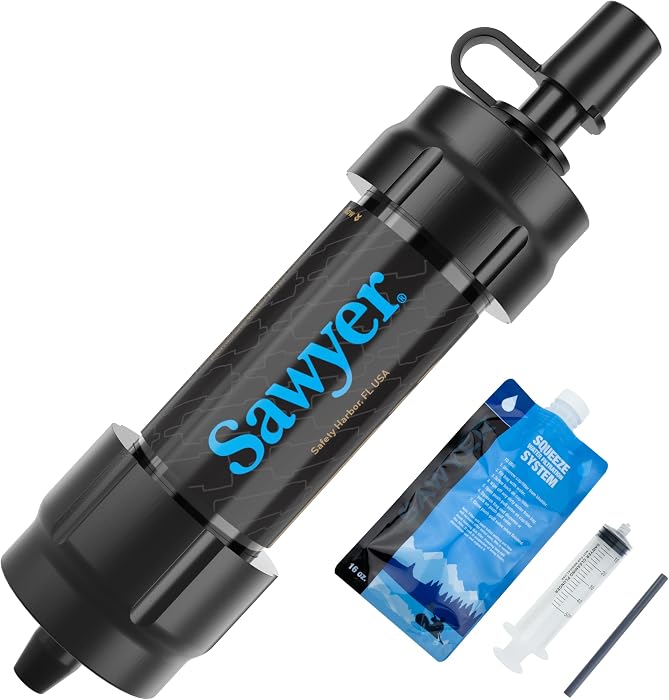
Compared with the Squeeze, the MINI is the same idea shrunk down: a 0.1-micron absolute hollow-fiber filter rated to 100,000 gallons that screws onto a 28 mm bottle, a hydration pack hose, or the 16-ounce pouch in the box. The kit also includes a short drinking straw and a cleaning plunger, and the whole thing sits in a palm.

The trade for that size shows up in filling speed. A 16-ounce pouch takes noticeably more squeezing than the Squeeze's larger bags, and the smaller body means more refills for the same dinner. What we noticed on the trail is how little thought it takes: no setup, no hoses, and a bright orange housing that is easy to find when you are digging through a pack at dusk.

As a one-person filter it is the right shape of compromise, light enough to forget and flexible enough to drink from directly or fill a bottle. For two people or for cooking water, the bigger pouches on the Squeeze are worth the extra ounces. Either way, backflush it at home before the first trip, because the first liter out of a new membrane can run cloudy.

Worth Noting

  • Smaller pouch and slower fill than the Squeeze
Our Verdict

We grab the MINI for solo trips where every ounce counts: it screws onto a standard bottle and weighs 1.6 ounces.

Check Latest Price
4

GRAYL GeoPress Best for Viruses and Travel

GRAYL GeoPress 24 oz Water Purifier & Water Filter Bottle

International travel

Field Score 95/100
Weight
15.9 oz
Removes
Viruses, bacteria, protozoa, chemicals
Capacity
24 fl oz
Cartridge Life
65 gallons (250 L)
View on Amazon

This is the priciest pick here, and the only one that combines virus removal with chemical reduction in a bottle you drink from. The cartridge uses electroadsorption and activated carbon to take out viruses, bacteria, protozoa, VOCs, PFAS, heavy metals, and the tastes that come with them. GRAYL rates a cartridge at 65 gallons, so the purifier is a consumable rather than a lifetime purchase.

Whether that coverage is worth the money depends entirely on the water you will meet. On a U.S. trail, a 0.1-micron hollow-fiber filter handles what is actually in the creek at a fraction of the weight. Below a village, a cattle pasture, or an industrial outfall, or on a trip where you will be drinking from taps you do not trust, the extra coverage stops being a luxury.

The press takes effort. You fill the outer cup, seat the inner press, and push down with your body weight; some people find it easy and some find it takes real strength, especially the first few times before the cartridge is wet. It is not a filter you can operate one-handed while holding a map.

What we appreciate is that it behaves like a bottle rather than a piece of equipment: 24 ounces you were carrying anyway, a wide mouth that fills easily from a shallow pool, and a drink spout that keeps the dirty side away from your mouth. That is the difference between a purifier you use and one that stays in the car.

Worth Noting

  • Heavy at 15.9 ounces
  • Water can escape if it rides sideways
Our Verdict

We take the GeoPress when the water might carry viruses or chemicals: it purifies a full 24 ounces in one press, and nothing else here covers that ground.

Check Latest Price
5

Survivor Filter PRO Best Pump Filter

Survivor Filter PRO Portable Water Filter for Camping

Dirty water, groups

Field Score 94/100
Weight
12.8 oz
Removes
Viruses, bacteria, protozoa, heavy metals
Flow Rate
500 ml/min
Filtration
Three-stage, 0.01 micron
View on Amazon

Three stages stack up inside a 12.8-ounce body: a 0.1-micron pre-filter, a carbon cartridge for heavy metals and chemicals, and a 0.01-micron ultra filter. Together they claim removal of viruses, bacteria, protozoa, and heavy metals, which is more than any hollow-fiber straw here can say. Survivor lists the flow at 500 milliliters a minute, and the kit includes hoses, a cup, a bag, and a backwashing syringe.

Pumping is a two-hand job: drop the inlet hose in the source, put the outlet in a bottle, and work the handle. That flexibility is the point. It fills an awkward container, a wide-mouth bottle, a cooking pot, someone else's bladder, and it pulls from water too shallow to scoop. The tubing kinks if you let it loop, so keep the hoses straight while you set up.

Where it earns its place for us is group trips and doubtful water. One person pumping keeps four bottles full, and the carbon stage does real work on taste. It is heavier than the Squeeze and slower than any gravity bag, so a solo ultralight trip is the wrong assignment.

The maintenance routine matters more here than with a straw. Pump a liter of clean water through after every trip and use the syringe to backflush; a filter that clogs on silt and stays clogged is the failure to watch for. The stages are replaceable, and that is the argument for a pump over a sealed straw.

Worth Noting

  • Heavy at 12.8 ounces for solo trips
  • Hoses kink and pumping is slow work
Our Verdict

We pump with this one when the source is genuinely doubtful: a 0.01-micron final stage, a carbon filter, and virus removal make it the most thorough setup here.

Check Latest Price
6

Waterdrop Gravity Filter Best Gravity Setup for Camp

Waterdrop Gravity Water Filter Straw

Camp and groups

Field Score 93/100
Flow Rate
700 ml/min
Filtration
0.1 micron, 5-stage
Filter Life
1,400 gallons
Bag Capacity
1.5 gallons
View on Amazon

Hanging a bag and walking away is the least work any filter here asks of you, and that is why this Waterdrop setup is the one we want at camp. The kit pairs a 1.5-gallon gravity bag with a 0.1-micron five-stage straw filter, plus a 16-ounce pouch for drinking on the move. The filter is rated to 1,400 gallons and flows at up to 700 milliliters a minute.

In practice one person fills the bag at the creek, hangs it from a branch or a strap, and opens the valve while everyone else lines up bottles. That covers dinner, dishwater, and the next morning's fill without anyone crouching in the water. Empty, the bag rolls up and the filter goes in a pocket, so it costs little space in a pack that is already full.

Flow is the variable to plan around. A clean membrane and a full bag run well, while a loaded filter or a nearly empty bag can turn a liter into a slow wait. Backflushing between trips keeps the pace where it belongs, and the carbon stage is what keeps creek water from tasting like creek.

Worth Noting

  • A full bag stays at camp, not on the trail
  • First liters can carry a plastic note
Our Verdict

We hang this one at camp and forget it: 1.5 gallons goes in at the creek and bottles come out filtered with nobody holding a pump.

Check Latest Price
7

Membrane Solutions S1

Membrane Solutions Personal Water Filter Straw S1

Certified filtration

Field Score 92/100
Filtration
0.1 micron, 5-stage
Filter Life
1,320 gallons
Filter Weight
2 oz
Certifications
NSF/ANSI 42, 372, 401
View on Amazon

Three certification numbers are the reason to look at this straw: 42 for chlorine and taste, 372 for lead-free materials, and 401 for microplastics and particulates, with a test report cited behind the claims. The membrane is 0.1 micron, the body is 7.1 inches and 2 ounces, and the end threads onto a standard 28 mm bottle.

That thread is the practical difference between this and a plain straw. Screw it onto a bottle, filter as you drink, and pass the bottle around, or use it as a straw straight from the source. The five stages include coconut-shell activated carbon, which is what handles taste and chlorine; hollow fiber on its own does neither.

Life is rated at 1,320 gallons, which puts it in the same range as the other straws here. Longevity of the housing is the open question for us: the filtration itself has held up, and the body and connections are the parts we would keep an eye on over a few seasons.

For most backpackers the simpler straw or a squeeze filter remains the easier call, since the S1 wins on paperwork rather than weight or volume. It is for the buyer who wants the certification and the bottle thread in one small object, and who would rather drink through a filter than squeeze one.

Worth Noting

  • Longevity of the housing is the open question
Our Verdict

We point certification-minded shoppers to the S1: it is the only straw here with NSF/ANSI 42, 372, and 401 behind it and a thread for a standard bottle.

Check Latest Price
8

Waterdrop Filter Straw

Waterdrop Water Filter Straw

Budget bottle filter

Field Score 91/100
Flow Rate
700 ml/min
Filtration
0.1 micron, 5-stage
Connections
Threads to bags and bottles
Filter Life
1,400 gallons
View on Amazon

Both ends come apart and thread onto a water bag or a bottle, which is more connection than most straws here offer. Inside is a five-stage setup: a 0.1-micron ultrafiltration membrane plus coconut-shell carbon, rated to 1,400 gallons and up to 700 milliliters a minute.

The carbon stage is the part that earns its keep on taste, and the backwash function means you can push clean water back through the membrane in the field instead of waiting until you get home. For a filter this small, that is the right set of features.

It is the same filter family as Waterdrop's gravity bag in a much smaller shape. The bag is for a camp and a group; the straw is for a bottle and one person. For a day hike, or a trip where you already carry a bottle with standard threads, the straw is the lighter half of that pair.

Cheapest of the threaded, carbon-filtered options here, and the one we hand to somebody building a first daypack kit. It will not replace a squeeze filter on a two-person trip, and it is not trying to.

Worth Noting

  • Flow tapers as the cartridge loads
  • Stated 12-month shelf life limits stashing it
Our Verdict

We like this one as a first kit filter: a threaded, carbon-filtered straw for about as little money as anything here, with a shelf life to check first.

Check Latest Price

How We Chose and Tested Backpacking Water Filters

To build the shortlist, I started with a couple dozen filters recommended by thru-hikers, guides, and shop staff, then narrowed by filtration type, packed weight, how each one connects to a bottle, bladder, or pouch, and price — from pocket-size straws up to press-style bottles and gravity setups with their own reservoir. We bought 12 of them and used them the way they're meant to be used, not on a countertop.

Weight came first: every filter went on a kitchen scale dry, then again soaked, since a wet filter and its pouch are heavier than the number on the box. Next we filled one-liter bottles from a silty creek and a slow-moving pond, timing how long each took and how much hand effort it demanded — squeezing, pressing, pumping, or just hanging a bag and waiting.

Every connection got a leak test: we threaded each filter onto bottles and bladders, filled them, and laid them on their sides inside a pack next to a dry shirt for an hour. We refilled with cold, tired hands at the end of a hiking day, which is when threads cross and pouches get over-squeezed. Flow rate was checked at the start and again after six months of dirty water to see which models clogged, and we dropped and stuffed bags and housings to watch for cracks.

The filters that survived went on day hikes, quick overnights, and a two-night weekend trip in the rain. Anything that leaked, split, or lost its flow quietly fell off the list.

How to Choose a Backpacking Water Filter

Start With How You Collect Water

A straw is the lightest thing that works and the least useful once you stop moving, because it drinks from the source and fills nothing. A squeeze filter turns a bag of creek water into bottles, which is what most backpackers need. A pump works from water too shallow to scoop and fills any container, at the cost of effort. A gravity bag is the least work for a group at camp and the most weight in a pack.

Decide by your evening rather than your morning. If you cook, refill bottles for the next day, and camp away from water, you need something that fills containers. If you drink at a stream you happen to walk past and keep going, a straw is enough.

Know What a Hollow-Fiber Filter Will Not Remove

Almost everything here relies on a hollow-fiber membrane with pores around 0.1 to 0.2 microns, which catches bacteria and protozoa and lets water pass. Viruses are smaller, and dissolved chemicals, pesticides, and heavy metals go straight through. Purifiers that add carbon or electroadsorption, like the GRAYL GeoPress and the Survivor Filter PRO, claim that extra coverage.

For a U.S. or Canadian backcountry trip, hollow fiber is the standard and the weight savings are real. For travel, or for water downstream of villages, livestock, or industry, pay for the purifier.

Weigh the Whole System, Not the Filter

A liter of water weighs about 2.2 pounds, so the filter that lets you refill twice a day saves more weight than it adds. The gap between a 1.6-ounce straw and a 16-ounce purifier is roughly half a liter of water. What we look at instead is the container, because soft bags and pouches fail at seams, corners, and cap threads long before a membrane does.

Carry one hard-sided 28 mm bottle as a backup and choose a filter that threads onto it. It is the cheapest insurance in this category.

Plan for Cold, Storage, and Shelf Life

A wet hollow-fiber membrane that freezes can crack, and a cracked filter looks perfectly fine and stops working. On subfreezing nights, keep it in a jacket pocket or inside the sleeping bag, and let it dry fully before it goes into storage.

Shelf life varies more than you might expect: one straw here states 12 months, while others give no expiration at all. If you are buying for a go-bag, read that line before you commit, and store the filter dry and out of the sun.

Frequently Asked Questions

Final Verdict

Most backpackers should buy the Sawyer Squeeze. It fills bottles, hangs as a gravity system at camp, and goes inline on a hydration pack, all from a 2.5-ounce filter rated to 100,000 gallons, and the pouches are the only part you will replace.

If your water might carry viruses or chemicals, whether on international travel, through farmland, or below a village, the GRAYL GeoPress is worth the extra weight. Everyone else can add a 1.62-ounce LifeStraw to the pack as the backup that needs no bottle at all.