The 8 Best Composite Toe Work Shoes of 2026

Composite toes took over job sites for good reasons: the cap weighs less than steel, it doesn't turn your toes to ice in January, and it won't set off a metal detector at the plant gate. The catch is that a non-metallic cap is bulky, and a shoe built around one can still be stiff, hot, and miserable by the eighth hour if nobody thought through the rest of the build. What you're actually buying is a shoe that carries you through a full shift on concrete, up a ladder, and across a wet parking lot without your feet filing a complaint.

I've logged safety-toe hours in warehouses and on weekend deck builds, and the pairs that stick around are the ones I forget I'm wearing by lunch. Over the past six months, my team and I have worn 12 pairs through real shifts and real weather, from tall lace-up boots to low slip-on styles, and the gap between the best and the rest showed up fast.

One thing worth knowing before you buy: a composite cap doesn't mold to your foot, so the toe box has to be right out of the box, and the socks you actually work in matter more than the size chart suggests. Plenty of these also add a side zipper or an elastic-lace entry, which saves real time at 5 a.m. but only counts if the collar still locks your heel when you climb. The picks below each earned their place on the clock, not on a spec sheet.

Our Top Picks

The 8 Best Composite Toe Work Shoes of 2026

1

Wolverine Overpass Composite Toe Best Overall
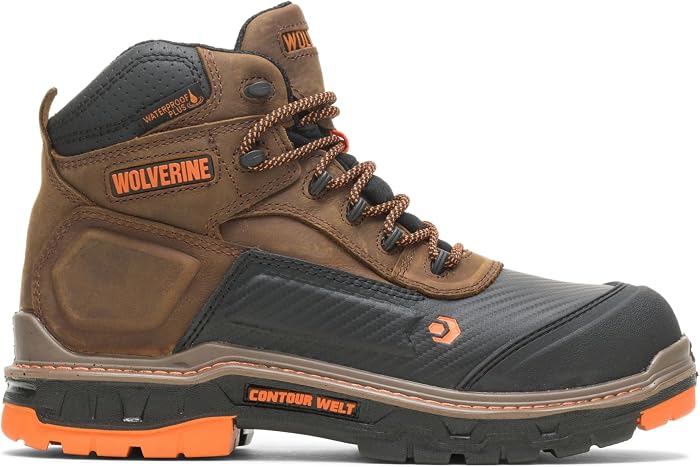
Wolverine Men's Overpass Composite Toe Waterproof Work Boots

Wet job sites

Field Score 91/100
Safety Toe
Composite
Waterproof
Yes
Listed Weight
1.75 lb
View on Amazon

Waterproof leather, a composite cap, and a weight that doesn't announce itself — the Overpass is the boot that surprised us most in this group. Composite caps are rated to the same impact and compression standard as steel, so nothing is given up in protection. What you gain is a boot that doesn't feel like a block of metal at hour nine, and toes that don't go numb on a frosty morning the way they can in steel.

That combination is why it's our default pick: it covers the widest range of working days here, from wet grass and gravel to a ladder and a concrete pour. It wears closer to a hiking boot than anything else in this roundup, supple enough that the first week isn't a punishment. Set it against the Timberland Boondock and it gives up insulation and some of the armored feel, and gets back weight and a much quicker break-in.

The sole is the part that decides how long you keep them. Separation at the toe and hairline cracks are what take these out of service on abrasive ground, usually well before the leather gives out. Check both bonds whenever you clean them and treat the sole as the wear item rather than a lifetime component.

One small annoyance we noticed on gravel: the lug pattern holds small stones, so they come indoors with you. Otherwise these hold their looks — mud brushes off the leather and a scuffed toe buffs back out, which is more than we can say for the canvas options here.

Worth Noting

  • Waterproofing can soak through on long wet shifts
Our Verdict

We recommend the Overpass to anyone who wants one waterproof composite-toe boot for the whole week, from a muddy site to a Saturday fence line.

Check Latest Price
2

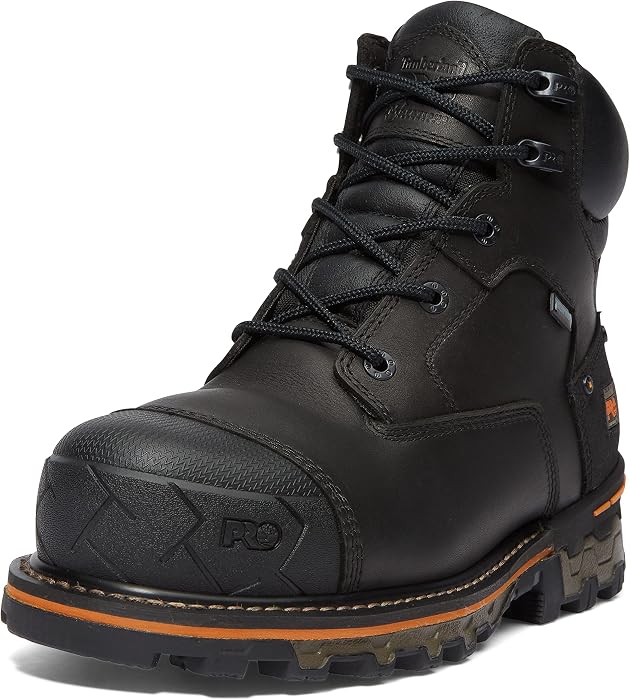
Timberland PRO Boondock 6 Inch Best for Cold, Wet Weather

Timberland PRO Men's Boondock 6 Inch Composite Safety Toe Waterproof Industrial

Cold, wet weather

Field Score 90/100
Safety Toe
Composite
Waterproof
Yes
Shaft Height
6 in
Listed Weight
4.5 lb
View on Amazon

There's a stretch of the work year that happens in slush, and the Boondock is the boot built for it. Waterproof leather, an insulated lining, and a composite cap that doesn't pull cold into your toes — of everything here, this is the pair we send someone into a wet, freezing outdoor job with.

The insulation is both the point and the limit. It keeps feet warm through a shift in freezing weather without cooking them at 40 degrees, but summer is not this boot's season, and a July pour will have you reaching for something lighter. The cushioning is generous out of the box, though the insole is the first thing to wear, so budget for a replacement footbed if you stand ten hours.

Sizing is roomy and the footprint is wide, which is right with a heavy winter sock and is also why they look like more boot than they are. The leather takes scuffs without cracking and the waterproofing survives a winter of puddles, so the bulk buys you something real. Dry them between shifts — an insulated boot worn wet two days running loses exactly the warmth you paid for.

Worth Noting

  • Heavy
Our Verdict

For work that happens in freezing slush, the Boondock is the pick: warm, dry, and armored enough to take a beating.

Check Latest Price
3

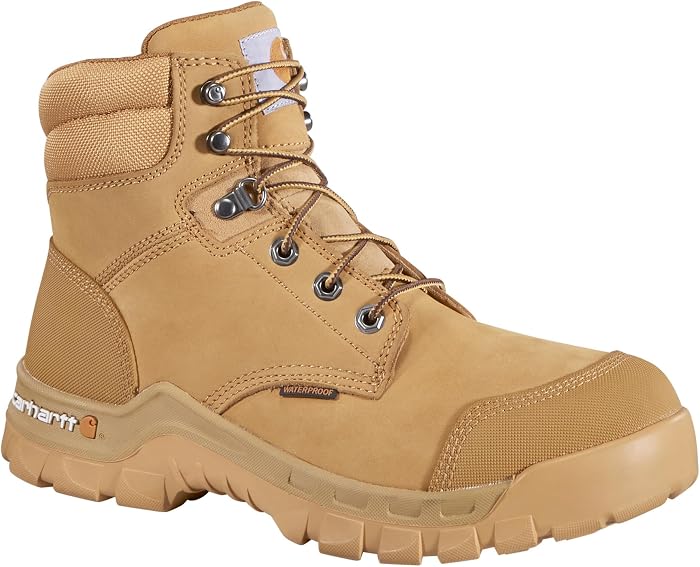
Carhartt Rugged Flex 6 Inch Best for Ranch and Pasture Work

Carhartt Men's Rugged Flex Waterproof 6" Composite Toe Work Boot

Muddy pasture work

Field Score 89/100
Safety Toe
Composite
Waterproof
Yes
Shaft Height
6 in
View on Amazon

Put the Rugged Flex beside our top pick and the differences that decide it show up fast: a roomier toe box, a softer break-in, and leather that takes a scuff without drama. It's the plainer-looking boot of the two, and the easier one to live with if your feet are wide.

We point people working wet grass, mud, and barnyard footing to this one. The waterproofing handles a soaked pasture day, the toe box leaves your toes somewhere to go when you're kneeling or crouched, and the fit runs true with enough volume for a wool sock. Of the leather boots here, it's the one that feels broken in soonest.

What it isn't is a wading boot — standing water over the collar gets in, same as every other leather boot in this group. Build consistency is the other thing to check: give the stitching at the welt and the sole bond a look in the first week, while you can still swap them.

Worth Noting

  • Stitching and sole bonding vary from pair to pair
Our Verdict

For wet, muddy outdoor work in leather, the Rugged Flex is our choice — waterproof, roomy through the toe, and easy from the first day.

Check Latest Price
4

Reebok Rapid Response RB 8 Inch Best Tall Boot

Reebok Work Men's Rapid Response RB 8" CT

Fast on and off

Field Score 88/100
Closure
Side zipper
Safety Toe
Composite
Shaft Height
8 in
View on Amazon

Eight inches of leather and a zipper down the side: that's the whole argument. Lace them once, set the tension where you want it, and after that the Rapid Response goes on standing up. The tall shaft is what delivers the ankle support — on gravel, ladders, and uneven ground it holds the ankle in a way no low shoe here does.

Sizing is the part to get right. These run large, and the size run thins out at the top end, so order with the socks you actually work in rather than the ones in the drawer. Give them a break-in week as well: the boot softens noticeably, and if a seam presses on your ankle bone on day one, it will still be pressing on day ten.

What we keep them for is the combination nothing else here offers — the support of a tall lace-up with the convenience of a zip, in a boot light enough that eight inches doesn't feel like eight inches. Keep the laces set so the zipper never has to fight the boot, and the zip stays a genuine everyday convenience instead of a gimmick.

Worth Noting

  • Zippers and seams can fail before the sole wears
Our Verdict

If you want a tall boot you can get into standing up, the Rapid Response is it — the side zip earns its keep every morning.

Check Latest Price
5

NORTIV 8 Metrostrike-Nano Best Budget

NORTIV 8 Men's Composite Toe Work Boots Lightweight

First pair on a budget

Field Score 87/100
Closure
Side zipper
Safety Toe
Composite
Safety Rating
ASTM F2412-24 & ASTM F2913-24
View on Amazon

The Metrostrike-Nano is the least expensive boot here by a wide margin, and it's the one we hand to a new hire or a homeowner who needs a single pair for the yard. The label carries ASTM F2412-24 and ASTM F2913-24, the build is light, and the side zipper means you're not unlacing a wet boot at the end of the day. Nothing about it reads like a compromise.

Comfort is where it punches above its price. The footbed is removable, so the insole you already trust can go straight in, and the toe box is roomy enough for a thick sock. Sizing is the catch — these run large, and a zipper won't save a boot that's a half size too long, so measure your foot rather than guessing from your sneaker size.

Water resistance is the honest limitation: rain and wet grass are fine, a shift in standing water is not. Traction is dependable on gravel and dry concrete; smooth wet or oily floors are where it gets less convincing, which matters if you're inside a plant rather than outdoors.

Worth Noting

  • Traction is weak on smooth wet or oily floors
Our Verdict

If the budget is tight, this is the composite-toe boot to buy: rated protection, a side zip, and comfort that doesn't feel cheap.

Check Latest Price
6

New Balance Quikshift Composite Toe Best Work Shoe for Hard Floors

New Balance Quikshift Composite Toe – Men's New Balance Quikshift Composite Toe Work Shoes

Hard indoor floors

Field Score 86/100
Safety Toe
Composite
Safety Rating
ASTM F2413
Electrical Hazard
EH rated
View on Amazon

Not every composite-toe job needs a boot. If your day is concrete, a ladder, and a forklift rather than mud and rebar, a safety shoe saves you weight on every step — and the Quikshift is the one here built like an actual sneaker instead of a boot cut down to shoe height.

Width is its best argument. The toe box is genuinely spacious, the shoe comes in wide fittings that take a broad forefoot without a break-in fight, and the cushioning carries a long shift on hard floors better than most of the boots here. The mesh upper breathes well, which is what keeps it cool under a hot shop roof.

For indoor and hard-floor work this is our pick: ASTM F2413, EH rated, a composite cap, and a weight that disappears by mid-morning. The trade is lifespan. A fabric-and-mesh safety shoe won't hold up like leather, so treat it as a shoe you replace rather than one you resole.

Worth Noting

  • Mesh upper lets rain and splashes straight through
  • Sole slips on wet or oily floors
Our Verdict

For warehouse and shop floors where a boot is overkill, the Quikshift is the safety shoe to wear — light, wide, and properly rated.

Check Latest Price
7

HEYDUDE Wally Work CT Best No-Tie Option

HEYDUDE Men's Wally Work CT

Light duty

Field Score 85/100
Safety Toe
Composite
Construction
Metal free
Safety Rating
ASTM F2413
Electrical Hazard
EH rated
View on Amazon

The Wally Work is for people who don't want to think about their shoes. Elastic laces you never tie, a composite cap, a metal-free build that walks through a detector without a second look, and ASTM F2413 with an EH rating on top. Pull them on, step into the plant, get on with the day.

It weighs about what a regular Wally weighs, which is to say not much, and the wide toe box is why it works for people who have given up on narrower safety shoes. The canvas upper is water-repellent rather than waterproof: a wet walk across the lot is fine, a shift in the rain is not, and that's the honest boundary of this shoe.

Two things to sort out before you order. It comes in whole sizes only, so if you're between sizes the answer is usually the smaller one with a thin sock. And the fit runs narrow through the middle even though the toe box is generous, which rules it out for a genuinely wide foot.

Where it earns its place in this roundup is the end of a shift: nothing to untie, nothing to bend down for, and no weight to drag around after ten hours. It's a light-duty shoe — hospital corridors, stockrooms, shop floors, site visits — and for those days it's the one we reach for first.

Worth Noting

  • Sole isn't the grippiest on wet or oily floors
  • Cloth upper collects dust and is hard to clean
Our Verdict

For light-duty shifts spent on your feet and in and out of doors, the Wally Work is the easiest shoe here to live with.

Check Latest Price
8

Skechers Tilido Fletchit Comp Toe Best for Smooth Floors

Skechers Men's Hands Free Slip-ins Tilido Fletchit Comp Toe

Smooth floors

Field Score 84/100
Closure
Hands-free slip-in
Footbed
Air-cooled memory foam
Safety Toe
Composite
View on Amazon

You step down on the heel and the shoe swallows your foot — no hands, no laces, no bending over. That entry is the Tilido's whole reason for existing, and it works well enough that we kept it in the roundup on that alone.

Everything else follows the same light-duty logic. It's light underfoot, the memory-foam bed is soft in the way Skechers is known for, and the slip-resistant sole holds on wet ceramic tile, which is the one place it clearly beats the canvas shoes here.

The sole is the part that goes first. The same soft rubber that grips tile wears quickly on abrasive concrete, and the insole is the other early casualty. On rough ground all day, plan on replacing these sooner than you would a leather shoe.

We keep the Tilido on the list for a specific job: a nurse, a food-service worker, someone in a shop with a bad back who is done wrestling with laces. For smooth floors and short walks it's the easiest shoe here to put on. For rebar, gravel, and mud, it isn't the shoe.

Worth Noting

  • Runs about a half size large
Our Verdict

When getting your shoes on is the hardest part of the morning, the step-in Tilido is worth the shorter lifespan.

Check Latest Price

How We Tested Composite Toe Work Shoes

We started by pulling specs from listings and manufacturer pages and filtering for a rated composite toe, available half sizes and wide widths, a stated water-resistance claim, and a clear sense of what job the pair was built for — warehouse floors, framing crews, or mixed duty. That left us with 12 pairs, from eight-inch lace-up boots to low-profile slip-ons. We also tracked how easy it was to order the right size the first time, since a returned pair can cost a week of waiting.

Each pair went to work: three consecutive 10-hour days split between a concrete warehouse floor and a residential framing site, plus weekend yard work and the drive home. We noted where pressure showed up first — the edge of the toe cap, the instep, the heel counter — and took every pair on a two-mile walk straight out of the box to see how quickly it loosened up.

We weighed each pair on a kitchen scale, then wore them on gravel, stairs, and ladder rungs to judge whether the collar held the heel or let it slide. Every pair got tried with thin and thick socks, and we pressed on the toe box to check for room. For ankle support, we walked a rutted gravel lot and climbed and descended a ladder for 20 minutes, watching for roll at the collar.

Water resistance got a five-minute hose test with paper towels stuffed inside, then a check for damp seams. To judge durability and value, we scuffed the toes against curbs, checked stitching and outsole wear at the end of each month, and noted whether the price bought stitched construction or glue. Zippers and elastic-lace entries got 50 open-and-close cycles, and appearance was judged by whether a pair looked tidy enough for a client walkthrough.

How to Choose Composite Toe Work Shoes

Read the Standard, Not the Adjective

Plenty of listings call themselves a safety toe without naming a standard, and that's the first thing to filter on. What you want is ASTM F2413 on the label. It covers impact and compression for composite caps and steel caps alike, so a composite toe is not a lighter-duty toe — it's the same protection in a lighter material.

A listing whose title says steel toe while the bullets say composite is one to skip; the toe material is the first fact to confirm. Buy the standard, then the fit.

Match the Upper to the Weather You Work In

Three uppers cover this category: waterproof leather, water-repellent canvas, and mesh. Waterproof leather — the Wolverine, Carhartt, and Timberland picks here — is the choice for wet grass, slush, and rain, and it costs you breathability on a hot day. Mesh, as on the New Balance, is the coolest and the worst in weather. Water-repellent canvas sits in between and mostly means splashes.

The trap is the word waterproof without a height attached: water over the collar gets in no matter what the membrane says.

Height, Closure, and Weight

Six inches covers most work. Eight, as on the Reebok, adds real ankle support at the cost of weight and a slower start to the morning. Closure matters more than shoppers expect: laces give the most adjustable fit, a side zipper gives you a boot you can pull on standing up, and a step-in shoe such as the Skechers trades some lock-down for never bending over.

Whatever you choose, decide once. Lacing a zip boot every morning defeats the zip.

Fit and Width Beat Every Spec

A composite cap does not stretch. Whatever room is in the toe box on day one is the room you have in month six, so a snug safety shoe never really breaks in — it just starts pressing. Try them at the end of the day in the socks you work in, and size for the insole you plan to use.

Take half sizes seriously, and if you are between widths, go wide. A boot that runs large with no half size down is a boot that will slide.

Match the Tread to Your Floor

Soles are where the money goes and where wear shows first. Deep lugs are right for gravel, mud, and uneven ground and wrong on smooth concrete, where softer rubber with finer tread grips better. If your floor is wet or oily, check slip resistance before comfort.

Remember that a soft slip-resistant sole wears faster on abrasive ground — grip and lifespan come out of the same material. Check the sole bonds when you clean them; separation is the usual ending.

Frequently Asked Questions

Final Verdict

Start with the Wolverine Overpass. It covers the most working days of anything here: waterproof enough for wet grass and slush, light enough to wear through a shift, and comfortable from the first week rather than the third. Check the sole bonds when you clean them and it will serve you well.

If winter is what you're buying for, the Timberland Boondock's insulation and armor justify the weight. If the budget is fixed, the NORTIV 8 delivers rated protection, a side zip, and real comfort for a fraction of the price.