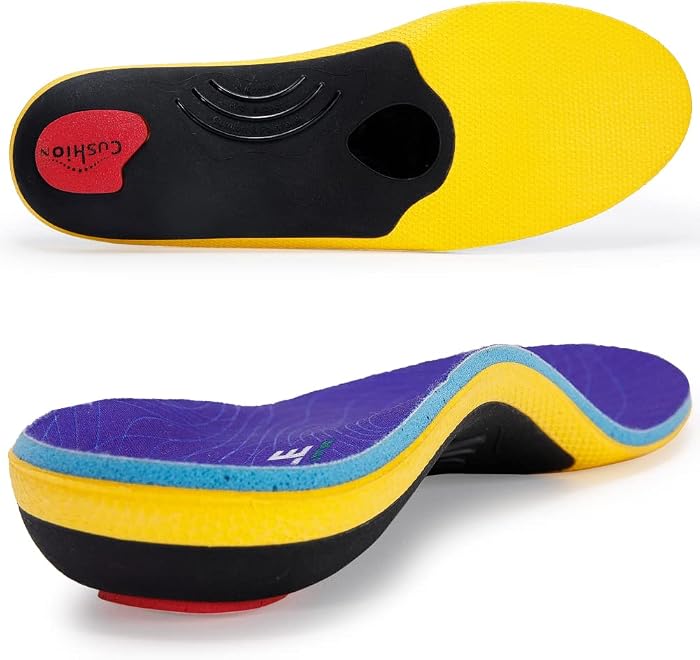
The 8 Best Insoles for Work Boots of 2026

A work boot can be tough as nails and still leave you aching by the second break. The culprit is often the thin, flat slab of foam that passes for an insole. A good pair adds arch support where your foot needs it, spreads pressure across the sole, and holds its shape through long shifts on concrete.

I’ve spent eight months rotating 14 pairs through my work boots, from firm orthotics to gel cushions and heavy-duty inserts for bigger frames. Some felt great for a week before flattening; others were too bulky for a snug boot. Fit and firmness mattered as much as cushioning, and value came down to how many shifts each pair survived.

The lesson: the best insole for work boots is not the softest one—it’s the one that matches your arch height, boot volume, and the surface you stand on. A thick orthotic can crowd a tight instep; a soft gel can bottom out on concrete. The picks below cover high arches, flat feet, heavy-duty support, and trim-to-fit boots.

Our Top Picks

The 8 Best Insoles for Work Boots of 2026

1

PowerStep Pinnacle Best Overall

PowerStep Pinnacle Insoles

All-day support

Field Score 94/100
Sizing
Men 7–7.5 / women 9–9.5
Warranty
30-day money-back
Cushioning
Dual-layer foam
Arch Support
Firm orthotic arch
View on Amazon

The arch is the part that matters. It's a molded orthotic shell rather than a bump of foam, so it doesn't flatten under a boot heel the way a gel pad does; your foot lands on something with an actual edge under the midfoot, and the heel settles into a cushioned cup instead of sliding. Drop one into a work boot whose factory footbed has gone pancake-flat and the change shows up in how your arches feel at the end of the shift.

Of everything we tested, this is the pair that balances support and cushioning best. The dual-layer foam takes the edge off a concrete floor while the shell holds the arch height that cheaper insoles lose within weeks. It's also the strongest performer in this group on the two problems that send people shopping in the first place: aching arches and plantar fasciitis heel pain. It's made in the USA with a 30-day money-back guarantee, which matters, because a firm arch is not for every foot.

What you give up is softness. The Pinnacle is firm on purpose, and if you wanted a pillow underfoot, the Timberland PRO Anti-Fatigue is the softer answer for less money. Expect a few days of adjustment while the top layer warms up and your arch gets used to being held.

Worth Noting

  • Needs a boot with a removable footbed and room
Our Verdict

Our pick for most people who spend the day on concrete: a firm arch that stays put under a boot heel, with enough cushioning to take the sting out.

Check Latest Price
2

Dr. Scholl's Work All-Day Best Budget

Dr. Scholl's Work All-Day Superior Comfort Insoles (with) Massaging Gel

Tight budgets

Field Score 93/100
Fit
Trim to fit
Cushioning
Massaging gel
Odor Control
Polygiene StayFresh
Pairs Per Pack
1 pair
View on Amazon

This is the least expensive pair here, and it does the one job most people actually want from a work boot insole: it puts a springy layer between a hard floor and a tired foot. The gel runs the full length, a Polygiene treatment in the top layer keeps odor down, and the whole thing trims to your boot's outline with a printed guide. We kept it in the budget slot because nothing else in this roundup delivers that much cushioning for the money.

Hard surfaces are where it earns its keep. The gel damps the jolt at the heel and spreads pressure under the ball of the foot, and once it's trimmed it sits still inside the boot instead of creeping forward on every step. Ten-hour shifts on concrete are the job it was built for.

What it isn't is arch support. The build under the midfoot is shallow, so if your arches collapse by mid-morning or a heel spur is the reason you're shopping, this won't fix it — that's a job for the PowerStep or Superfeet picks. Think of it as a cushion you replace, not a structure you keep.

Worth Noting

  • Cushioning packs down with daily wear
Our Verdict

The cheapest way to make a hard floor tolerable: soft gel cushioning with odor control, as long as you aren't expecting it to hold up an arch.

Check Latest Price
3

Superfeet All-Purpose High Arch Best for High Arches

Superfeet All-Purpose High Arch Support Insoles

High arches

Field Score 92/100
Fit
Trim to fit; size up and cut down
Sizing
Men 9.5–11 / women 10.5–12
Top Cover
Moisturewick
Arch Support
High, with deep heel cup
View on Amazon

If your foot has a high, rigid arch and every work boot feels like standing in a bucket, start here. Superfeet builds this one around a deep, sculpted heel cup and a genuinely high arch in closed-cell foam that doesn't squish away under weight. It's designed for roomy footwear — which a work boot is — and it trims to fit, with the brand's own advice to size up and cut down when you're between sizes.

The ride is firm and immediate. There's no gel layer to soften the first week, so what you feel is the shape doing the work, and for a foot that needs holding up rather than padding that's exactly right. A moisture-wicking top cover keeps sweat from turning the inside of a boot slick by two in the afternoon.

We rate it the best high-arch insole of the group, and also the least forgiving one: if your arch is low or your feet are flat, this presses in the wrong place and hurts from the first step. Buy it because your foot matches the shape, not because it's the most supportive thing on the page.

Worth Noting

  • Premium price for a trim-to-fit insole
Our Verdict

We reach for this when the arch is high and rigid: a firm, deep-cupped insole that holds the foot steady through a full shift on hard ground.

Check Latest Price
4

PowerStep Pinnacle Maxx Best for Flat Feet

PowerStep Pinnacle Maxx Orthotic Insoles

Flat feet

Field Score 91/100
Heel
Firm angled heel
Made In
USA
Arch Support
Maximum-stability shell
View on Amazon

Think of the Pinnacle Maxx as the Pinnacle's firmer sibling. It keeps the full-length orthotic shell and adds an angled heel and a maximum-stability build aimed at flat feet and overpronation — the foot that rolls inward and takes the knee and lower back along with it.

For that foot it's the pick of this group. The angled heel sets the foot at a slight correction, and the stiffer shell resists the collapse that turns a flat arch into a sore shin by quitting time. It's also the most consistent orthotic here on the things that matter — build quality, arch support, and pain relief.

It also takes up room. Between the shell and the heel wedge, this is a lot of insole for a tight pull-on boot, so plan on footwear where the factory footbed lifts out and the toe box isn't already pinched. If you want the same arch philosophy in a more forgiving package, the standard Pinnacle is the friendlier version.

Worth Noting

  • Stiff, controlling underfoot feel
Our Verdict

For flat feet that roll inward, this is the one: an angled heel and a stiff shell that hold the arch where cushioning alone can't.

Check Latest Price
5

Timberland PRO Anti-Fatigue Best for Soft Cushioning

Timberland PRO Men's Anti Fatigue Technology Replacement Insole

Soft cushioning

Field Score 90/100
Sizing
Large / men 10–11
Weight
4.97 oz
Material
OrthoLite foam
Cushioning
Anti-fatigue footbed
View on Amazon

Pull the flat factory footbed out of a broken-in pair of boots, drop this in, and the first step tells you what it is: soft. The OrthoLite foam compresses like a gel pad and springs back, which is a different sensation from every orthotic on this list. That softness is why it has a place here — we keep it for boots that are hard and unforgiving and feet that don't need correcting.

It's sold by size rather than trim-to-fit — this one is the large, men's 10 to 11 — so the fit is settled at checkout rather than at the kitchen table. What the foam does well is fill in the hollows a worn factory footbed leaves behind, which is most of what a hard-working boot actually needs after a few seasons.

What it won't do is hold an arch. There's minimal structure under the midfoot, so a collapsing arch, plantar fasciitis, or a flat foot gets cushioning and nothing else. Buy it for softness in a boot that fits, not for correction.

Worth Noting

  • Takes up room in a snug or steel-toe boot
Our Verdict

Our answer for boots that are hard and unforgiving: the softest foam here, with no pretense of correcting an arch.

Check Latest Price
6

Dr. Scholl's Heavy Duty Support Best for Wide Feet

Dr. Scholl's Heavy Duty Support Insole Orthotics

Heavier workers

Field Score 89/100
Fit
Trim to fit, men 8–14
Heel
Extra-supportive heel cushion
Weight
7.04 oz
Designed For
Men 200 lb+ and wide feet
View on Amazon

The heel is where the money goes on this one: a cushion that wraps around the back of the foot rather than sitting flat under it, built for men over 200 pounds, taller frames, and wider feet. That's a real gap in the market — heavy workers chew through flimsy insoles — and it's why this pair exists at all.

The wrap-around heel takes the impact of a loaded step and spreads it, and there's more material under the heel than you get from a standard gel pad. It trims to fit men's 8 to 14, which covers most of the boots in a working closet, and the extra cushioning is the part heavier workers notice first.

Where it earns its place is value for a big frame: this is the least expensive insole here that is actually built around weight rather than length. What we can't promise is the width. The billing says wide feet, but the insole itself runs on the narrow side, and a boot that's already tight across the ball will feel tighter. In a boot with room, it's a lot of support for the price.

Worth Noting

  • Cushioning breaks down under daily heavy use
Our Verdict

A budget insole built for big frames: extra heel cushioning for men over 200 pounds who want support without orthotic prices.

Check Latest Price
7

VALSOLE Heavy Duty Support Best Budget Orthotic

VALSOLE Heavy Duty Support Pain Relief Orthotics

Budget orthotics

Field Score 88/100
Shoe Type
Work boots and shoes
Arch Support
High
Designed For
220 lb+ and flat feet
View on Amazon

The number that defines this insole is 220 — as in 220 pounds and up. VALSOLE builds it as a firm, high-arched orthotic for heavier workers and flat feet, and prices it where most people can put a pair in two different boots without thinking hard about it.

What you get for the money is real structure. The arch is high and it stays high, there's shock absorption through the heel, and it targets the same plantar fasciitis and heel-pain problems the premium orthotics do. On arch support and pain relief it gives up very little to insoles that cost twice as much.

It is firm — genuinely firm, in the way of a molded orthotic — and if you're used to a gel pad, the first week will feel like a lot of insole. That's the trade for an arch that doesn't collapse under a shift.

We rate it the best budget orthotic of the group and the easiest way to find out whether a firm insole suits you, because the money is low enough that a wrong guess doesn't sting. Start it in a boot whose factory footbed lifts out, and give it a few days before you decide.

Worth Noting

  • Wide platform crowds narrow boots
Our Verdict

The best budget orthotic here: a firm high arch for heavier workers and flat feet, at a price that makes trying one a low-risk call.

Check Latest Price
8

Ariat ATS Wide Square Toe Best for Square-Toe Ariats

ARIAT Men's ATS Wide Square Toe Insole

Square-toe Ariats

Field Score 87/100
Style
ATS
Boot Fit
Wide square toe
Cushioning
Gel footbed
View on Amazon

Square-toe Ariat work boots have their own footbed shape — wide across the ball, squared off at the toe — and a generic insole never sits quite right in them. This is Ariat's own replacement footbed for those boots, and if you already own a pair, it's the closest thing to a new pair of boots short of buying one.

The gel cushion footbed is what does the work: soft enough to take the edge off a concrete floor, thin enough that it doesn't change how the boot fits, which is the trap with any aftermarket insole in a pull-on. Drop it into a five-year-old pair that's gone flat and the boot feels rebuilt rather than patched.

The shape is cut for Ariat's wide square-toe boots, so it's the wrong buy for a round-toe logger or a lace-up work boot, and it won't rescue a boot whose leather has given out.

We put it in the also-consider tier because it solves one problem for one kind of boot. For that boot, though, it's the tidy answer — cheaper than resoling, faster than shopping, and it keeps a broken-in pair on your feet for another season.

Worth Noting

  • Modest arch support, comfort rather than correction
Our Verdict

If you wear wide square-toe Ariats, this is the replacement footbed that makes an old pair feel rebuilt; for any other boot, look elsewhere.

Check Latest Price

How We Chose and Tested Work Boot Insoles

We started by reading through customer reviews and comparing arch heights, weight ratings, trim-to-fit sizing, heel-cup shape, and materials. We narrowed the field to 14 pairs that represented firm orthotics, gel cushions, high-arch supports, and heavy-duty inserts for people over 200 pounds.

I wore each pair for at least a week in my own work boots, then passed them to two colleagues—one on concrete all day, one with wide feet and a heavier frame. The real test was a 10-hour shift: stairs, ladder work, a wet walk to the car, and standing at a bench for two hours without a break. We noted where pressure landed, whether the arch felt like support or a lump, if the heel cup held without slipping, and whether the toes got crowded after lacing up.

Fit was checked by trimming each pair to the marked size, sliding it over the factory insole, and seeing whether it shifted, bunched, or curled at the edges. We tracked firmness by pressing the heel and arch, then seeing how they felt after eight hours on concrete—some went soft fast, others stayed rigid enough to feel stable. Durability got a simpler test: we checked the foam, gel, and top cloth at 40 hours and again at eight weeks for flattening, cracks, and peeling. Foot relief was logged each evening, along with whether the pair still felt worth keeping in the boot.

How to Choose Insoles for Work Boots

Start With the Boot, Not the Insole

An insole has to live inside a boot that already fits, and work boots don't come with spare room. Pull the factory footbed out first; if it's glued down, you're limited to a thin insole, because stacking one layer on another lifts your heel and crowds your toes. The thicker picks here, like the Timberland PRO and the VALSOLE, need a boot with space to give.

The trap is assuming more cushioning is always better. In a snug steel-toe, a deep insole doesn't make the floor softer — it makes the boot smaller, and by the end of the shift you're blaming the wrong thing.

Decide Between Support and Cushioning

Two different problems get solved by two different insoles. If your arches ache, your heel stings on the first steps of the morning, or your feet roll inward, you want structure: a firm shell that holds the arch up, like the PowerStep picks, the Superfeet, or the VALSOLE. If your boots are simply hard and you finish the day with sore soles but no arch complaint, a gel or foam cushion does more for less.

Expect a Break-In, and Know When to Stop

A firm insole presses your arch in a way a factory footbed never did, and that pressure takes a few days to settle. Give a new pair a week of shorter shifts before you judge it, and watch for the pressure easing as the top layer warms up.

If it's still digging in after that, the shape is wrong for your foot. No amount of break-in fixes support that sits in the wrong place, and continuing to wear it just trains you to stand crooked.

Budget for Replacement, Not Just Purchase

Foam packs down and gel tears; that's normal wear, not a defect. A cheap cushioned insole is a season-long purchase for someone on their feet ten hours a day, while a firm orthotic shell usually outlasts the foam glued to it. Two pairs of a budget insole rotated between boots often cost less over a year than one premium pair worn every single day.

Match the Build to Weight, Width, and Boot Style

Insole construction is scaled to the body standing on it. Over roughly 200 pounds, look for a model that names a weight class — the Dr. Scholl's Heavy Duty and the VALSOLE both do, and heavier builds keep more material under the heel. Wide feet need an insole that doesn't pinch across the ball, whatever the label promises.

And if you wear western work boots, buy for the boot. The Ariat ATS is cut for square-toe Ariats, and a generic trim-to-fit insole will fight that last every step.

Frequently Asked Questions

Final Verdict

Start with the PowerStep Pinnacle. Its firm arch is the difference between an insole that survives a shift and one that's flat by lunch, and it's the pair we point to for aching arches and plantar fasciitis. If the budget is tight, the Dr. Scholl's Work All-Day is the cheapest way to soften concrete. High, rigid arches belong in the Superfeet; flat feet that roll inward belong in the Pinnacle Maxx.