The 5 Best Electric Bikes for Hunting of 2026

The hardest part of most hunts isn't the cold or the waiting — it's the walk in. Half a mile of layers, a pack, and a stand between you and the spot, and you arrive sweating through your base layer with nothing to do but sit there and cool off. A hunting e-bike fixes that: it gets you there fast, quiet, and dry, with the gear on a rack instead of your back.

Over the past seven months my team and I have ridden eight of these bikes through mud, washboard gravel, and snow, and the specs that read best on a listing page turned out to matter least in the field. Peak wattage is nice; torque on a wet climb, a battery that still has charge for the ride out, and a frame that feels solid when you drop off a rut are what get you home. Assembly varied more than I expected, too — one bike was trail-ready in twenty minutes, another ate an afternoon.

Weight is the number I'd circle first, because heavy is fine on the trail and miserable at the tailgate. Seven months in, the differences between these bikes come down to how well each one balances those two moments.

Our Top Picks

The 5 Best Electric Bikes for Hunting of 2026

1

PHILODO Falcon Best Overall
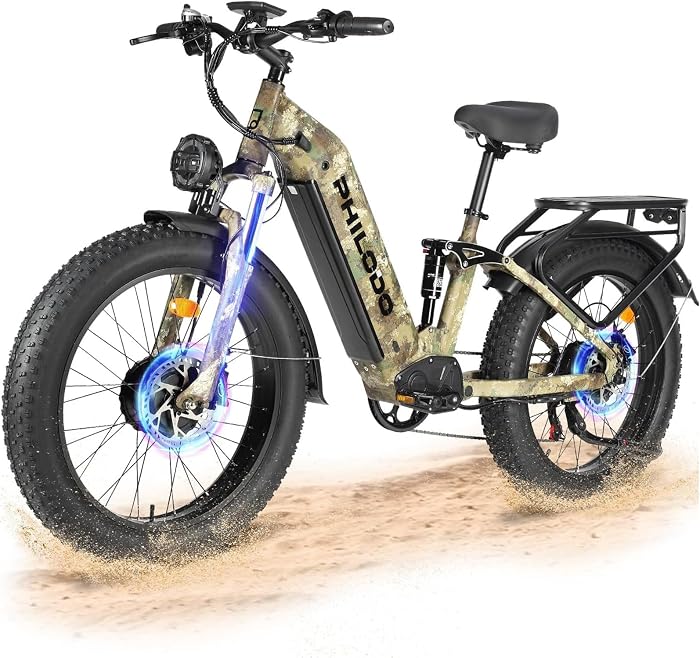
PHILODO Falcon – Falcon 60V Off-Road Electric Bike

Backcountry stand access

Field Score 87/100
Motor
Dual motor
Tires
24 in. fat
Battery
60V 32Ah
Claimed Range
Up to 100 miles (PAS)
View on Amazon

Camo paint is the last thing that should sell anyone on a hunting bike, and on the Falcon it's the first thing you see. Underneath the wrap is the combination that earns it the top spot in this group: a 60V 32Ah battery that is the largest here, two hub motors you can run together or one at a time, and 24-inch fat tires on a full-suspension frame with a lockable fork and a rear air shock. The dual-motor switch is the part we keep coming back to. On a rutted climb with a loaded rack, that second motor is the difference between spinning out and walking the last hundred yards.

Battery management is where this bike rewards a little planning. Run the front hub off on the flat access road and save both motors for the climb back to the truck; the six modes make that a handlebar decision rather than a rewiring job. The fork locks out for washboard gravel, and the air shock takes a pressure change when you add weight, so a bike loaded with a stand, layers and a cooler doesn't wallow through the corners.

It is a tall bike. Shorter riders will want the seat down and may add bar risers to sit more upright, and the 24-inch wheels are the smaller of the fat-tire sizes here. You trade a little rollover for a platform that's easier to handle when you're pushing it through a gate or over a ditch.

Shipping is the practical catch: this one usually runs a week and a half or more before it leaves, so order well before opening day rather than the week you plan to hunt.

Worth Noting

  • Tall stance fits taller riders best
  • 100-mile claim assumes light pedal assist
Our Verdict

Our top pick for most hunters: the biggest battery in this group, dual-motor climbing power and a camo frame, for less than the other dual-motor bike here.

Check Latest Price
2

FREESKY Ranger M540 Best for Heavy Loads

FREESKY Ranger M540

Hauling heavy loads

Field Score 84/100
Motor
Dual, 5000W peak
Torque
250 N·m
Battery
1200 Wh
Payload
400 lb
View on Amazon

Two 2,500-watt motors, 250 newton-meters of torque and a 400-pound payload rating: the Ranger's numbers read like the spec sheet for a small truck, and in this group it's the closest thing to one. What that buys you is margin. Rider, pack, rifle scabbard and a full cooler all sit inside the rating, which is more load than any other pick here is rated to carry.

We think that rating is the reason to pay the premium. This is the most expensive bike on the list, and what the money buys is a step-thru frame that fits riders from about 5-foot-4 upward, 26-inch fat tires, and two years of coverage on the motor, battery and frame, the longest warranty of the group. For a machine that lives in a barn and works a few hard weeks a year, that coverage is worth more than a couple of miles per hour.

Seven modes include walk-assist and single- or dual-motor drive, so you can push a loaded bike up a washed-out section without fighting the drivetrain, then run one hub on the flats to stretch the charge. The cost is weight. This is a heavy bike, and getting it into a lifted truck bed is a ramp job or a two-person job.

It's also certified to UL2271 and UL2849, which is the paperwork you want if the bike is going to charge in a garage, a shed or the back of a camper.

Worth Noting

  • Most expensive bike in this group
  • Heavy enough to want a ramp or a helper
Our Verdict

Buy it if you haul a trailer or a lot of gear: 400 pounds of payload, 250 N·m of torque and the longest warranty here make it the group's workhorse.

Check Latest Price
3

Aipas M1 Pro Best Step-Thru

Aipas M1 Pro Electric Bike for Adults

Step-thru trail comfort

Field Score 83/100
Motor
1800W peak
Weight
88 lb
Battery
48V 17.5Ah
Claimed Range
Up to 85 miles
View on Amazon

Getting on and off a bike in insulated bibs with a pack on is its own small skill, and the M1 Pro's step-thru frame takes it out of the equation. The open front is what we noticed first, and it stayed the thing we appreciated most over a day of stopping at gates, checking cameras and getting back underway.

The rest of the package is honest midrange hardware: an 1800W peak rear hub with 110 N·m of torque, a 48V 17.5Ah battery, 26-inch fat tires, a 100mm front fork and a rear shock, and 180mm mechanical disc brakes with metal pads. It rides comfortably on gravel and along rough field edges, and the wide tires smooth out what the suspension doesn't.

Weight is the trade. At 88 pounds with a high-carbon steel frame, this is not a bike you toss onto a rack one-handed; a ramp changes the loading routine entirely. We minded that least on loose gravel, where the weight settles the bike instead of letting it skitter.

Day-to-day details are where it wins ground on the others. A USB port under the handlebar controller keeps a phone charged, the battery comes out for charging indoors, and the whole bike is certified to UL 2849. With the adjustable bars and seat, riders from about 5-foot-5 up can share it.

Worth Noting

  • 88 pounds with a steel frame to load
  • Mechanical disc brakes need periodic adjustment
Our Verdict

Our pick for riders who want to mount and dismount without gymnastics: step-thru access, 26-inch fat tires and real suspension at a midrange price.

Check Latest Price
4

ESKUTE C300R-SO Best Budget

ESKUTE Electric Bike for Adults

Budget trail riding

Field Score 82/100
Gears
8-speed
Motor
Peak 1800W
Battery
48V 20.8Ah
Claimed Range
Up to 86 miles (PAS1)
View on Amazon

The C300R-SO is the least expensive way into a 26-inch fat-tire hunting bike in this group, and it doesn't feel stripped: an 8-speed drivetrain, a 48V 20.8Ah battery, full suspension, fenders, a taillight and a center display with NFC card and app unlock. The gearing is the underrated part. Eight speeds with a low enough range to actually pedal a heavy bike home if the charge runs out is worth more in the woods than any display feature.

At 998.4 watt-hours, the battery is second in capacity only to the Falcon here, and it charges through a port on the frame, so you don't have to unbolt and carry a heavy pack into the garage every night. That's a small thing until it's February and the bike lives in a shed.

What you give up is refinement. The alloy steel frame is heavy, and the step-over top tube means swinging a leg over a loaded rack or a strapped-on pack takes commitment. The keyless unlock is closer to novelty than necessity out here; we cared much more about the wide stance and the way the fat tires tracked on gravel.

It arrives about 90 percent assembled with the tools in the box, so a Saturday morning gets you riding instead of reading instructions.

Worth Noting

  • Heavy alloy steel frame
  • Step-over top tube with a loaded rack
Our Verdict

The budget pick: 26-inch fat tires, full suspension and an 8-speed drivetrain for less than anything else here, with the second-biggest battery in the group.

Check Latest Price
5

Jasion X-Hunter Best for Tight Vehicle Storage

Jasion X-Hunter/ST/PRO Electric Bike for Adults

Tight vehicle storage

Field Score 81/100
Tires
20 x 4.0 in.
Weight
71 lb
Battery
48V 13Ah (624 Wh)
Folded Size
33 x 16 x 30 in.
View on Amazon

Folded down to 33 by 16 by 30 inches, the X-Hunter disappears into the back of an SUV, a motel room or a lease trailer. That trick is the entire reason to consider it, since it's the only folding bike in this group. If your hunt starts with a long drive and ends with a short ride, being able to stow the bike behind the seat beats a bigger wheel.

For the money you get a 20-inch fat-tire bike with a 1400W motor, 80mm of front air suspension, a rear shock, a 48V 13Ah battery and UL 2849 certification. On gravel roads, grass two-tracks and camp loops it's genuinely fun, and the 4-inch tires handle soft ground without drama.

Twenty-inch wheels and a hinge are not what you want for a half mile of rutted, root-crossed trail, and that's where we draw the line: this is a camp bike and an access-road bike, not the bike for reaching a stand deep in rough country. At 71 pounds it is also still heavy, so folding takes seconds and lifting the folded bundle into a trunk does not.

Between seasons it doubles as a town bike, which is more than most of the fat-tire machines here can claim.

Worth Noting

  • 20-inch wheels limit rough-trail use
  • 71 pounds to lift once folded
Our Verdict

If the bike has to live in a trunk or behind a truck seat, this is the one: it folds smaller than anything else here and still rides on fat tires.

Check Latest Price

How We Tested Hunting E-Bikes

We started with every fat-tire e-bike we could find that claimed hunting or trail duty, then filtered for the things that matter once you leave pavement: enough nominal motor to pull a loaded pack up a grade, full suspension, a removable battery, and UL 2849 certification wherever a maker offered it. That left eight bikes, which we rode for seven months. Assembly came first — I unboxed each one alone with only the included tools and timed it, noting missing hardware and whether the brakes and derailleur arrived dialed in or needed a shop. Build quality got checked with a torque wrench, a washboard gravel road, and a lot of listening for rattles, plus a hard look at welds and at whether the battery latch held over bumps.

The bikes lived where hunting bikes live. They hauled a climbing stand and a 25-pound pack to a blind before daylight, climbed a wet clay two-track after rain, and crossed a sand wash and a snow-covered logging road. We logged top speed by GPS on flat gravel in each assist level, then ran a standing-start climb to see which motors bogged down under load. Fat tires and suspension were judged by how planted the bike felt in ruts, whether the front end washed out, and how much noise the motor made on a still morning — a whining hub is a fine way to empty a ridge.

Battery life got the least glamorous test of all: the same twelve-mile loop at the same assist level, repeated until the low-voltage cutoff, with notes on how much range cold mornings stole. Then we weighed every bike on a hanging scale and lifted each into a truck bed at chest height, because the lift, not the number, is what decides whether you take it out again. Value came down to what was in the box and what we had to go buy.

How to Choose an Electric Bike for Hunting

Torque and Motor Layout Matter More Than Top Speed

Every bike here uses hub motors, and the figure that decides a loaded climb is torque at the wheel, not the peak watts in the headline. Twin-motor bikes drive both ends: the FREESKY Ranger runs two 2,500-watt motors for a combined 250 N·m, and the Falcon splits its power front and rear with the option to run one motor at a time.

Compare carefully, though, because a combined figure across two motors is not the same measurement as the 110 N·m a single rear hub like the Aipas M1 Pro puts down. What we look for is enough grunt to climb a loaded grade at walking pace, plus a walk-assist mode so the bike can push itself beside you when the track gets too rough to ride.

Watt-Hours Tell You More Than Claimed Miles

Every range claim here is a pedal-assist best case on easy ground. Multiply volts by amp-hours and you get a number you can actually compare: the Falcon carries roughly 1,920 watt-hours, the ESKUTE about 998, the Aipas about 840, the Jasion 624, and the FREESKY states 1,200 outright. The bigger the pack, the more of your day happens before you start watching the gauge.

Size that pack against your longest round trip to a stand, then add a reserve. Plan around the assist level you'll genuinely use coming back in the dark, not the one you rode out on.

Tires, Suspension, and Frame Shape

Four-inch tires are the reason these bikes work on soft ground: run them at low pressure and they float over sand, snow and a plowed field edge where a narrower tire digs in. Twenty-six inches rolls over roots and ruts best. The Falcon's 24-inch wheels trade a little rollover for a lower, handier platform, and the Jasion's 20-inch wheels go with its folding frame rather than with rough country.

We think full suspension earns its keep on washboard gravel and roots, and a step-thru frame earns its keep every single time you swing a leg over in bibs, boots and three layers.

Weight, Loading, and the Rack You'll Need

Published weights here run 71 pounds for the folding Jasion and 88 for the Aipas; several of these bikes don't state one at all, so ask before ordering if a hitch rack is part of your plan. The trap is assuming a folding bike is a light bike. Seventy-one pounds is still a two-handed lift into a tall trunk.

Budget for a ramp or a riding buddy, and check that the rack is rated for the bike with the battery installed, because that's how it will travel.

Frequently Asked Questions

Final Verdict

After riding all five, the PHILODO Falcon is the bike we point most hunters toward. It carries the most energy in this group, puts power down at both wheels when a loaded climb demands it, and stays midrange on price while doing it. The tall stance is the one thing to check against your own height before you order.

Haul a trailer or a serious load and the FREESKY Ranger's 400-pound rating and longer warranty justify the step up. Keep the approach short and the budget tight, and the ESKUTE C300R-SO covers the same ground for the least money here.