The 8 Best Tire Deflators for Off-Road Air-Down of 2026

Kneeling in the dirt at a trailhead, crouched over a valve stem with a pocket gauge and a stick, is nobody's idea of a good time. Get it wrong and you either crawl the whole trail on rock-hard tires or risk popping a bead on the first washboard turn. A tire deflator does one job: it takes four tires down to a set pressure and stops there, so you're not babysitting each valve.

The trouble is that set pressure means three different things depending on what you buy. Some units come preset at the factory, some let you dial in your own number with a lock ring, and a few are really a gauge and a hose that rely on you to pull the tool off at the right moment. I've spent the last six months airing down 12 of them, and the spread in speed, accuracy, and build quality had nothing to do with what they cost.

Speed matters more than I expected, since a slow deflator turns a five-minute job into a twenty-minute one. Accuracy matters more, because a tool that reads 15 psi and delivers 22 sours the whole day. What follows is what held its setting and what I'd hand a friend before their first trip.

Our Top Picks

The 8 Best Tire Deflators for Off-Road Air-Down of 2026

1

ARB ARB505 Deflator Kit Best Overall
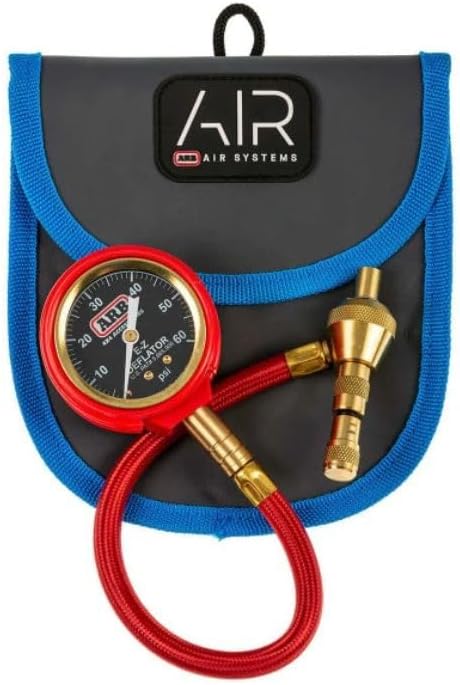
ARB ARB505 Deflator Kit 10-60 PSI Tire Pressure Gauge Rapid Air Down Offroad

Frequent trail runs

Field Score 95/100
Gauge
Dial with rubber guard
Style
Valve core out through chuck
Weight
12 oz
Pressure Range
10 to 60 PSI
View on Amazon

Unscrew the valve core through the ARB505's chuck and the tire dumps air fast while the 10-to-60 PSI dial stays live in your hand. When the needle reaches your number, thread the core back in and move to the next wheel. The braided hose and swiveling gauge head let you keep the dial face-up from any stem angle, which matters more than it sounds when you are crouched behind a rear wheel in the dark.

This is the deflator we recommend first, because there is so little to get wrong with it: one thing for you to control, a gauge you can read while the air is moving, and brass and stainless internals in a geared movement wrapped in a rubber guard. The canvas pouch keeps grit out of the works, and a dial full of dust is a dial you cannot trust.

That dial is the one soft spot. It can read several PSI low against a known-good gauge, so test yours at trail pressure before you depend on the number and remember the offset. It is also the most expensive one-tire-at-a-time tool in this group, and you are paying for the guard, the swivel head and the warranty rather than for features you can see.

What that money buys is speed plus a gauge that reads while the core is out, which together turn airing down from a chore into a two-minute stop. Compared with the JACO RapidFlow below, you are paying for the heavier build and the swivel head; the JACO does the same core-out job with a glow dial for a lot less money.

Worth Noting

  • Dial can read several PSI low
  • Most expensive single-tire tool here
Our Verdict

Buy the ARB505 if you air down regularly: pull the core, watch the live gauge, hit your number, and the brass build takes the abuse. Check the dial against a trusted gauge first.

Check Latest Price
2

JACO RapidFlow Tire Deflator Best Value Rapid Deflator

JACO RapidFlow Tire Deflator with Gauge (0-60 PSI)

Budget trail use

Field Score 94/100
Gauge
Glow-in-dark dial
Warranty
Lifetime
Bleed Rate
1 PSI per second
Pressure Range
0 to 60 PSI
View on Amazon

The RapidFlow does the same core-out trick as our top pick for a lot less money, and it adds two things the ARB does not: a glow-in-the-dark dial and a lifetime warranty. We think that combination makes it the value pick of this group, the air-down tool we point people toward when the budget is real but the trail days are frequent.

JACO rates the flow at 1 PSI per second, roughly 15 PSI in 15 seconds, which is quick enough that airing down stops feeling like a penalty. The dial is marked in 1 PSI increments and calibrated to ANSI B40.1, and the kit ships with a 4-in-1 valve tool, replacement cores and a storage pouch. The spares matter more than they sound, because a lost valve core ends your day.

The gauge is where to keep your skepticism. It can be off by several PSI, so test it once against a gauge you trust and treat the difference as a correction you apply every time. It also does one tire at a time, so you are still walking four corners. Neither is unusual for this style, and at this money we prefer the speed and the warranty to a prettier dial.

Worth Noting

  • Gauge can be several PSI off
  • One tire at a time
Our Verdict

For most shoppers this is the smart buy: core-out speed, a glow dial, spare cores and a lifetime warranty for far less than the premium tools. Verify the gauge once.

Check Latest Price
3

Staun Automatic Tire Deflator Kit Best Automatic Kit

Staun Automatic Tire Deflator Kit

Hands-off four-tire setup

Field Score 93/100
Units
4 automatic deflators
Weight
5.5 oz
Factory Preset
18 PSI
Pressure Range
6 to 30 PSI
View on Amazon

Screw one Staun onto each stem and walk away. Each brass barrel holds a spring that shuts the flow at the pressure you dialed in, so all four tires come down together and stop together while you sort your boots and gloves. On a cold trailhead morning that is a different experience from kneeling at one wheel at a time.

The range is 6 to 30 PSI and they arrive set at 18, which covers sand, dirt and most rock work. Adjustment is a small collar you turn by hand, and the whole set weighs 5.5 ounces in a leather pouch that disappears into a door pocket.

We rate the Staun kit as the best hands-off option in this guide, but only for someone willing to do the setup properly. Each of the four is calibrated on its own, they can drift off the mark, and the sets that arrive close are the ones that stay close. Set them on a spare tire, verify each against your gauge, then lock the setting, and a dab of threadlocker on the collar is the trick that keeps them honest.

It is also the most expensive way to solve this problem here. Whether that pays off comes down to how often you are on the trail: a few weekends a season does not justify it, and twice a month probably does. What sells it in person is the footprint, because there is no bag of gauges and hoses to pack around it.

Worth Noting

  • Each unit needs its own calibration
  • Settings can drift off the mark
Our Verdict

For frequent off-roaders who want to set four deflators and step back, the Staun kit is the best hands-off set here, provided you calibrate and lock each unit first.

Check Latest Price
4

Boulder Tools 4-Deflator Kit Best Budget Automatic Kit

BOULDER TOOLS Adjustable Automatic Tire Deflator

First automatic kit

Field Score 92/100
Chuck
360-degree swivel tip
Units
4 automatic deflators plus gauge
Weight
9.6 oz
Pressure Range
0 to 80 PSI
View on Amazon

The cheapest automatic kit here is also the one that asks the most of you before a trip. Four brass deflators, a 0-80 PSI gauge and a molded case all come in the box, and once the four units are set they do genuinely air all four tires at once and shut off on their own.

We think it is the right first automatic set for someone who is not ready to spend Staun money. The swivel chuck tips seal easily on muddy stems, the gauge covers pressures well past anything a 4x4 needs, and the case means the kit lives in one place in the truck instead of rolling around the floor mats.

Consistency is the catch. The units can disagree with each other by a few PSI, so setting them is a driveway job with a spare tire and a gauge you trust, not something to sort out at the trailhead. The bleed is leisurely too, so you will have time to sort your gear while the tires come down.

None of that disqualifies the kit at this money. Set all four at home, number them with a paint pen so you know which one drifts, and recheck them at the start of each season. Do that and the convenience is real, and the price leaves room for the recovery gear you actually wanted.

Worth Noting

  • Units can disagree by a few PSI
  • Slow bleed
Our Verdict

The cheapest route to hands-off airing down: four auto-stop deflators, a gauge and a case, as long as you are willing to calibrate all four before you trust them.

Check Latest Price
5

TeraFlex 4807200 Air Deflator Best Simple Bleeder Set

TeraFlex 4807200 Air Deflator

Simple no-gauge bleeding

Field Score 91/100
Type
Screw-on bleeder
Weight
2.4 oz
Storage
Threads together on a key ring
View on Amazon

A handful of knurled brass barrels, no gauge, no spring, nothing to calibrate. Screw a TeraFlex onto each valve stem and the tool simply holds the pin down so the tire bleeds; thread them together on the key ring when you are done and the stack takes up less room than a pen. We think that simplicity is the whole appeal, because there is nothing here to drift, clog or read wrong.

The routine is the satisfying part: four on, then a slow lap back to the first tire as you check each one with your own gauge. The flow is unhurried, which is fine on a 31-inch tire and less fun on a 40, but it also means you are less likely to blow past your target between checks.

Two things to know before you buy. First, you supply the gauge; these tell you nothing, so the accuracy of your air-down is the accuracy of whatever you press on the stem. Second, the key ring is for storage, not for actually carrying a cluster of brass in your pocket. Treat the stack as a glovebox item and it is one of the better small-money buys here.

Worth Noting

  • No gauge, so you set the stopping point
  • Unhurried bleed on big tires
Our Verdict

If you already own a good gauge and just want the valve held open on all four tires, this pack is the simplest, toughest cheap option in this guide.

Check Latest Price
6

Lisle 19860 Tire Deflator Best for Stock TPMS Wheels

Lisle 19860 Tire Deflator

Stock TPMS wheels

Field Score 90/100
Type
Screw-on valve cap
Weight
0.8 oz
Markings
Marked by tire position
Valve Core
Stays in place
View on Amazon

Every tool in the Lisle set is marked for a wheel position, which sounds fussy until you have done a five-tire rotation and cannot remember which deflator was on the left rear. Screw one on each stem, let the tires bleed, and each cap goes back where it came from, which is also the idea behind leaving your TPMS sensors paired to their corners.

The core stays in the whole time. The cap depresses the pin through wide openings on the sides, so air escapes quickly without anything small and brass coming out into the sand. Nothing to lose, nothing to drop, no valve tool in your pocket.

On a stock daily driver that sees a beach a few times a year, that is exactly the right amount of tool. They are barely bigger than a valve cap, they weigh almost nothing, and they vanish into a glovebox until you need them.

The pin is the part to keep an eye on, since it can work loose with use, and a cap that stops holding the pin open is just a cap. There is also no gauge, so your stopping point is whatever you press on top. For the money and the size, though, this is the least fussy way here to bleed four tires without touching a valve core.

Worth Noting

  • Pin can work loose with use
  • No gauge to tell you where you stopped
Our Verdict

For stock wheels and TPMS sensors you would rather not disturb, the Lisle caps are the low-drama choice: no cores to pull, each marked for its own wheel, nothing to calibrate.

Check Latest Price
7

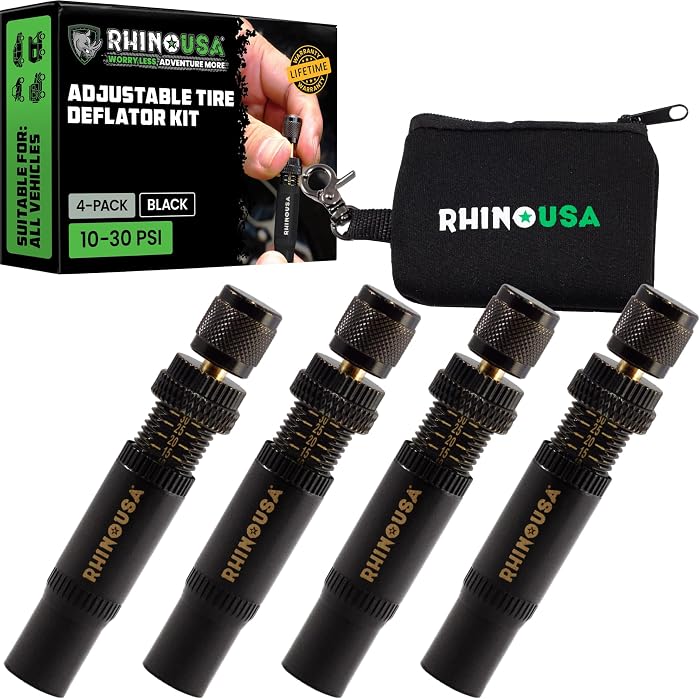
Rhino USA Adjustable Deflator Kit

Rhino USA Adjustable Tire Deflator Kit (4-Pack)

Glovebox-sized set

Field Score 89/100
Scale
Laser-etched PSI marks
Units
4 auto-stop deflators
Weight
5 oz
Pressure Range
10 to 30 PSI
View on Amazon

The Rhino set is the smallest automatic kit here: four five-ounce barrels that clip together on a keychain pouch and carry a pressure scale laser-etched into each body, so the marks will not wear off in a glovebox full of tools.

The range is 10 to 30 PSI, squarely trail pressure for sand, rock and dirt, and each unit sets independently, so you can run 12 in the sand on Saturday and 20 on a fire road on Sunday. Screw them on, let them stop on their own, and pull them off.

We like the packaging and the etched scale more than the dial-in experience: the marks are small, and hitting a number exactly takes patience plus a gauge to confirm it. Rhino's lifetime replacement is the reassurance, because if a unit stops holding its setting it is covered rather than landfill.

If your target is below 10 PSI for deep sand, this set will not get you there, and a 6-30 kit is the answer instead. Within its window it is a tidy, wallet-sized set that does what an automatic kit is supposed to do without asking for garage space.

Worth Noting

  • Small marks are fiddly to set
  • Nothing below 10 PSI
Our Verdict

A compact, well-marked automatic set for 10-30 PSI trail pressures; buy it if glovebox size matters and you will take the time to dial each unit against a gauge.

Check Latest Price
8

Smittybilt R.A.D Rapid Air Deflator Best for Easy Gauge Reading

SmittyBilt R.A.D RAPID AIR DEFLATOR

Easy gauge reading

Field Score 88/100
Hose
Nylon braided
Gauge
2-inch dial, 1 PSI increments
Weight
8 oz
Pressure Range
0 to 60 PSI
View on Amazon

The reason to look at the Smittybilt R.A.D is the dial: two inches across with 1 PSI increments, so 18 and 20 look different at a glance instead of sharing a hash mark. The knurled brass knobs work with gloves on, and the rubber housing around the gauge takes a knock without cracking.

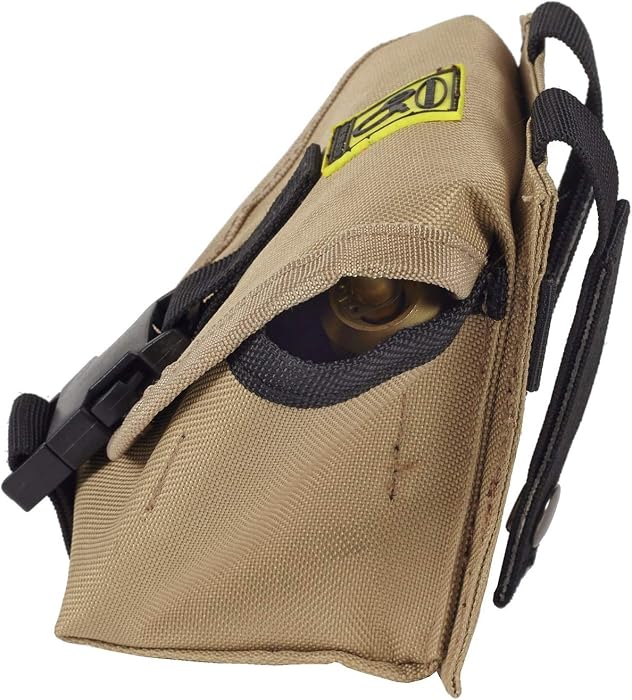
It is the familiar core-out design. Unscrew the valve core through the chuck, let the tire dump, watch the dial, thread the core back in. A nylon braided hose keeps the gauge where you can see it, the range runs 0 to 60 PSI, and the MOLLE bag straps to a roll bar or seat back instead of rattling around under it.

The gauge is the part to verify, since it can read a couple of PSI off, and on a deflator that is the difference between 15 and 13. The instructions are also thin, so your first tire is a fumble while you work out the sequence and the second one takes a minute.

What we keep coming back to is dial size. Of the core-out tools here, this is the one we hand to someone who has never aired down before, because the gauge is the easiest to read from standing height. It costs less than the ARB and more than the JACO, and the reading experience is the reason to pick it anyway.

Worth Noting

  • Gauge can read a couple PSI off
  • Thin instructions on the first tire
Our Verdict

We like the RAD for its big, readable one-PSI dial: a core-out deflator that is easy to teach from and easy to read at dusk, as long as you check the gauge first.

Check Latest Price

How We Tested the Best Tire Deflators

We started by reading through offroad forums and manufacturer spec sheets, then narrowed the field to tools that covered a usable off-road pressure range, held a setting once it was locked in, and either came as a four-tire kit or could be bought as one. That left 12 deflators, from single screw-on units to adjustable four-packs, and we ran them for six months.

Most of the testing happened where these actually live: a driveway the night before a trip, then trailheads outside Moab on rock and a sandy two-track that had us down at 15 psi before lunch. Every deflator went onto the same set of tires. We timed each tire from street pressure to target with a stopwatch, noted the total for all four, and paid attention to whether we had to stand there watching the gauge or could walk away and load the cooler.

Accuracy got checked twice: once against the tool's own gauge or preset, then again with a calibrated digital gauge on all four tires five minutes later, which is where several of them drifted a pound or two. We adjusted every preset deflator up and down its range, left them set for a week in a gear bag, and rechecked. Ease of use came down to cold hands, screwing them on with gloves in low light without cross-threading brass. For durability, they got tossed in recovery bags, dropped on gravel, and buried in dust, and we pulled the o-rings and threads apart afterward to see what wore.

We also kept track of what came in the box, since a cheap deflator plus a separate accurate gauge often costs more than the kit that includes both. A few are still riding around in the truck, and we'll update as they age.

How to Choose a Tire Deflator

Automatic or Hand-Held: Who Watches the Pressure

An automatic kit puts a spring-loaded unit on each stem and shuts the flow at a preset pressure, so all four tires come down while you get ready to ride. A hand-held air-down tool gives you a live gauge and full control, one tire at a time, with no setup to maintain. Automatic sets win on convenience; hand tools win on flexibility, because you can stop wherever you like.

The trap with automatic kits is assuming the preset is the pressure you will get. Each unit is calibrated on its own, so set them on a spare at home, verify each against a gauge you trust, and lock the setting before you rely on it.

Check the Range Against the Pressure You Run

Automatic sets come in windows, often 6 to 30 PSI or 10 to 30 PSI, while hand-held gauges typically run 0 to 60 or 10 to 60. Your window has to cover the lowest pressure you actually use. Deep sand can call for single digits, and a 10-30 set will not go there; a 6-30 kit or a 0-60 gauge tool will.

On the top end, anything past 40 PSI is just the drive home, so a 0-60 dial is plenty. Write down the number you air down to before you shop and buy a tool whose range brackets it with a little room on both sides.

Valve Cores: Speed Versus Simplicity

Two designs dominate. Core-out tools let you unscrew the valve core through the chuck so air leaves through a wide-open hole, which is the fastest bleed you can get without a compressor. The price is a tiny brass core in the dirt if you fumble it, so carry spares; the JACO kit includes replacement cores and a valve tool for exactly that reason.

Cap-style and spring-loaded deflators leave the core in place and depress the pin instead. Slower, but there is nothing small to lose. If you run TPMS wheels and would rather not touch the sensors, leaving the core in is the calmer route.

Verify the Gauge Once, Then Trust the Offset

Every gauge on this page is a mechanical instrument, and mechanical instruments drift. Check yours against a gauge you trust at two pressures, say 15 and 35 PSI, and remember the difference; a dial that reads three low everywhere is easy to live with once you know about it.

Favor 1 PSI increments if you air down to specific numbers, because a two-inch dial with one-PSI marks is quicker to read than a small face crowded with hash marks. Glow-in-the-dark faces earn their keep at dusk more than you would expect.

Frequently Asked Questions

Final Verdict

The ARB505 is the deflator we recommend to anyone who airs down more than a couple of times a season. Pulling the core through the chuck gives you the fastest bleed this side of a compressor, the dial tells you where you are while the air is still moving, and the brass and stainless build is what separates it from the cheap copies. Check the gauge against one you trust, and it is the one we reach for.

If handling valve cores is not for you, the Staun kit does four tires hands-off at once, and it rewards the time you spend setting it. If the ARB's price is the sticking point, the JACO RapidFlow delivers the same core-out speed with a glow dial for a lot less.