The 7 Best Electric Knife Sharpeners of 2026

An electric knife sharpener can bring a drawer of dull blades back in about ten minutes, or it can leave a good chef's knife with a wavy edge and a scratched face. I got the second outcome once, courtesy of a borrowed machine and a knife I'd had for a decade. What separates those two results is whether the angle stays controlled and whether the abrasives actually hone an edge or just chew at it. We spent eight months putting 11 sharpeners through real work to see which camp each one landed in.

What surprised me is how little stage count mattered next to angle guidance. A three-stage machine with a sloppy guide can mar a blade faster than a plain two-stage model that holds its line. Then come the daily annoyances: a motor loud enough to clear the room, a base that creeps across the counter, instructions written for someone who already knows the answer. Those small things decide whether a sharpener earns permanent drawer space.

The picks below did the least damage and the most good. Some are built for kitchen knives, others for scissors, serrated blades, and a garage full of garden tools.

Our Top Picks

The 7 Best Electric Knife Sharpeners of 2026

1

Work Sharp MK2 Best Overall

Work Sharp MK2 Electric Knife Sharpener

All-around sharpening

Field Score 95/100
Works On
Knives, scissors, tools
Blade Types
Straight and serrated
Abrasive Type
Flexible belts
Speed Settings
2
View on Amazon

A drawer of kitchen knives is one kind of dull; a hunting blade and a pair of bypass pruners are another. The Work Sharp MK2 is the one we reach for when all three are in the same pile, and that range is why it earns our top spot. It is a belt sharpener, not a pull-through, so the abrasive conforms to the blade instead of forcing it into a fixed slot.

The two-speed motor is the detail that makes it more than a kitchen gadget. We use the slower setting for a finishing pass on a chef's knife and the faster one when a mower blade or axe needs reprofiling. The edge guide holds a consistent angle, and the flexible belts wrap around serrated edges and curved blades that a rigid wheel can miss. Scissors and garden tools are part of the same job, which is unusual for a machine this compact.

What we like most is the lack of ceremony. There is no oil, no water, no stone to flatten; you plug it in, choose a belt, and make a few passes. The three-year warranty is a useful vote of confidence, and the belts are replaceable. It is not the machine for someone who wants a mirror-polished 15-degree edge on a single Japanese knife; that is a specialist's job. But for a household that sharpens everything from paring knives to pruners, it is the most useful sharpener on our counter.

Worth Noting

  • Belts wear out with use
Our Verdict

This is our default recommendation because it sharpens kitchen knives, hunting blades, and garden tools with one two-speed belt system.

Check Latest Price
2

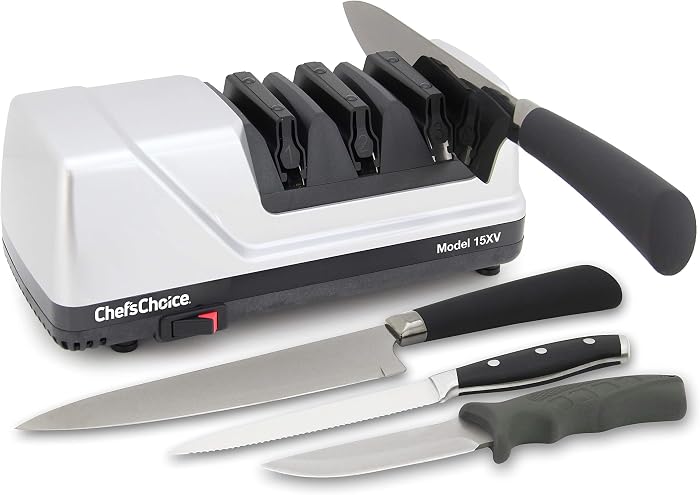
Chef'sChoice 15XV Best for Kitchen Knives

Chef’sChoice 15XV EdgeSelect Professional Electric Knife Sharpener

Kitchen knife precision

Field Score 93/100
Stages
3
Abrasives
100% diamond
Edge Angle
15 degrees
Blade Types
Straight and serrated
View on Amazon

The 15XV is the kitchen specialist: three stages, 100 percent diamond abrasives, and a guided system that converts a factory 20-degree edge to a 15-degree Trizor edge. That finer angle is the reason it slices so cleanly through tomatoes and raw fish, but it is also the reason you don't want to use it on a cleaver or a hunting knife that sees bone.

We tested it on a mixed drawer of European and Asian knives, and the difference was most obvious on the Asian blades that already wanted a shallower angle. The spring guides do the angle-holding for you, so the learning curve is short; the manual is worth reading because the stage sequence matters. The one caveat is the blade face: the guides can leave marks, especially if you let the knife tip drop or use heavy pressure. Tape the blade or practice on a cheaper knife if the finish matters.

Where it earns its keep is repeatability. Once you have converted a knife, a few passes in stage 3 bring the edge back without resetting the bevel. That is the difference between a sharpener you use twice a year and one you keep on the counter. If you own mostly German or American knives, the 20-degree Chef'sChoice Hybrid 250 is a closer match; if you want one machine for everything, the Work Sharp MK2 is more flexible.

Worth Noting

  • Premium price for a kitchen-focused machine
Our Verdict

If your knives are kitchen knives and you want a precise 15-degree edge, this is the one we recommend.

Check Latest Price
3

Presto EverSharp 08800 Best Budget

Presto 08800 EverSharp Electric Knife Sharpener

Budget kitchen touch-ups

Field Score 92/100
Guides
Precision blade guides
Stages
2
Wheels
Sapphirite
Blade Types
Non-serrated
View on Amazon

The Presto EverSharp 08800 is the lowest entry point here, and for a lot of households that is the whole argument. It is a two-stage electric sharpener with Sapphirite wheels and precision blade guides. There is no angle dial, no speed control, and no belt to change. You pull the knife through the coarse slot until it bites, then through the fine slot to hone. That simplicity is the point: it takes minutes, not an evening.

We found the results best on standard non-serrated kitchen knives. The guides hold a usable angle, and the fine wheel leaves an edge that slices tomatoes without sawing. It is not the tool for a high-end Japanese knife or a serrated bread knife; the fixed slots are too blunt a tool for that. But for a drawer of everyday knives that have gone soft, it is the least fussy way to get them back.

What we appreciate most is the size and the lack of maintenance. It stores in a cabinet, wipes clean, and doesn't ask you to buy replacement belts. The trade-off is that you give up the adjustability and the polished edge of the premium machines. If you want a sharpener for a hunting knife or a set of Asian knives, spend more; if you want dull kitchen knives to cut again, this is enough.

Worth Noting

  • Not for serrated or high-end blades
Our Verdict

For everyday kitchen knives on a tight budget, the Presto EverSharp 08800 is the simplest way to get a usable edge.

Check Latest Price
4

Chef'sChoice Hybrid 250 Best for Small Kitchens

Chef'sChoice Hybrid Knife Sharpeners for 20-Degree Straight and Serrated Knives

Small kitchens

Field Score 91/100
Stages
3
Abrasives
Diamond
Edge Angle
20 degrees
Sharpening
Electric and manual
View on Amazon

The Hybrid 250 is the one we reach for when counter space is tight. It is a compact three-stage sharpener that combines electric and manual stages: the electric side does the grinding, and the manual side lets you finish the edge with more control. The 20-degree angle is the traditional European profile, so it suits chef's knives, santokus, and serrated blades without asking you to relearn your knife set.

The hybrid layout is more useful than it sounds. You can run a dull knife through the electric stages, then use the manual stage for a few light strokes without powering the machine back up. That makes it easier to stop before you over-sharpen, which is the main risk with any electric sharpener. The diamond abrasives cut quickly, and the guides keep the blade steady.

We liked the small footprint and the fact that it doesn't need a dedicated spot on the counter. The trade-off is capacity: it is a home sharpener, not a commercial one, and the narrow slots can be fussy with a thick hunting blade. If you sharpen a lot of outdoor knives, the Work Sharp MK2 is the better tool; if you want a compact kitchen sharpener with a manual finishing stage, this is the one.

Worth Noting

  • Narrow slots can be fussy with thick blades
Our Verdict

For a small kitchen and a mix of European-style knives, the Hybrid 250 packs three useful stages into a compact body.

Check Latest Price
5

Work Sharp Ken Onion Mk2 Best Adjustable

Work Sharp Ken Onion Mk2 Electric Knife Sharpener

Adjustable-angle work

Field Score 90/100
Speed
Variable
Works On
Knives, scissors, tools
Angle Range
15 to 30 degrees
Sharpening Method
Flexible abrasive belts
View on Amazon

The Ken Onion Mk2 is the most adjustable sharpener here: the guide dials from 15 to 30 degrees, and the belt speed is variable rather than fixed to two settings. That is a different kind of tool from the set-and-forget kitchen sharpeners. It is built for the person who wants to reprofile a hunting blade, set a 15-degree edge on a fillet knife, and then slow the belt down for a delicate finishing pass.

We like the control, but we also noticed that it asks more of you. The angle guide is precise, yet you still have to keep the blade steady and let the belt do the work; pressing harder only removes more metal. The flexible belts handle serrated edges and curved blades well, and the machine has the power to take a damaged edge back to a clean bevel. The learning curve is real, but it is shorter than freehand stones.

The price puts it in premium territory. For a kitchen-only household, the Chef'sChoice 15XV is simpler and easier to live with. For a hunter, a cook with a mixed knife roll, or anyone who wants one machine to handle 15- and 20-degree blades, the Ken Onion is worth the step up.

Worth Noting

  • Premium price for a specialist tool
  • Belts are a consumable
Our Verdict

For hunters and cooks who want to set 15- to 30-degree edges with variable speed, this is the most capable machine here.

Check Latest Price
6

Presto EverSharp 08810

Presto 08810 Professional EverSharp Electric Knife Sharpener

Mixed blade thickness

Field Score 89/100
Stages
3
Wheels
Sapphirite
Blade Types
Kitchen and sport knives
Blade Thickness
Thick, medium, thin
View on Amazon

The blade-thickness selector is the reason to look at the Presto EverSharp 08810. A small dial adjusts the guides for thick hunting knives, medium chef's knives, and thin paring or fillet blades, so the machine can hold a more appropriate angle across a mixed drawer. It is a three-stage sharpener with Sapphirite wheels, and it is aimed at people who want one electric machine for kitchen and sport knives.

The three stages give you more control than the two-stage Presto: coarse grinding, a finer hone, and a finishing polish. In practice, that means you can bring back a neglected knife without jumping straight to a finishing wheel, and the thickness selector keeps a thick blade from rocking in the slot. The instructions are worth following, especially the stage order.

The motor is the weak point. It can bog down when you rest a heavy blade on the wheels or push too hard, so you have to let the machine do the work. That is not a dealbreaker for kitchen knives, but it is a reason to look elsewhere if you sharpen cleavers or hunting knives regularly.

For a home cook with a mixed set of blades and a light hand, it is a capable step up from the two-stage Presto. For heavy outdoor blades, the Work Sharp MK2 or Ken Onion is the better choice. The thickness selector is a genuinely useful feature, not a gimmick; just don't expect the motor to muscle through a thick spine.

Worth Noting

  • Motor can bog down on heavy blades
Our Verdict

We recommend the 08810 for a mixed drawer of kitchen and sport knives, provided you keep a light hand; the blade-thickness selector is genuinely useful.

Check Latest Price
7

Narcissus QN-M866 Best for Light-Duty Touch-Ups

Narcissus QN-M866 – Knife Sharpener

Light-duty touch-ups

Field Score 88/100
Motor
30-watt DC
Stages
2
Extra Slot
Scissors
Dust Collection
Metal dust box
View on Amazon

The scissors slot is the detail that makes the Narcissus QN-M866 more than another cheap pull-through. It is a two-stage electric sharpener with a dedicated side slot for scissors, a metal dust collection box, and a compact body that fits in a drawer. The 30-watt motor is rated to run continuously for over an hour, which is more than enough for a home drawer.

We found it best for light touch-ups. On a moderately dull chef's knife, the coarse stage brought the edge back and the fine stage left it usable for everyday prep. On a badly neglected blade, it took more passes than we wanted, and the results were less consistent. The machine is small and light, so you need to hold it steady; the dust box is a nice touch because it keeps the grit from spreading across the counter.

This is not the sharpener for a high-end knife or a heavy hunting blade. Long-term durability is a real question mark, and that is the main reason it sits in our also-consider tier rather than higher. But for a renter, a small kitchen, or someone who wants to sharpen scissors and paring knives without spending much, it has a clear place.

Worth Noting

  • Struggles with very dull blades
  • Durability is a question mark
Our Verdict

For scissors, paring knives, and light kitchen touch-ups in a small space, we think the Narcissus is a useful budget helper.

Check Latest Price

How We Tested the Best Electric Knife Sharpeners

We started by gathering every electric sharpener we could find that offered a real angle guide, then narrowed the field by abrasive type, stage count, whether it could handle serrated blades and scissors, and how much counter space it occupies. Eleven models made the cut, a mix of two-stage, three-stage, and belt-driven machines across budget and professional price points, and we used each of them for eight months.

The knives were our own: stamped paring knives, forged chef's knives, a bread knife that had been tearing instead of slicing, kitchen shears, pruners, and a handful of pocket knives that hadn't cut cleanly in years. We dulled them deliberately, then counted how many passes it took to slice a ripe tomato under its own weight and to shave a clean curl from a sheet of paper. After each session we tilted the blade under a bright light to look for scratches, and we resharpened the same chef's knife over and over to see whether a machine held its angle or wandered.

On the counter we watched for the complaints that come up again and again: whether the base skated while the motor spun up, and how loud the thing ran at arm's length — a couple of the belt models whined badly enough that we moved them to the garage. We leaned into each motor to see if it bogged down under pressure, wiped up the metal dust afterward, and timed how long it took to swap a worn belt or clean an abrasive wheel. Two of us assembled every machine without opening the manual first, to see how far the labeling alone got us, then compared notes on how useful the instructions actually were. Value got a hard look too: we asked whether the extra money bought faster edges and more control, or just a heavier box.

How to Choose an Electric Knife Sharpener

Pick the edge angle first

We put the edge angle ahead of the stage count because it determines what the knife is good for. Most kitchen knives leave the factory at 20 degrees per side, while many Asian knives are ground closer to 15 degrees. A 15-degree edge slices cleanly but has less metal behind it, so it is a poor match for heavy chopping or a hunting knife that hits bone. A 20-degree edge is the sturdier everyday choice. If your drawer mixes both, an adjustable model is worth the extra complexity; if you own one style, match the machine to it and skip the dial.

Choose the abrasive and stage count

Three abrasive styles dominate: diamond wheels, flexible belts, and ceramic or Sapphirite wheels. Diamond cuts fast and holds its shape; belts conform to curved and serrated edges; wheels are simple and sturdy. More stages do not automatically mean a better edge. A three-stage machine adds a polishing step, but a two-stage with good guides can be enough for everyday kitchen knives. We look for a coarse stage that removes material efficiently and a fine stage that leaves a clean, not ragged, edge.

Pay attention to motor power and speed

An electric sharpener only works as well as its motor under load. A weak motor bogs down when you rest a heavy blade on the abrasive, which forces you to push and removes more metal than you intended. Variable speed helps: slow for a delicate finishing pass, faster for reprofiling a damaged edge. Let the machine do the work and use light pressure. If you sharpen cleavers or hunting knives, a stronger motor is worth more than an extra stage.

Match the machine to your blades

A kitchen-only sharpener can be wonderful on chef's knives and useless on a thick hunting blade. Check the guide width and the maker's blade list before you buy. Serrated knives need a dedicated slot or a flexible belt; scissors need a side slot or a removable guide; garden tools need a belt that can wrap around a curved edge. If you want one machine for the kitchen, the workshop, and the field, a versatile belt sharpener is the safer bet.

Plan for consumables and storage

Belts and wheels are consumables. A machine that is cheap to buy but expensive to feed is not a bargain, so check replacement availability before you commit. Dust collection helps if you sharpen indoors, and a compact body is easier to store, but it still needs a stable surface while running. We prefer a slightly larger machine that sits still to a tiny one that skates across the counter.

Frequently Asked Questions

Final Verdict

For most households, the Work Sharp MK2 is the one we recommend: two speeds, flexible belts, and enough range for kitchen knives, hunting blades, and garden tools. If your knives are almost all kitchen knives and you want a precise 15-degree edge, the Chef'sChoice 15XV is the better specialist. If you are shopping on a tight budget, the Presto EverSharp 08800 gets the job done with fewer decisions.