The 6 Best Serrated Knife Sharpeners of 2026

A serrated knife is a row of tiny saws, and a dull one is worse than a dull chef's knife: it tears tomatoes, squashes bread, and makes you work for every slice. The fix isn't a honing steel—those smooth rods skate right over the scallops—so a dedicated sharpener has to get into each groove without flattening the teeth. I've been through a drawerful of gadgets that claimed to do it, including a few that left the edge rougher than when I started.

Over the past eight months, my team and I tested 14 serrated knife sharpeners on the same tired bread and tomato knives. The ones worth keeping shared a few traits: a slot or guide that actually centered the blade, a handle or base that stayed put, and a stage progression that didn't chew up the teeth. We also noted footprint, because these tend to live in a drawer or on a crowded counter, and timed how many passes each needed to bring an edge back. The picks below made the job feel quick, controlled, and worth the money.

Our Top Picks

The 6 Best Serrated Knife Sharpeners of 2026

1

AccuSharp Knife Sharpener Best Overall

AccuSharp Knife Sharpener

Kitchen and field

Field Score 95/100
Blades
Straight and serrated
Handle
Fits left or right hand
Weight
1.6 oz
Abrasive
Diamond-honed tungsten carbide
View on Amazon

A blunt bread knife is the most quietly infuriating tool in a kitchen. It tears the crust, squashes the crumb, and pressing harder only makes it worse. The AccuSharp is the fix we hand people first: a 1.6-ounce pull-through that lives in a drawer or a jacket pocket and puts a working edge back on a blade in a few passes rather than an afternoon.

What we appreciate most is how little it asks of you. The diamond-honed tungsten carbide blades sit in a fixed V, the handle fits either hand, and a full-length guard keeps your fingers behind the edge. It takes straight blades as readily as serrated ones, which is why it earns a place in a knife roll or a hunting pack as well as a kitchen drawer — one small tool covering the bread knife, the steak knives, and the skinner at the bottom of the bag.

The trade is aggression. Carbide removes steel in a hurry, and on a scalloped edge the V works mainly on the tips of the teeth, so light passes and an early stop are how you keep a good serrated knife good. On a drawer of inexpensive steak knives that bite is exactly what you want, and there is no setup, no angle to hold, and nothing to plug in.

Worth Noting

  • No angle adjustment for 15-degree knives
Our Verdict

Our default pick: among the least expensive sharpeners here, small enough for a jacket pocket, and quick enough that you will actually use it.

Check Latest Price
2

Chef'sChoice 15XV EdgeSelect Best Electric

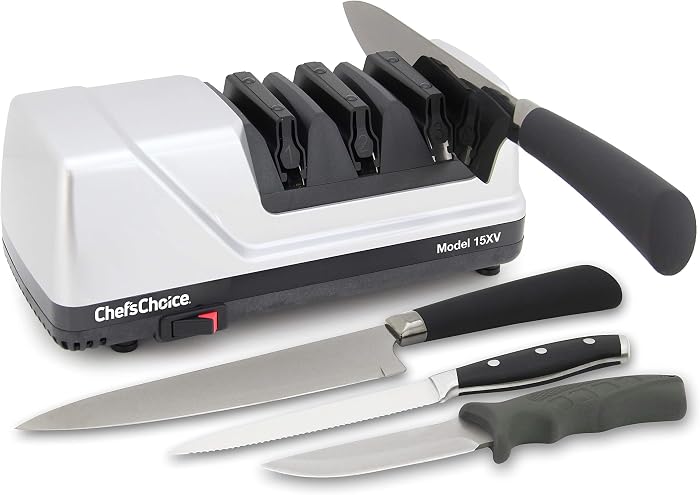
Chef’sChoice 15XV EdgeSelect Professional Electric Knife Sharpener

Full knife blocks

Field Score 93/100
Stages
3-stage
Weight
4.2 lb
Abrasive
100% diamond
Edge Angle
15 degrees
View on Amazon

This is the only electric sharpener here, and the only one that costs as much as a good knife. What the money buys is consistency. Patented spring guides hold the blade at the angle its slot was cut for, so a serrated edge gets the same treatment pass after pass without you judging a bevel by eye, and three stages take a factory 20-degree edge down to a 15-degree Trizor edge and then strop it.

Speed is the other argument: you feed a knife through a slot and set it down sharp, then reach for the next one. That is why this machine suits a household where nobody wants a sharpening session. The instructions are unusually specific about different knife types, and the 100-percent diamond abrasives cover straight and serrated blades on the same unit — a real advantage when the serrated set is a bread knife, six steak knives, and a tomato knife.

It is a counter appliance, though — 4.2 pounds and about 10 inches long, so it stays out rather than going back in a drawer. And on polished blade faces the guides can leave fine scratches near the edge. They are cosmetic, but run the knife you care least about first to see how yours fare.

Worth Noting

  • Priciest option here by a wide margin
Our Verdict

We choose it when a whole block needs work: three diamond stages, guides that hold the angle, and serrated blades sharpened without you steering.

Check Latest Price
3

Chef'sChoice Manual Sharpener Best Manual

Chef'sChoice Manual Knife Sharpeners for 15

Precise manual work

Field Score 92/100
Blades
Straight-edge and serrated
Weight
8 oz
Abrasive
100% diamond
Edge Angles
15 and 20 degrees
View on Amazon

Same maker as the electric machine, same 100-percent diamond abrasives, none of the motor. The manual Chef'sChoice is 8 ounces and about 9 inches long, so it goes in the knife drawer instead of owning counter space, and it sharpens straight and serrated blades through preset slots that set the bevel for you.

The 15-or-20-degree choice is what separates it from the cheap pull-throughs. A serrated knife ground at 20 degrees belongs in the 20-degree slot; a Japanese-style blade at 15 belongs in the other one. Choosing wrong does not ruin a knife in a single pass, but you spend the session fighting the bevel that is already there, and the edge feels worse than the tool deserves.

We like it best in a small kitchen, where the electric would sit on the counter and irritate somebody. It braces steadily enough to work one-handed and it is quick enough that touch-ups actually happen, and it stores in the same drawer as the knives it maintains. For a cook who wants a genuinely sharp serrated edge without learning to hold an angle on a stone, this is the sensible middle of the list.

Worth Noting

  • Plastic housing is the wear point
Our Verdict

For a sharp edge with no cord and no counter footprint, we point to this one: diamond abrasives and a real choice of angles.

Check Latest Price
4

KitchenIQ Edge Grip 50009 Best Budget

KitchenIQ Edge Grip 50009 – 50009 Edge Grip 2-Stage Knife Sharpener

Cheap everyday touch-ups

Field Score 91/100
Blades
Straight and serrated
Stages
2-stage
Abrasive
Carbide and ceramic
Dimensions
1.75"L x 1"W x 3.75"H
View on Amazon

The detail worth knowing is the V-shaped notch in the base. Set the sharpener over the edge of a counter or table and it locks there, so a long bread knife can be drawn through without its tip dragging across the countertop. With serrated knives the awkward part is usually the length of the blade rather than the steel, and this one solves that at the lowest price tier here.

Two stages, carbide then ceramic, and the ceramic is the one that matters for serrated knives. It refines the tips of the teeth without hogging off steel the way a coarse carbide slot does, which is why we treat this as a maintenance tool rather than a rescue: a few light pulls every couple of weeks keeps steak knives cutting instead of tearing.

It is tiny — under four inches tall and about half an ounce — and that is both the argument and the objection. In a drawer it disappears. In your hand it feels small and slightly fiddly, particularly behind a thick blade, so brace it on the counter and let the notch do the holding.

Worth Noting

  • Small body is awkward to hold
Our Verdict

We keep one of these in the drawer for quick touch-ups: the counter-edge grip steadies a long blade and the ceramic side polishes a serrated edge back into use.

Check Latest Price
5

Sharp Pebble Orange Ninja Best Dedicated Serrated Setting

Sharp Pebble Orange Ninja – Orange Ninja Serrated & Kitchen Knife Sharpener

Serrated-first sharpening

Field Score 90/100
Blades
Straight and serrated
Stages
4-stage
Weight
10.9 oz
Dimensions
8.18"L x 1.96"W x 3.3"H
View on Amazon

Most sharpeners mention serrated blades somewhere in the fine print. This one puts them in the name and gives them a setting, with a thumb switch that moves between the standard and serrated configurations so you are not dragging a scalloped edge through the same V you use on a chef's knife.

The layout is four labeled slots in an ABS body with a rubberized foot that stays put on the counter. The switch works under your thumb without lifting the tool, the compact body fits a drawer, and it is set up to work the same way for left-handed cooks — a small thing most inexpensive manuals ignore.

Where we hesitate is the edge itself. On very dull knives the results split: some blades come back nearly razor-sharp and others barely change, so we rate it as a touch-up tool rather than a rescue. If your serrated knives only need maintenance, that is fine. If a bread knife has been crushing crusts for two years, start with one of the diamond sharpeners here.

Worth Noting

  • Mixed results on very dull blades
Our Verdict

We point to it when serrated is the whole job: it is the only sharpener here with a stage labeled for those teeth.

Check Latest Price
6

AccuSharp Gourmet 15-Degree Best for 15-Degree Knives

AccuSharp Gourmet 15-Degree

15-degree knives

Field Score 89/100
Blades
Straight-edge and serrated
Abrasive
Diamond-honed tungsten carbide
Dimensions
2.38"L x 0.75"W x 5.5"H
Edge Angle
15 degrees
View on Amazon

Fifteen degrees is the bevel on most Japanese-style and gourmet knives, and it is a bevel that needs a sharpener cut to match — which is the only reason this model exists alongside the standard AccuSharp. Same diamond-honed tungsten carbide idea, ground for a 15-degree edge, with reversible blades and a full-length finger guard.

It is the most packable shape here: 5.5 inches tall, three-quarters of an inch wide, 1.6 ounces, so it drops into a pocket, a glovebox, or a tackle box. We like it for the knife you actually carry — a 15-degree folding blade with a partly serrated edge is exactly the case it was built for — and the reversible blades give you a fresh cutting face without buying a new tool.

The boundary is the angle. One bevel only, so it cannot serve a mixed drawer of 20-degree kitchen knives, and a mixed knife roll still needs a second tool. What you get in exchange is a sharpener that does not undo the bevel you paid for.

Our Verdict

The right buy if your knives are ground at 15 degrees: it keeps a gourmet bevel, serrated or straight, without fighting it.

Check Latest Price

How We Tested Serrated Knife Sharpeners

We started by gathering every sharpener we could find that claimed to handle serrated edges—manual pull-throughs, handheld diamond hones, and electric models—and narrowed the field by checking whether the maker actually listed a serrated slot, how many stages it offered, and whether the footprint would fit in a standard kitchen drawer. That left 14 units, which we used for eight months.

We kept a rotation of deliberately dull bread knives, tomato knives, and steak knives by the cutting board. Each sharpener got the same lineup: a crusty loaf that should slice cleanly, a ripe tomato that should give under the blade's own weight, and a bagel that shouldn't turn into a torn mess. I counted passes and timed each session, then checked the scallops with a fingertip and a close look to see whether the teeth were sharpened or simply rounded over; I also watched whether the slot or angle guide let the blade rock.

Because most of these live within arm's reach, I also used them the way a cook would: one hand on the handle, one hand feeding the blade, often with damp fingers. I noted whether the grip stayed secure, whether the base walked across the counter, and whether a left-handed friend could use it without contorting. After each session, I checked the abrasive slots and guides for clogging, wobble, or plastic shavings, and I set each unit on both a butcher block and a laminate counter to see if the base left scratches.

At the end, we weighed build quality and the number of usable stages against the price and against how many passes it took to revive a dead knife. A sharpener that needed extra passes but cost little could still be a good value; a fussy electric model did not get a pass just because it had more stages.

How to Choose a Serrated Knife Sharpener

Start With the Abrasive

Carbide is the blunt instrument: hardened V-jaws that scrape a new edge onto whatever passes between them. It is fast and inexpensive, and on a set of everyday steak knives it is all you need. Ceramic cuts more slowly and refines rather than reshapes, which suits a serrated edge you want to keep for years.

Diamond sits between the two on speed but can be had with a guided angle, and that combination is what we prefer when the knife is worth keeping. Both Chef'sChoice sharpeners here use 100-percent diamond abrasives, which is a large part of why they hold an edge longer between sessions.

A Dedicated Serrated Stage Beats a Shared Slot

On a straight blade, a V-slot contacts the whole bevel. On a serrated blade it touches the tips of the teeth and skips the valleys, so pass after pass gradually flattens the points that do the cutting. A sharpener with a stage designated for serrated edges at least asks you to treat those teeth differently; the Orange Ninja is the only one here that has one.

If your serrated knives are inexpensive steak knives, a shared slot is fine. If one of them is a good bread knife, be stingy with the passes and stop as soon as the teeth bite again.

Match the Angle to the Knife

Western kitchen knives are usually ground at roughly 20 degrees per side; Japanese-style and many gourmet knives at 15. A sharpener cut for one angle will fight the other, and a serrated knife is no exception. The manual Chef'sChoice lets you choose either, which is what makes it the pick for a mixed block, while the AccuSharp Gourmet is the specialist for a 15-degree set.

If you do not know what your knives are, assume 20 degrees for a serrated bread knife, since that is the common grind on Western blades.

Manual or Electric

Electric sharpeners trade money and counter space for consistency: the guides hold the angle, the work takes seconds, and nobody in the house needs to learn anything. That is the case for the 15XV, and it is a strong one in a busy kitchen.

For serrated blades specifically, we lean manual. Light pressure, fewer passes, and you stop the moment the teeth come back — control that matters more on a scalloped edge, where a coarse stage can do a lot of damage in one careless pull.

Size, Grip, and Where It Lives

Small sharpeners are easy to store and awkward to hold, which is the tension in the compact models here, the KitchenIQ especially. The fix is a base that braces against something: KitchenIQ's V-notch hooks over a counter edge so a long blade clears the countertop, and the Orange Ninja's rubberized foot keeps it from skating.

If your serrated knives are long bread knives, prioritize stability. If they are steak knives and a folding blade in a pack, portability wins and the two-ounce handhelds make more sense.

Frequently Asked Questions

Final Verdict

Our default is the AccuSharp. It costs little, weighs almost nothing, and handles a serrated edge and a straight one without a setup routine — the sharpener that gets used because using it is not a project.

If the knives are worth more than the sharpener, the manual Chef'sChoice gives you diamond abrasives and the right angle for either grind. For a whole block at once, the 15XV does the work while you hold the handle.