The 8 Best Framing Nailers of 2026

The first jam always seems to arrive with a sheet of OSB balanced on your shoulder and your arms already burning. A framing nailer should buy you time, not strand you on a ladder, and the difference between those two days is decided long before you squeeze the trigger. The right one sinks a 3-1/2-inch nail flush in a single shot, reloads without a fight, and holds up through a full day of sheathing, subfloor, and fence work.

Over the past six months my team and I have run eight of them through real work — a garage wall, a shed roof, subfloor panels, a fence line — and the pattern showed up fast. Weight gets the most attention, but balance matters more: a well-balanced 8-pounder beats a nose-heavy 7-pounder once you're toenailing overhead. Air or battery reshapes everything else, and nail capacity only starts to matter around the four-hundredth nail of an afternoon.

None of these are cheap tools, so the ones below had to prove they wouldn't jam, wouldn't misfire when the compressor sagged, and wouldn't quit on me mid-sheet.

Our Top Picks

The 8 Best Framing Nailers of 2026

1

Metabo HPT NR90AES1 Best Overall

Metabo HPT Framing Nailer

All-around framing

Field Score 94/100
Weight
7.5 lb
Trigger
Selective actuation
Nail Angle
21° plastic collated
Nail Length
2 to 3-1/2 in
View on Amazon

At 7.5 pounds, the NR90AES1 is light enough that the framing gun stops being the reason you take a break. We noticed the balance first: the body sits close to the hand, so it points where you aim it without much wrist correction. That matters more than the number on the spec sheet when you are working overhead or toe-nailing a stud.

The tool drives 21-degree plastic-collated nails from 2 to 3-1/2 inches, and Metabo's selective-actuation switch lets you move between sequential and contact firing with a flip. We kept it in sequential mode for layout and cutover work, then switched to contact when sheathing a wall; that flexibility is why it works as a first framing nailer rather than a one-job tool.

The tool-less depth dial is another detail we appreciated. It adjusts without a wrench, so you can sink a nail flush in soft lumber, then dial back for engineered stock without hunting for a tool. The 5-year warranty is the quieter advantage: it is the kind of coverage that makes a working gun easier to keep in service.

Worth Noting

  • Guarded nose can crowd high toe-nails
Our Verdict

The NR90AES1 is our first recommendation for most framing work: light enough to control overhead, powerful enough for 3-1/2-inch nails, and simple to switch between trigger modes.

Check Latest Price
2

NuMax SFR2190 Best Budget

NuMax SFR2190 Pneumatic 21 Degree 3-1/2" Framing Nailer

Budget framing

Field Score 93/100
Weight
8.6 lb
Nail Angle
21° plastic collated
Nail Length
2 to 3-1/2 in
Nail Diameter
0.113 to 0.131 in
View on Amazon

The NuMax SFR2190 is the budget framing gun in this group, but it does not feel like a toy. It runs 21-degree plastic-collated full-round nails from 2 to 3-1/2 inches, uses a one-piece hardened steel drive blade, and includes an anti-dry-fire lockout that keeps the tool from firing empty.

We found the 8.6-pound body stable on fence lines and shed walls, and the dual-mode trigger is easy to switch between precision and bump firing. The magazine loads from the rear and the depth adjustment is straightforward, so the first-hour learning curve is short. That is the right kind of budget tool: simple controls, no mystery features.

The compromise shows up at the edges. The last few nails in a strip are where jams tend to appear, and clearing one is easier if you stop and release the magazine instead of forcing the next shot. That is a fair trade for a budget framer that still drives full-round nails.

Worth Noting

  • Heavier than the top pick
Our Verdict

The NuMax SFR2190 is our budget pick for real framing work: it drives full-round 21-degree nails, includes anti-dry-fire protection, and leaves money for lumber.

Check Latest Price
3

Bostitch F21PL Best for Metal Connectors

BOSTITCH Framing Nailer

Framing plus connectors

Field Score 92/100
Weight
8.15 lb
Nail Length
1-1/2 to 3-1/2 in
Nose Options
Two quick-change nosepieces
Power Source
Pneumatic
View on Amazon

The useful trick with the Bostitch F21PL is the extra nosepiece. Swap it on and the framing nailer becomes a metal-connector tool for joist hangers and straps; swap back and it drives 1-1/2- to 3-1/2-inch round-head nails.

The magnesium body is listed at 8.15 pounds, the push-button depth guide makes adjustment simple, and the rafter hook gives you a place to hang the gun while you measure. The conversion takes a moment, but it is quicker than switching tools.

We think the quick-change system earns its keep when joist hangers and straps are part of the job; one tool covers two fastening tasks without a second gun in the truck. If your work is wall framing and sheathing, a simpler 21-degree nailer covers the same ground without the extra nosepiece to keep track of.

Worth Noting

  • Premium cost for occasional framers
  • Nail loading can be fussy with some strips
Our Verdict

The Bostitch F21PL is the two-in-one pick for crews that install joist hangers and framing nails on the same job, with a magnesium body that keeps the extra capability portable.

Check Latest Price
4

Milwaukee M18 FUEL 2745-20 Best Cordless

Milwaukee M18 FUEL 2745-20 – M18 FUEL 30 Degree Framing Nailer

Hose-free framing

Field Score 91/100
Nail Angle
30°
Power Source
Cordless
Battery Platform
M18
View on Amazon

The first thing you notice about the Milwaukee M18 FUEL is what is missing: the air hose. On a remodel where the compressor stays in the truck, that is a real convenience, and the tool still has the punch to set framing nails.

The battery and motor make it noticeably heavier than the pneumatic picks here, and overhead work is where you feel that mass. The single-rack magazine also means more reloads on a long wall.

We think the hose-free convenience is worth that weight for M18 users doing punch-list framing, shear walls, and remodels where dragging a hose is the bigger hassle. For all-day production framing, a pneumatic gun is still easier to carry.

Worth Noting

  • Single-rack magazine needs frequent reloads
Our Verdict

The Milwaukee M18 FUEL is the cordless framing nailer for crews already on the M18 platform: no hose, no compressor, and enough power for structural work.

Check Latest Price
5

Metabo HPT NV90AGS Best Coil Nailer

Metabo HPT Coil Framing Nailer

Coil-fed framing

Field Score 90/100
Weight
7.7 lb
Trigger
Selective actuation
Nail Angle
15° wire coil
Nail Length
1-3/4 to 3-1/2 in
View on Amazon

A coil magazine changes the rhythm of the work. The NV90AGS carries 15-degree wire-collated nails from 1-3/4 to 3-1/2 inches, so you spend less time feeding a strip and more time moving down the fence line.

The 7.7-pound body and selective-actuation switch make it manageable, and the tool-less depth dial is easy to reach with gloves on. Metabo backs it with a five-year professional warranty, which matters on a tool that feeds from a coil.

The coil format is the reason to choose it, but it also makes this a specialist: high capacity matters on long runs, not on a small repair.

We recommend the NV90AGS to fence and deck crews who want fewer reloads; the five-year warranty gives the tool a longer service runway. If your work is intermittent, a strip nailer is simpler and cheaper to feed.

Worth Noting

  • Durability can vary under hard use
Our Verdict

The NV90AGS is our coil-fed pick for fence and deck crews who want fewer reloads, with 3-1/2-inch capacity and Metabo's five-year warranty.

Check Latest Price
6

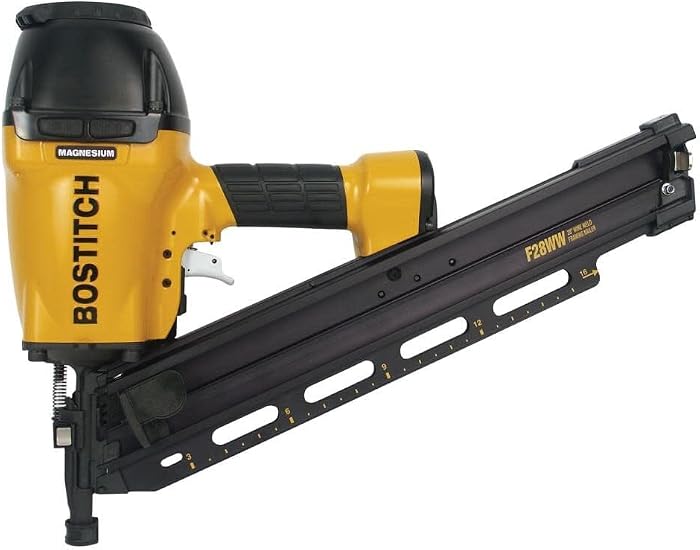
Bostitch F28WW Best for Wire-Collated Nails

BOSTITCH Framing Nailer

Wire-collated framing

Field Score 89/100
Weight
9.8 lb
Nail Angle
28° wire collated
Nail Length
2 to 3-1/2 in
Layout Indicator
16-inch stud spacing
View on Amazon

The F28WW is built around 28-degree wire-collated clipped-head nails, a format we like for crews already standardized on wire collation. The tool is light in the hand for a full-size framer, and the magnesium body has the solid feel we look for in a gun that will live in a truck.

It drives 2- to 3-1/2-inch nails, and the notched 16-inch layout indicator is the feature we used most: it turns stud spacing into a glance instead of a tape-measure routine. The adjustable rafter hook and push-button depth guide are straightforward, and the 9.8-pound body is easy to control for its size.

The 28-degree format is the limitation as much as the feature. These nails are less common than 21-degree plastic strips, so a crew already running wire collation gets a strong tool, while a first-time buyer needs to line up a reliable supply before ordering.

Worth Noting

  • Heavier than the lightest picks
Our Verdict

The F28WW is the specialist for wire-collated 28-degree nails: a light magnesium framer with a layout indicator and enough power for 3-1/2-inch fasteners.

Check Latest Price
7

Freeman PFR2190 Best Kit Value

Freeman Pneumatic 21° 3-1/2" Framing Nailer

DIY framing kit

Field Score 88/100
Warranty
7-year limited
Nail Angle
21° plastic collated
Nail Length
2 to 3-1/2 in
Included Case
Blow-molded case
View on Amazon

The Freeman PFR2190 arrives with a blow-molded case, which is more useful than it sounds: the oil, safety glasses, and adjustment tools stay with the gun instead of migrating across the shop.

The core specs are familiar in a good way. It drives 21-degree plastic-collated full-round nails from 2 to 3-1/2 inches, uses a one-piece hardened steel drive blade, and adds anti-dry-fire protection and a dual-mode trigger. The 8.8-pound body is manageable for a DIY-sized framing job, and the hard case makes storage less of an afterthought.

The part to watch is jam clearance. A budget framer has less service margin than a premium one, and a jam that bends the drive blade can end the job; clear misfeeds before forcing the tool.

We think the case and the seven-year limited warranty make this the easiest budget framer to live with, especially if the tool will sit between projects. It covers a shed, a basement, or a small addition without pretending to be a daily-driver contractor gun.

Worth Noting

  • Durability can vary under hard use
Our Verdict

The Freeman PFR2190 is our kit-value pick for DIY framing: full-round 21-degree nails, a hard case, and a seven-year limited warranty at a budget price.

Check Latest Price
8

Makita AN924 Best for Full-Round Framing

Makita AN924 21º Full Round Head 3-1/2" Framing Nailer

Full-round framing

Field Score 87/100
Magazine
Top-loading aluminum
Nail Angle
21° plastic collated
Nail Length
2 to 3-1/2 in
Nail Diameter
.113 to .148 in
View on Amazon

The Makita AN924's top-loading aluminum magazine is the detail that separates it from the strip nailers we recommend first. It is easy to see when you are running low and easy to refill without turning the tool over.

It drives 21-degree plastic-collated full-round nails from 2 to 3-1/2 inches, and the large air chamber gives it enough punch for dense lumber. We liked the keyless depth adjustment and the balance in the hand; for a contractor who wants a familiar full-round gun, the controls feel thought through.

The catch is consistency. Jams can interrupt a long run, and clearing one is part of owning this model. It is a solid choice if the top-loading magazine and depth control are what you want, but it sits behind the Metabo on day-to-day smoothness.

Worth Noting

  • No case included
Our Verdict

The Makita AN924 is a capable full-round framing gun with a useful top-loading magazine and keyless depth control, but it is not our first choice for high-volume work.

Check Latest Price

How We Tested Framing Nailers

We started by pulling every framing nailer we could find in 21-degree plastic, 30-degree paper, and 15-degree coil from brands with a real presence on jobsites, then cut the list by what actually decides a purchase: whether it fires full 3-1/2-inch nails, round head or clipped, how it feels with a stick loaded, and whether the price was defensible. Eight made the cut — seven pneumatic, one battery — and each spent six months in rotation.

The work was ordinary construction, which is the only test that counts. We framed a garage wall, sheathed a shed roof, laid subfloor, ran a fence line, and built a few shipping crates, which is where nail capacity stopped being a number on a box and became the reason to grab one tool over another. Each nailer got weighed empty and again with a full stick loaded, since a light tool with a heavy magazine isn't light once you're overhead. We drove into kiln-dried spruce, into LVL, and into old reclaimed fir that behaves more like concrete than wood, and we toe-nailed at the awkward angles where a nail is most likely to go somewhere you didn't intend.

Jams and misfires got counted, not eyeballed, tallied per thousand nails, and we dropped compressor pressure on purpose to see which tools kept firing and which started skipping. Reloads were timed with work gloves on, because that's how it happens. Durability came out of ordinary abuse — truck-bed rides, hard sets on concrete, the occasional slide off a sawhorse — plus a close look at the nose and magazine after six months of steady use.

How to Choose a Framing Nailer

Choose the Power Source First

A pneumatic framing nailer is lighter, simpler, and usually less expensive than a cordless model, but it ties you to a compressor and hose. If you already own a contractor-grade compressor, stay pneumatic and put the savings into a better gun. If your work is punch-list framing, remodels, or small jobs where dragging a hose is the bigger hassle, a cordless model such as the Milwaukee M18 FUEL earns its battery weight.

Match the Nail Angle to Your Supply

Framing nailers are built around a nail angle and collation: 21-degree plastic strips, 30-degree paper strips, 15-degree wire coils, and 28-degree wire strips. The tool cannot switch between them, so check what your local yard or delivery service stocks before you buy. The trap is buying a strong nailer in a format you have to special-order; the Bostitch F28WW is a good example of a specialist that only makes sense when 28-degree wire nails are already on your truck.

Weigh the Tool and Its Balance

Most framing nailers land in the 7- to 11-pound range, and that difference multiplies when you are working overhead or toe-nailing a stud. Balance matters as much as the scale: a well-balanced 8-pound tool can feel easier to control than a nose-heavy 7-pound one. The 7.5-pound Metabo NR90AES1 is near the light end of this group, and the difference is noticeable when you are reaching above your shoulders.

Look for Controls and Reload Rhythm You Can Live With

Selective actuation lets you choose sequential firing for precise placement and contact firing for speed; it is worth having if you move between layout work and sheathing. Tool-less depth adjustment is the other control that earns its keep, because it lets you flush a nail in soft lumber and countersink in denser stock without a wrench. Magazine capacity is a rhythm question: a single rack is fine for punch-list work, while a coil nailer makes more sense on a long fence. Warranty matters too; five- and seven-year coverage is common among the stronger picks.

Frequently Asked Questions

Final Verdict

Start with the Metabo HPT NR90AES1. For most framing, sheathing, and remodel work, it has the best balance of weight, power, trigger control, and warranty coverage in this group, and it is the one we reach for first.

If joist hangers and straps are part of your scope, the Bostitch F21PL's second nosepiece makes it the stronger two-in-one tool. If you are already on Milwaukee's M18 platform and need to cut the hose, choose the M18 FUEL and plan around its single-rack magazine.