The 9 Best Greenhouse Kits of 2026

The first strong wind of spring tells you more about a greenhouse kit than any product photo will. I've watched a thin cover work itself loose in a single gust and a sturdier frame take the same hit without a shiver. The difference is usually in the joints, the ground stakes, and how the cover attaches — details nobody photographs.

Most people buy one for calmer reasons: seedlings crowded onto every windowsill, and a tomato season that ends a month too early. A kit fixes both, provided it goes up without a fight, holds heat, and doesn't turn into a kite. We've spent eight months setting up and living with 12 kits — pop-ups, poly-film walk-ins, rigid panel houses — through rain, wind advisories, and one wet snow.

The footprint, by the way, is the least interesting number on the box. A 6-by-8 that holds warmth, vents properly, and has shelves you can actually reach beats a 20-foot tunnel you can't cool down in July. The picks below are sorted by how much room you really need and how much weather you're asking the thing to ignore.

Our Top Picks

The 9 Best Greenhouse Kits of 2026

1

EAGLE PEAK 8x6 Pop-Up Greenhouse Best Overall

EAGLE PEAK 8x6 Easy Setup Pop Up Greenhouse

First walk-in kit

Field Score 89/100
Cover
Polyethylene (PE)
Frame
Powder-coated alloy steel
Setup
Pre-assembled pop-up frame
Footprint
98.4"L x 70.9"W x 91.7"H
View on Amazon

The frame on the EAGLE PEAK 8x6 comes out of the box already joined, so setup is mostly walking the legs apart, pushing the center lock up until it clicks, and draping the cover over the peak. One person can get it standing; the cover goes on more easily with a second set of hands at the corners, but nothing about it needs tools or a free weekend.

At 91.7 inches to the peak, this is the tallest interior of any kit here, and that height is what we appreciated most. You can stand upright, hang a small fan from the crossbar, and reach a bench-height tray without folding yourself in half. The 8x6 footprint holds two folding tables or a season's worth of potted plants with a walkway down the middle, and the roll-up door plus two screened vents give you somewhere to dump heat on a sunny afternoon.

The trade-off is that a pop-up frame is a tension structure, not a bolted one. At 37.3 pounds it's light enough for one person to drag into position before the stakes go in, and light enough that an exposed site will work it loose, so plan on a fence line or a wall behind it and weight on the base skirt.

Worth Noting

  • Film cover has a shorter life than rigid panels
Our Verdict

The one we reach for first: an 8x6 walk-in one person can raise without tools, with headroom to stand up and work inside.

Check Latest Price
2

Ohuhu 12-Shelf Walk-In Greenhouse Best With Built-In Shelving

Ohuhu 57 x 57 x 76'' Greenhouses for Outdoors

Shelved seed starting

Field Score 88/100
Cover
Reinforced PE
Frame
Alloy steel, push-fit
Shelves
12 metal mesh, 3 tiers
Footprint
56.3"L x 55.5"W x 76.8"H
View on Amazon

Twelve shelves are the whole argument for the Ohuhu. They run down both side walls at three heights, so a flat of seedlings sits at chest level where you can reach it and the pots you're overwintering go underneath. At 56.3 by 55.5 inches on the ground it takes up most of a small patio, but unlike a bare walk-in, it arrives with its own staging.

Assembly is push-fit and tool-free, and the frame is light enough that one person can shift it around the patio before committing. What it does best is the unglamorous job: holding a humidity pocket steady for seedlings and keeping a couple of dozen pots out of the frost. The roll-up zipped door and two screened windows let you drop the heat before it cooks a flat of tomatoes.

The shelves are also the weak point: each one clips to the frame at two points, and a heavy tray will slide, so a handful of zip ties at the corners is five minutes well spent. Beyond that, this is a kit for a patio grower who wants staging and a walk-in in one purchase, not for anyone trying to shelter a whole vegetable bed.

Worth Noting

  • Cover can tear while you stretch it on
Our Verdict

Twelve shelves turn a small walk-in into a seed-starting station, and no other kit here gives you this much staging for the money.

Check Latest Price
3

Quictent 20x10 Tunnel Greenhouse Best Large Tunnel

Quictent 20x10x6.6FT Tunnel Greenhouse for Outdoors with 2 Hinged Doors

Large garden tunnels

Field Score 86/100
Cover
150 GSM PE with UV inhibitor
Doors
2 hinged, 180 degrees
Vents
8 mesh screen windows
Footprint
236.3"L x 118.2"W x 78.8"H
View on Amazon

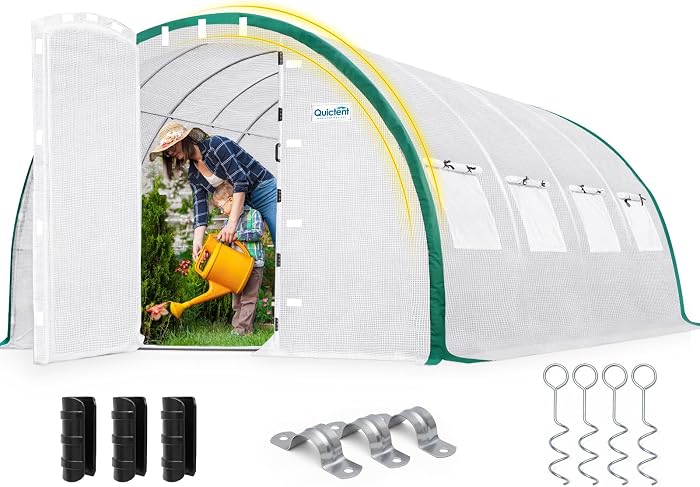
Two hinged doors are what separate this tunnel from every zippered hoop house on the page. Each one swings open 180 degrees and stays where you put it, which means you walk in with an armful of flats instead of wrestling a zip from your knees. Anyone who has owned a zippered tunnel knows that isn't a small upgrade.

The rest of the build backs it up. The 20x10 footprint gives roughly 194 square feet under a 6.6-foot peak, the frame carries extra crossbars across the top to stop sagging, and the 150 GSM cover has a UV inhibitor plus reinforced seams at the stress points. Eight mesh windows move air without letting in the cabbage moths.

Assemble it with two people, and watch a video first — the printed directions are the weakest part of the package. At 92.6 pounds with the cover on, this is a structure you site once rather than shuffle around the yard, and the extra bracing is why you won't want to move it anyway.

Worth Noting

  • Directions are thin for a frame this size
Our Verdict

Our pick for a serious garden: a 20-foot tunnel with hinged doors that skip the zipper fight, plus mesh windows down both sides.

Check Latest Price
4

Sylviera 8x10 Polycarbonate Greenhouse Best Year-Round Greenhouse

Sylviera 8x10 Polycarbonate Greenhouse – 8x10 FT Greenhouse with Hygrometer

Year-round growing

Field Score 85/100
Frame
Aluminum alloy
Vents
2 adjustable roof vents
Panels
4mm double-wall polycarbonate
Footprint
120"L x 97"W x 81"H
View on Amazon

Polycarbonate panels are the reason to spend real money on a greenhouse. The Sylviera's are 4mm double-wall, which means two sheets with trapped air between them — the same trick as a storm window — so the structure holds warmth after the sun drops instead of bleeding it through a single layer of film.

We like how the details line up: an aluminum frame with reinforced corners, two adjustable roof vents, a lockable door, and a hygrometer inside so you're not guessing at humidity. It reads as a permanent garden building rather than a tent, and it's designed to stay up year-round in a way the film kits simply aren't.

Budget a full day and two people, and test-fit everything before you tighten a single bolt. The same rigidity that makes the panels fussy on assembly day is what should keep this standing when a pop-up frame would be in the neighbor's yard.

Worth Noting

  • Panels and rails don't always line up
  • Costs several times what a film kit does
Our Verdict

Buy this one if the greenhouse stays up through winter: rigid polycarbonate panels and an aluminum frame, with no film cover to replace.

Check Latest Price
5

JESLED Indoor Grow-Light Greenhouse Best Indoor Greenhouse

JESLED Indoor Greenhouse with Grow Light

Indoor seed starting

Field Score 84/100
Use
Indoor
Layers
5 adjustable-height
Lights
6 x 3 ft full-spectrum LED
Footprint
35.4"L x 13.8"W x 59"H
View on Amazon

If your growing season starts in a spare bedroom, the JESLED is built for exactly that: five adjustable-height layers on a metal stand, six 3-foot full-spectrum LED bars, and a zip-up EVA tent that holds the humidity in. It stands 59 inches tall and a little over 3 feet wide, so it fits against a basement wall or beside a sliding door without taking over the room, and it's the only kit here designed around that job.

The tier-by-tier switching is what makes it useful rather than just bright. You can run one shelf for cuttings that need less light and another for seedlings stretching toward a windowsill, and the built-in timer takes the guesswork out of the on-off cycle. We also rate the sealed light housings, since an indoor greenhouse gets humid inside that tent.

Two things to know before you buy. The shelves are 13.8 inches deep, which is fine for seed trays and small pots and tight for anything wider, and the whole unit is indoor-only — the tent and lights are not built for a porch. Lockable casters mean you can roll it out of the way when guests arrive, which is more than most grow-light racks manage.

Worth Noting

  • 13.8-inch shelf depth limits pot size
  • Indoor only; not built for weather
Our Verdict

For a spring's worth of seedlings started indoors, we like this setup best: six LED bars, a timer, and a zipped tent on casters.

Check Latest Price
6

Greengro 28-Inch Walk-In Greenhouse Best for Narrow Spaces

Greengro 28-Inch Walk-In Greenhouse

Narrow porches

Field Score 83/100
Cover
PE with high-tensile grid
Frame
Metal, tool-free connectors
Shelves
4, across 3 tiers
Footprint
57"L x 28"W x 76"H
View on Amazon

Twenty-eight inches is the number that matters here. The Greengro is 57 inches long and only 28 deep, so it slides onto a porch, against a garage wall, or down the narrow side of a house where a square walk-in would block the path. At 76 inches tall, you still step inside rather than crouch over it.

For a kit this inexpensive it does the core job well: close it up and it gets genuinely warm inside, which is what you want for early seed sowing and for nursing a few tender plants past the first frost. Assembly is tool-free, and the maker rates the grid-reinforced PE cover to winds of 45 mph — take that as a fair-weather promise rather than a storm one.

The zipper is the single point of failure, since it's the only way in, and a jammed zip means lifting the cover off to reach your plants. Pull it slowly, keep grit out of the track, and this one earns its corner of the porch.

Worth Noting

  • Little room to move inside at 28 inches
Our Verdict

A 28-inch-deep kit is what fits a porch, a side yard, or the strip beside the steps, and this one does it with four shelves and no tools.

Check Latest Price
7

KING BIRD 25x10 Tunnel Greenhouse Best for Big Vegetable Plots

KING BIRD Premium 25x10x6.6FT Greenhouse for Outdoors

Big vegetable plots

Field Score 82/100
Cover
150 GSM PE, UVI 6
Vents
10 roll-up screen windows
Weight
95.8 lb
Footprint
295.2"L x 118.1"W x 79.2"H
View on Amazon

Twenty-five feet of tunnel changes what a greenhouse is for. Instead of staging pots, you're walking rows: 242 square feet under a 6.6-foot peak, with a door at each end and ten roll-up screen windows down the sides. It's the biggest structure here by a wide margin, and the only one that would swallow a full set of raised beds in a line.

The frame is the part that impressed us most: galvanized steel with extra top crossbars, diagonals, bottom poles, and two stiffeners, which is more bracing than most tunnels at this size carry. The cover is 150 GSM with a UV rating and grid reinforcement, and the two-layer doors — one PE, one mesh — let you keep the screen shut while the solid panel is rolled out of the way.

Ventilation is generous: ten windows plus two mesh doors means you can move a lot of air on a hot afternoon, and because both ends open you're never walking the full length to reach a plant at the far wall. The trade is a lot of closure hardware to keep straight, and hardware is where tunnels get old.

So this is the pick when square footage is the whole point — a long vegetable bed, a winter greens crop, a small market garden — and the two-ended access is what makes 25 feet workable. For a backyard with a handful of pots, the extra length is just more cover to replace.

Worth Noting

  • Door zippers fail and tear from the cover
Our Verdict

If you need to cover a real vegetable plot, this is the most growing space here for the money, though the door zippers need care.

Check Latest Price
8

SPECILITE 56-Inch Walk-In Greenhouse

SPECILITE 56×56×78Inch Walk-in Greenhouse for Outdoors Garden Plant

Budget first greenhouse

Field Score 81/100
Cover
Thickened PE
Frame
Metal, no-tool assembly
Weight
22 lb
Footprint
55.1"L x 55.1"W x 77.6"H
View on Amazon

Nothing about the SPECILITE pretends to be permanent, and that's the point. It's a 55-inch square of PE cover over a metal frame, it goes together without tools, and at roughly 22 pounds it can be picked up and shifted when you want the patio back for a weekend.

As a first greenhouse, it earns its place. The maker says the interior fits 24 pots, and a 55-inch footprint with an open middle will hold that many small ones, while the zippered roller door and two screened side windows give you real control over heat and airflow. Closed up on a sunny morning it warms fast, which is exactly what a tray of seedlings wants.

Where it shows its price is in the frame: thin tubes, plastic connectors, and a cover that needs a warm afternoon to stretch into place. Treat it as a seasonal structure rather than a permanent one and it does its job without complaint.

Worth Noting

  • Thin frame and plastic connectors flex
Our Verdict

The least expensive square walk-in here: 56 inches on a side, no tools, and light enough to move when the seasons change.

Check Latest Price
9

Aoodor 6x10 Polycarbonate Greenhouse

Aoodor 6x10 Polycarbonate Greenhouse – 6 x 10 Ft Walk-in Greenhouse with Gutter

Compact rigid kit

Field Score 80/100
Frame
Aluminum
Extras
Gutters and adjustable skylight
Panels
Polycarbonate
Footprint
120"L x 72"W x 81"H
View on Amazon

Gutters are the detail most greenhouse kits skip, and they're the one that keeps a 6x10 from turning its doorstep into a mud puddle. The Aoodor runs them along both eaves with drainage outlets, and adds adjustable skylights that do double duty: more light in winter, more heat out in July.

The rest is a scaled-down version of the rigid formula — polycarbonate panels that pass light comparable to glass and insulate far better than film, an aluminum frame, and a lockable door. At 120 by 72 inches on the ground with an 81-inch peak it's a two-person greenhouse rather than a family one: enough for a bench of tomatoes, a shelf of herbs, and a chair in the corner, which makes it the middle path between a film walk-in and a full-size panel house.

Assembly is the usual rigid-kit bargain. The parts are labeled and the tools are in the box, but the panels and rails want two people and a patient afternoon, and the instructions have gaps. Get the frame square before you glaze anything and the rest goes on easily enough.

Worth Noting

  • One roof vent is thin for a sealed box
Our Verdict

A compact rigid greenhouse for a patio corner, with gutters that keep runoff off the door and a price below the big kits.

Check Latest Price

How We Tested 12 Greenhouse Kits Through a Full Spring

We started by narrowing the field to kits with real anchoring hardware and frames described in materials rather than adjectives, then sorted them by footprint, covering, and door style so a pop-up wasn't being judged against a 20-foot tunnel. We bought 12 of them and spent eight months putting them up in backyards, on patios, and — for the indoor models — in a spare room with one north-facing window. Price wasn't a filter; value was.

Every kit got the same first test: one person, a step ladder, and a stopwatch. We timed assembly from box to last stake and noted exactly where a second pair of hands became unavoidable, usually at the roof crossbars or the cover pull. Then we loaded the shelves with wet seed trays and full pots and left them a week to see which tiers bowed, and whether a watering can could reach the back row without unloading anything.

The weather handled the rest. We watched all 12 through a spring wind advisory, checking for racked frames, slapping covers, and stakes pulling out of wet ground, then re-staked the ones that needed it. On clear 70-degree afternoons we logged interior temperature against the outside reading every hour, which is how you tell a house that holds heat from one that only holds light. Roofs got hosed down to look for pooling and seam leaks, and doors and windows were opened 20 times in a row, bare-handed and then in gloves, to see which zippers snagged and which screens actually moved air.

Three of the heavier houses stayed up through a wet snow, checked weekly for condensation, mildew on the inside of the cover, and bent members. Anything that failed a step got pulled, re-examined a month later, and re-rated.

How to Choose a Greenhouse Kit

Decide How Long It Stays Up

Permanence is the first fork in the road. A pop-up or push-fit walk-in goes up in an afternoon and comes down for storage, which suits renters, decks, and gardeners whose season has a hard end. A bolted tunnel — the hoop house style — or a polycarbonate panel house is meant to stay out through winter, and it costs more in both money and assembly time.

Pick the structure your spring actually requires. A seasonal film kit asked to survive a nor'easter is the most common way people end up disappointed.

Site It for Sun Before Anything Else

Greenhouses don't make light, they trap heat, so a shaded spot gives you a cool, damp shed with clear walls. Put the kit where it gets sun through the middle of the day, clear of a tree's summer canopy, and within hose reach — you'll water more often than you expect.

Leave a few feet clear on the door side. You'll be carrying trays in and out, and a door that opens into a shrub gets old fast.

Anchor What the Stakes Won't Hold

Every one of these kits ships with ground stakes, and every one of them is a lightweight sail. A 20-foot tunnel presents well over 100 square feet of surface for wind to push on, and a frame that weighs less than an adult loses that argument every time.

Use t-posts or screw-in anchors at the corners, weight the base skirt with pavers or blocks, and check the whole thing again after the first blow.

Cover Material Sets the Lifespan

Film covers — polyethylene with a grid or scrim — are inexpensive, light, and good for a few seasons; sun eventually makes them brittle and the seams go first. Rigid polycarbonate panels cost more, insulate better, and don't flap, but they need a square frame and a level base to sit in.

Whichever you pick, ask the seller whether a replacement cover or panel is stocked. The cover is the part that fails first, and a kit with no replacement path becomes a frame with a tarp over it.

Ventilation, Headroom, and the Door

A sealed greenhouse hits sauna conditions by mid-morning in April, so count the openable panels before you count the shelves. Screened windows and roll-up sides move air without letting in pests, and hinged doors avoid the zipper that eventually separates on a tunnel.

Then check the numbers you'll live with: peaks here run from about 76 to 92 inches, and a 28-inch-deep kit leaves very little room to turn around inside. Measure the door swing, too.

Frequently Asked Questions

Final Verdict

The EAGLE PEAK 8x6 earns the top spot because setup is where these purchases are won or lost, and it's the only kit here a single person can raise, use, and take down again without a helper or a toolbox.

If your plans run bigger than a patio, the Quictent's hinged doors solve the failure that plagues zippered tunnels on a daily basis. And if the greenhouse is staying up for good, skip film altogether: the Sylviera's polycarbonate panels are the difference between a structure and a cover.