The 8 Best Horse Liniments of 2026

Horse liniment does two jobs at once: it takes the heat out of a hot, puffy leg, then warms the muscle underneath so it loosens. The catch is that those jobs pull against each other. Push the menthol hard enough to reach a deep muscle and a thin-skinned horse will dance away from the sting and come up pink where you rubbed.

I keep a hard-working trail gelding and a 22-year-old who moves like a rusty gate on cold mornings, so I know what I want from a bottle. Over four months, our team put 14 liniments through the same barn routine — gels, liquids, sprays, menthol-heavy and menthol-free, drugstore bottles and barn-size jugs — and the gap between good and useless showed up in the first ten minutes.

Format matters more than the label suggests: a gel stays put on a vertical leg, a liquid covers a whole shoulder faster and runs through a sponge, and a spray is what you reach for when both hands are full of horse. The picks below handle a quick pre-ride rub and a stiff horse on a cold morning alike.

Our Top Picks

The 8 Best Horse Liniments of 2026

1

Absorbine Veterinary Liniment Gel Best Overall

Absorbine Veterinary Liniment Gel

Everyday muscle soreness

Field Score 95/100
Size
12 oz
Format
Gel
Show Safe
USEF competition as directed
Active Ingredients
Menthol and herbal extracts
View on Amazon

A gel earns its keep the moment you open it over a shoulder: it sits where you put it. Absorbine's holds its shape long enough to work in with the flat of your hand, so the menthol and herbal extracts end up in the muscle rather than running down the leg and onto the aisle floor. That single behavior is why it's our top pick for most horses.

The sensation arrives in two stages — a cold hit as you rub, then a warmth that settles in and stays. It's strong enough to get a reaction out of a stiff horse without the chemical slap of a competition-strength rub, and it dries down clean instead of leaving a film on your palms.

Then there's the label, which is unusually forthcoming. It's show safe for USEF competition when used as directed, which matters if your horse is in work and your season is sanctioned. It also gives real directions: three or more times a day, applied with the lay of the hair, lightly wrapped to speed things along, and kept out of the saddle area if you're riding afterward. That last line is easy to skip, and it's the one that keeps a menthol rub from becoming a sore back under a pad.

Twelve ounces isn't the bargain of the group by volume, but a gel goes further than a wash or a brace because you're dotting it on rather than covering a whole horse, so ours lives in the tack trunk rather than the feed room. It also has a second life as a human muscle rub, which tells you something about how it feels going on.

Worth Noting

  • Strong spearmint-menthol scent lingers on hands
  • Slower to cover a whole hindquarter than a spray
Our Verdict

It's the one we recommend to most people: a gel that stays on the muscle, warms fast, and carries a show-safe label you can actually rely on.

Check Latest Price
2

Absorbine Bigeloil Liniment Best Liquid Liniment

Absorbine Bigeloil Liniment Liquid

Whole-body washes

Field Score 91/100
Size
32 fl oz
Format
Liquid concentrate
Sensation
Milder than Absorbine's original liquid
Also Used As
Body wash and brace, diluted
View on Amazon

Bigeloil is a concentrate, and that changes what the bottle is for. Full strength it's a leg rub; mixed at two to three ounces per quart it's a brace you sponge on before work; at two to four ounces per gallon it's a body wash for a horse that finished the day sweaty and tight.

The difference from Absorbine's orange-label liniment is deliberate. Bigeloil is the milder of the two — a warm herbal tingle rather than a burn — which makes it the one to use routinely rather than save for a crisis.

It also dilutes further than anything else here, so a 32-ounce bottle keeps going long after a gel would be scraped empty. That's the economics of a concentrate: you're buying liniment and water and doing the mixing yourself, and the bottle lasts accordingly.

We reach for this one when the job is a whole horse rather than a spot — a rinse after a hard ride, a brace before one, a set of legs that need sponging rather than rubbing. If you only ever treat a single stiff shoulder, a gel is the tidier tool; this is for the horse in full work.

Worth Noting

  • Thin, watery liquid runs down a vertical leg
  • Needs measuring and mixing before each diluted use
Our Verdict

If liniment is part of your weekly routine, buy the quart: one concentrate covers the post-ride wash, the pre-ride brace, and the sore spot.

Check Latest Price
3

Four Oaks Farm Natural Release Spray Best Menthol-Free

Four Oaks Farm Natural Release Spray

Use under tack

Field Score 90/100
Size
16 fl oz
Format
Spray
Free Of
Menthol and alcohol
Under Tack
Saddles, wraps, and blankets
View on Amazon

There's a part of the horse where a menthol rub can't go: under the pad, under a standing wrap, under a blanket that will hold the fumes against the skin. Four Oaks built its spray for that gap — no menthol, no alcohol, and a label that allows it under saddles, wraps, and therapeutic blankets.

The formula is magnesium from the Dead Sea, arnica, and eucalyptus, and it goes on as a fine mist that sinks in fast and leaves nothing oily behind. We like it for a horse in full work because you can spray a back, saddle up, and ride without wondering what's cooking underneath — and because it doesn't sting a clipped coat the way an alcohol-based brace can.

The trade is sensation. Without menthol there's no tingle telling you something is happening, and on a horse managed with strong rubs the first application can feel like nothing at all. Judge it across a week of consistent use rather than one pass, and buy a menthol gel instead if what you want is a hard counter-irritant after a workout. It comes in three spray sizes and a gel, so the small bottle can live in the grooming box while the big one stays in the barn.

Worth Noting

  • Costs more per ounce than the menthol gels
Our Verdict

Anywhere a rub has to sit under tack, this is the one we reach for — no menthol, no sting, nothing cooking under the pad.

Check Latest Price
4

Farnam Vetrolin Liniment Best Bulk Size

Farnam Vetrolin Horse Liniment for Muscle Soreness

Large barns

Field Score 89/100
Size
128 fl oz
Format
Liquid concentrate
Best Use
Body wash, brace, or leg rub
Key Ingredients
Five essential oils
View on Amazon

A gallon of liniment sounds like a lifetime supply until you see how it gets used: an ounce to a quart for a body wash, four ounces to a quart for a brace, full strength on legs that are stocking up. At barn scale that jug empties faster than the size suggests.

Our favorite use for it is the one that gets the least attention: a post-work rinse. Sponged over a hot horse after a summer ride, it cools the legs and leaves the coat with a shine, because Vetrolin's five essential oils do double duty as a finishing product. That's more than most liniments here can claim.

Full strength on the legs is where it does its most serious work, and also where to be careful. This is a strong herbal formula, and left on thin skin behind the knee or sealed under a bandage it can be too much; dilute when the label says to and check the legs the next morning the first few times you use it.

Vetrolin also comes in a 32-ounce container and a 20-ounce non-aerosol spray, and for a single horse in a trailer those are the sensible buys. The gallon is a barn purchase, priced accordingly, and it's the cheapest way to buy this much liniment per ounce.

Worth Noting

  • Heavy gallon jug is awkward to pour
Our Verdict

Barns that work through liniment by the quart get the best value here; we reach for the gallon as a post-work rinse more than anything else.

Check Latest Price
5

Sore No More Gelotion Best for Sensitive Skin

Sore No More Gelotion Bottle

Sensitive-skinned horses

Field Score 88/100
Size
12 oz
Format
Thick gel
Free Of
Parabens, sulfates, synthetic additives
Skin Tolerance
Labeled not to blister or burn
View on Amazon

Sensitive skin is the whole reason to buy this one. Sore No More's Gelotion states plainly that it doesn't blister or burn, and for a horse that has reacted to a stronger rub — hot skin, a flinch, hair rubbed away under a wrap — that promise is worth more than extra tingle.

The texture is the other half of the appeal. It pours thinner than the name suggests, closer to a lotion than a gel, which carries it across a back or a hip in a couple of passes and lets it sink in without residue. On a big flat area it's faster than a stiff gel and far tidier than a liquid.

The maker also lists it free of parabens, sulfates, and synthetic additives, which is part of why it costs more per ounce than the Absorbine gel. We treat that premium as the price of a liniment you can put on a delicate horse without a long trial-and-error period.

Worth Noting

  • Costs more per ounce than our top pick
Our Verdict

Thin-skinned horses that have reacted to stronger rubs are why this one is here; it spreads easily and works without the sting.

Check Latest Price
6

Vita Flex Thermaflex Liniment Gel Best Budget

Vita Flex Thermaflex Horse Liniment Gel for Sore Muscles & Joint Relief

First-time buyers

Field Score 87/100
Size
12 oz
Format
Gel
Menthol
4%
Show Safe
USEF competition as directed
View on Amazon

Thermaflex is the least expensive way into a menthol gel here, and it doesn't make you give up the show-safe label to get there.

The label is unusually specific: menthol at 4 percent, plus MSM and extracts of calendula, rosemary, and cajuput oil. That number is worth noticing, because most of the gels on this page don't publish one at all — you know exactly how much counter-irritant you're putting on and can decide whether that's the right dose for your horse.

We treat it as the sensible first bottle. It's a straightforward rub with no mixing and no dilution, so you can work it in where the horse is sore and see how the next morning looks. If you're building a tack room from scratch, or you want a spare that stays in the trailer, this is the one to buy without agonizing over it.

Our Verdict

We keep this on the list as the cheapest sensible start: a show-safe 4 percent menthol gel that does the everyday job without fuss.

Check Latest Price
7

Vetericyn Mobility Equine Liniment Best for Wrap and Bandage Days

Vetericyn Mobility Equine Liniment for Fast-Acting Relief of Muscles and Joints

Wrap and bandage days

Field Score 86/100
Use
Under wraps and bandages
Size
16 fl oz
Type
Menthol-based topical analgesic
Format
Gel-lotion
View on Amazon

Vetericyn's liniment is the middle texture of this group — thicker than Bigeloil, thinner than the Absorbine gel, somewhere between a lotion and a gel. That makes it easy to work into a shoulder or a stifle without dragging, and it stays where you spread it long enough to get a hand over it.

The label's best instruction is the one for deeper relief: apply it and bandage over it. That's a different job from a rub you leave open to the air, and it suits a horse on stall rest or one that comes in with a filled leg. The bottle is 16 ounces, and it carries a lifetime warranty, which isn't something you see on a liniment.

We reach for it on wrap days rather than every day. As a plain rub it's fine but unremarkable; as the layer under a standing wrap or a pillow wrap it does something the gels here aren't set up for, and a bottle that size means you won't ration it.

Worth Noting

  • Strong menthol odor that lingers
Our Verdict

Our pick when the plan is to wrap: it spreads evenly, sinks in, and the label tells you to bandage right over it.

Check Latest Price
8

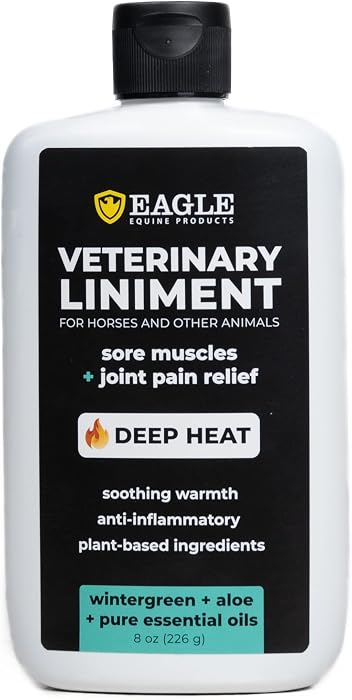
Eagle Equine Veterinary Liniment Gel Best for Mild-Scent Seekers

Eagle Equine Veterinary Liniment Gel – Veterinary Liniment Gel for Horses

Mild-scent seekers

Field Score 85/100
Size
9.14 oz
Scent
Mild botanical
Format
Gel
Key Ingredients
Menthol, wintergreen, essential oils
View on Amazon

Open this jar and you get lavender and eucalyptus first, not the eye-watering menthol cloud that follows most liniments out of the bottle. Eagle Equine builds its gel on roman chamomile, rosemary, tea tree, aloe, and witch hazel, with the menthol and wintergreen sitting underneath the botanicals rather than on top of them.

It's a proper gel, thick enough to hold on a hock, and it spreads further than the small jar suggests. The plant list is longer than anything else here, which is part of what you're paying for.

The heat is gentle rather than aggressive. It builds slowly and fades rather than announcing itself, which suits a horse that has had a bad reaction to a stronger rub but still needs something on a sore muscle; on a cool morning the warmth is subtle enough that you may want a blanket over the quarters afterward.

The horse this suits is the one that makes a face when the menthol bottle comes out, and the rider working in a small space where a cloud of menthol is the last thing anyone wants. You keep a counter-irritant; you lose the fumes.

Worth Noting

  • Small 9-ounce bottle for a midrange price
  • Wintergreen can sting clipped or thin skin
Our Verdict

A horse that objects to a menthol cloud does better with this botanical gel: gentle heat, mild scent, and the same counter-irritant idea.

Check Latest Price

How We Tested 14 Liniments in a Working Barn

We started at the feed store shelf and a stack of catalogs, listed about 30 liniments, and cut that to 14 by format (gel, liquid, spray), by whether they leaned on menthol or skipped it, and by cost per ounce. Then we used them for four months, on two horses and on ourselves — which is less strange than it sounds, since plenty of riders rub liniment into a sore shoulder with bare hands.

Applications followed the barn routine rather than a schedule. Each bottle got a shot on a hot, puffy leg after a long trail ride, on the stiff older gelding before turnout on cold mornings, and on muddy legs straight after hosing, when the coat is damp and half the products slide right off. I noted how long each took to sink in or dry, and how many applications we got before we scraped the bottom of the bottle.

Warmth was the axis that separated them most. I timed how long each took to register, whether it built to a real deep heat or stalled at a tingle, and whether it tipped into a burn after 20 minutes. Skin sensitivity got its own check: a patch on the inside of my forearm and one on the thin-skinned gelding's back, inspected for redness half an hour later. We paid attention to scent in a closed aisle, and to whether the horses objected — a couple of sharp, bitter formulas earned a snort and a sidestep, and one got licked at. Cost per application decided the rest, because a bargain jug that needs three times as much isn't a bargain.

How to Choose a Horse Liniment

Start With the Format, Not the Formula

A gel is for a spot: one shoulder, one hock, a back that's tight on a single side. It sits where you put it, which is why it's our default. A liquid concentrate is for a whole horse and a whole routine — you dilute it into a wash or a brace and sponge it over. A spray covers a large area quickly and suits a clipped coat, though it drifts in a breeze and some of it ends up on you.

Match the format to the size of the area you treat: spot rubs want a gel, legs that stock up after work want a concentrate, and a horse that won't stand still for a hand rub wants a spray.

Read the Tingle, Then Read the Skin

If a liniment doesn't tingle, most of us assume it isn't doing anything. That's backwards. The burn of menthol and wintergreen is a counter-irritant effect, not a measure of how much relief the muscle gets, and more of it mostly means more chance of a reaction on thin or clipped skin.

Two picks here address that directly: Sore No More's gelotion is labeled not to blister or burn, and Four Oaks leaves menthol out entirely. Patch-test a small area before a full application, and keep any menthol rub out of the saddle area before a ride — Absorbine's own directions say so.

Do the Arithmetic on Dilution

Concentrates look expensive until you divide by the bucket. A quart of Bigeloil or a gallon of Vetrolin is mixed at a couple of ounces per quart for a brace and a few ounces per gallon for a wash, so one bottle covers dozens of applications. Gels cost more per ounce, but you use far less at a time and none of it goes down the drain.

Buy the concentrate if you wash or brace after most rides. Buy the gel if you spot-treat a sore back twice a week and want the bottle to live in the tack trunk.

Check the Show-Safe Label Before You Need It

Only some liniments state competition clearance. Absorbine's gel and Thermaflex both say they're show safe for USEF competition when used as directed, and that qualifier is the whole claim — it means following the label's application and timing rather than improvising.

If your horse is showing, check the current rules for your association and keep a photo of the label on your phone. Rules and formulations change, and a bottle bought two seasons ago is not the authority.

Frequently Asked Questions

Final Verdict

The Absorbine gel is the liniment we hand to most people, because it does the everyday job — a sore back, a stiff hock, a horse that needs rubbing before turnout — without running off the leg or leaving a film on your hands.

If liniment is part of your weekly routine rather than a spot treatment, the Bigeloil quart is the smarter buy. If the rub has to sit under tack or a bandage, choose the Four Oaks spray or the Vetericyn instead.