The 7 Best Insoles for Square Toe Boots of 2026

Square toe boots solve one problem and quietly create another. The roomy toe box stops your toes from rubbing, but the footbed underneath is wide and flat, and the insole glued inside is usually a thin slab of foam with no real arch. Swap in something supportive and you hit the second problem: most insoles are cut for a tapered toe, so they curl at the edges, slide forward, or leave a gap you can feel with every step.

Over four months, my team and I wore 14 pairs in square toe work boots — on concrete shop floors, on ladders, on the walk back to the truck — and the differences showed up fast. One thing I'd tell a first-time buyer: thickness matters more than any cushioning claim on the package. Stack too much under the heel and your foot sits higher in the boot, which can make a roomy square toe feel loose.

What separates a good insole from a forgettable one is whether the arch is still doing its job at 4 p.m. and whether the edges stay where you put them. The pairs below are the ones that did, sorted by how you'll actually use them.

Our Top Picks

The 7 Best Insoles for Square Toe Boots of 2026

1

Ariat ATS Wide Square Toe Insole Best Overall

ARIAT Men's ATS Wide Square Toe Insole

Square toe boots

Field Score 93/100
Fit
Wide square toe, sized to boot
Type
Factory footbed replacement
Profile
Thin, no trimming
Cushioning
Gel footbed
View on Amazon

Almost every insole in this set asks you to cut it down to size, which in a square toe boot means guessing where the widest part of the toe box ends and hoping you guessed right. The Ariat ATS Wide Square Toe skips the scissors entirely. It is cut on Ariat's wide square toe last, sold in your boot size, and shaped to replace the factory footbed rather than layer on top of it.

That is the reason it is our top pick, and it matters more than it sounds. A trimmed insole in a boot this shape is always a compromise somewhere, short at the toe or pinched across the ball, and the ATS sits flush because nothing gets cut. The gel footbed is also thin, which is a compliment here: it does not tighten a boot you spent months breaking in.

What it is not is an orthotic. The arch is mild, and if your reason for buying is pain under the arch or a plantar fasciitis flare, this will not hold you up; the WalkHero and the VALSOLE are the picks for that. The ATS is a comfort footbed, restoring what the original had and adding a little more give under the heel.

The detail we did not expect is how far the shape travels. This footbed goes into Justin, Dan Post, and Red Wing square toe boots as readily as into Ariats, which makes sense once you notice that most wide square toe boots share an outline. Order your boot size, do not trim it, and swap it out when the cushion flattens.

Worth Noting

  • Mild arch; not a corrective insole
Our Verdict

If your square toe boots have a footbed you can pull out, we point you here: it drops in at your boot size, stays thin, and brings back the cushion the original lost.

Check Latest Price
2

Ariat Energy Max Wide Square Toe Best for Hot Work Days

ARIAT Men's Energy Max Work Insole Wide Square Toe

Hot work days

Field Score 92/100
Fit
Wide square toe, sized
Liner
Moisture-wicking with Agion
Cushioning
Rebound foam layer
View on Amazon

A square toe work boot in August is a bad place to spend ten hours. Ariat built the Energy Max for exactly that: a moisture-wicking liner treated with Agion for odor, open-cell foam meant to move heat away from the foot, and a rebound foam layer running the full length.

The liner is the part that earns the money. It stays smooth and dry underfoot in a way a fabric-topped insole does not after a few hours, and in a boot that never gets a chance to air out between shifts, that is most of the difference between finishing the day comfortable and finishing it ready to throw the boots in the truck bed.

Fit is the same argument as our top pick, one step down. It is cut for a wide square toe box and runs true to boot size, so it drops in without trimming, and the cushioning is a touch deeper than the ATS. What holds it back is the arch, which is moderate at best: comfortable, not corrective. If you are shopping because your arches hurt, keep reading.

Buy it for boots that get genuinely wet inside, summer fieldwork, barn work, a concrete pad in a shop with no air moving. For a boot that never runs that hot, the ATS does the same job for less.

Worth Noting

  • Top cloth wears through at the ball
Our Verdict

We send sweaty-shift workers here: the same square toe fit as our top pick, with the liner and foam that keep a hot work boot from turning into a swamp by noon.

Check Latest Price
3

Dr. Scholl's Work All-Day Insoles Best Budget

Dr. Scholl's Work All-Day Superior Comfort Insoles (with) Massaging Gel

Budget work boots

Field Score 91/100
Fit
Men's, trim to fit
Length
Full length
Cushioning
Massaging gel
Odor Control
Polygiene StayFresh
View on Amazon

These are the least expensive gel insoles we kept, and we kept them because they do one job well: a full-length gel layer that takes the sting out of a hard floor without trying to correct anything about your foot.

In a square toe boot they behave like a thin cushion, which is what most people actually need. They are sold trim-to-fit, so the fit is on you: cut them against the boot's original footbed with a little extra at the toe, then take small passes rather than big ones. A short insole creeps forward and bunches under your arch, and no amount of gel fixes that.

What they do not have is arch. The gel sits flat, so if your feet roll inward or your arches ache by mid-afternoon, this will feel like standing on a soft mat rather than being held up. The Polygiene treatment is a genuine plus in a boot, though, since closed footwear gets ripe fast and an odor-treated top layer buys a few more wears between cleanings.

The honest read: if your problem is tired feet on concrete, this is the cheapest gel fix here and it works. If your problem is structure, spend the extra and go further up this list.

Worth Noting

  • Packs flat under daily hard use
Our Verdict

For anyone on concrete all day who is not ready to spend much, these gel insoles are the low-risk first try, as long as you do not need your arches held up.

Check Latest Price
4

WalkHero Plantar Fasciitis Insoles Best for Arch Support

WalkHero Plantar Fasciitis Insoles

Arch pain

Field Score 90/100
Arch
Firm EVA with deep heel cup
Size
Mens 10-10 1/2 | Womens 12-12 1/2
Material
EVA
Designed For
Wider, high-volume shoes
View on Amazon

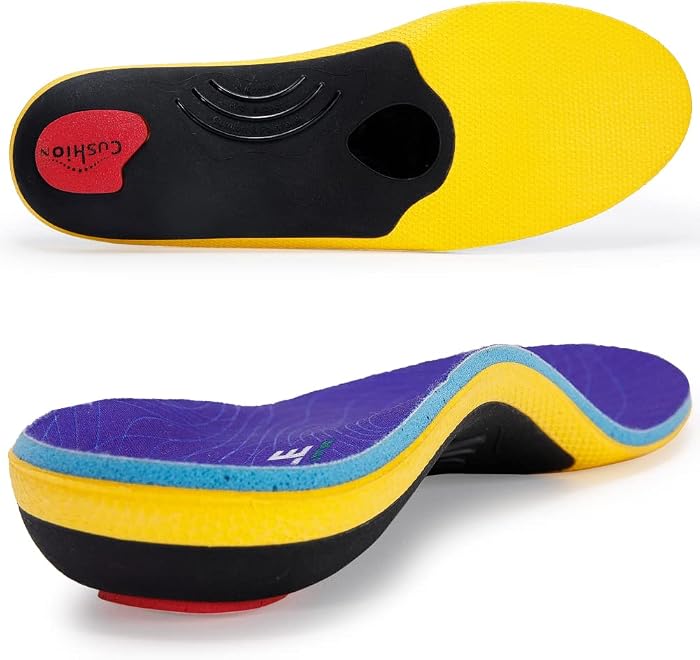
Where the Ariats are comfort footbeds, the WalkHero is an orthotic and does not apologize for it: a firm EVA shell, a deep heel cup that holds the heel where it lands, and a shape the maker builds for wider, high-volume shoes, work boots and basketball shoes and runners among them.

For the buyer it is aimed at, that is the right call. Plantar fasciitis and aching arches respond to structure more than squish, and this holds an arch up instead of flattening under load. It is not a pillow: the EVA is stiff, and if you came here expecting gel it reads as hard under the ball of the foot. Give it a few days before you decide.

Sizing is the practical wrinkle. This one runs roughly a half size short against your boot size, so go up rather than trusting the printed range. It is also not a trim-to-fit insole, so the width has to be right out of the box; in a smooth-bottomed boot a loose one will creep, and there is no trimming your way out of it.

This is the insole for someone whose day is organized around their feet: standing shifts, long walks on pavement, a heel that complains on the first step out of bed. It is not the one for a boot you wear to town twice a week.

Worth Noting

  • Firm EVA gives almost no cushioning
  • Can shift in a smooth-bottomed boot
Our Verdict

If arch or heel pain is why you are shopping, this is the pick we name: firm, high-volume support shaped for the wider shoes square toe boots already are.

Check Latest Price
5

Copper Fit Work Gear Insoles Best for Roomier Boots

Copper Fit Unisex Work Gear Comfort Insoles

Roomier boots

Field Score 89/100
Profile
Thick, cut to size
Top Layer
Ventilated
Cushioning
Triple-layer dual foam
View on Amazon

Not every pair of square toe boots needs an orthotic. Some have simply gone roomy: the leather has stretched, the factory footbed is pancake-flat, and the boot moves around your foot with every step. That is the boot the Copper Fit is built for.

It is the thickest insole here, a triple layer of foam with a ventilated top, and the bulk is the feature rather than a flaw. Drop it into a boot that has gotten sloppy and the volume comes back: your heel sits down in the boot instead of lifting, and a hard shop floor stops transmitting straight through your legs.

We also appreciate that the arch is gentle. There are people who want cushion and not correction, and this is the only pick here that gives it to them without an arch bump pressing under the instep. That is a smaller crowd than the orthotic shoppers, but it is a real one, and the price makes trying it easy.

Trim it against the factory footbed rather than eyeballing the boot's outline, and leave a little extra at the toe on the first pass. Foam is forgiving, but a ragged edge under your toes is not.

Worth Noting

  • Too thick for an already-snug boot
  • Top layer can peel away
Our Verdict

For a square toe boot that has gone loose, this is the fix we reach for: thick, flat foam that fills the boot back up without an arch shelf digging in.

Check Latest Price
6

Dr. Scholl's Heavy Duty Support

Dr. Scholl's Heavy Duty Support Insole Orthotics

200+ lb wearers

Field Score 88/100
Heel
Extra supportive heel cushioning
Size
Men's 8-14, trim to fit
Designed For
Men 200+ lbs, wide feet
View on Amazon

Dr. Scholl's built this one for a specific body: men over 200 pounds, tall men, and men with wide feet. The heel gets a cushion ring that wraps around it, the arch is a molded shell rather than a gel pad, and the whole thing is trimmed down from a men's 8-to-14 blank.

The heel is what earns its place. In a boot whose heel has worn down to nothing, that wrap changes how your legs feel at the end of a shift, and it is the reason this stays in the roundup despite being the least friendly insole here to wear in.

The trade is that molded shell. It is hard plastic, and against some boot bottoms it squeaks with every step; you will know within a lap of the barn aisle whether you drew that card. What it buys you is an arch and heel that do not collapse by noon, which is the whole reason to put up with it.

So: a heavy wearer, a standard-width boot, a heel that aches, and pain running up into the lower back. That is who this is for. If your square toe boots are an EE or wider, the shell will sit narrow and leave a gap at the edges of the footbed, and you are better off with the WalkHero. Trim it carefully and give it a day to settle before you judge the arch.

Worth Noting

  • Wears down under heavy daily use
Our Verdict

Heavier wearers over 200 pounds get serious heel and arch structure here, though the cut runs narrower than a product sold for wide feet suggests.

Check Latest Price
7

VALSOLE Heavy Duty Orthotics Best for High Arches

VALSOLE Heavy Duty Support Pain Relief Orthotics

High arches

Field Score 87/100
Arch
High arch support
Intended Use
Work, hiking, and western boots
Weight Rating
220+ lbs
View on Amazon

Before you buy these, check two things: that your boot's factory footbed lifts out, and that there is room to spare once it does. Given both, this is the most arch support in the roundup, a tall shell rated for 220 pounds and up, with shock absorption at the heel and a shape that does not fold under load.

That stiffness is the point. Where the gel insoles soften the ground, this one holds your foot in a position and keeps it there, which is what a heavy wearer with collapsing arches needs. It suits work boots, hiking boots, and western boots with removable inserts equally well, because the shape does not care what it is inside as long as there is room.

The limitation is width. It is cut to a standard men's width, and in an EE square toe boot it sits narrow, leaving a gap at the edges where the boot's own footbed used to reach. For an article about square toe boots, that is the frustration worth naming: a wider version would suit this buyer better than almost anything else here.

Worth Noting

  • Hard, unforgiving underfoot
  • Little cushion under the ball of the foot
Our Verdict

A tall, rigid arch for heavier wearers, best in a roomy boot whose factory footbed comes out, and not the pick for a snug square toe.

Check Latest Price

How We Tested Insoles for Square Toe Boots

We started by gathering every insole we could find that was either cut specifically for a wide square toe or wide enough to trim to one, then added the heavy-duty options built for people over 200 pounds, since so many square toe boots end up on folks who stand on concrete all day. That list ran past 30 pairs; we bought 14 and put each one into rotation. The trim-to-fit models we cut with kitchen shears along the printed lines, checking the shape against the boot's original footbed before anything went in.

Every pair went into at least one pair of square toe work boots and stayed there for full 10-hour shifts — on a shop floor, up and down a ladder, out in the yard on weekends, and on the walk to the truck at the end of the day. I measured each insole's thickness with calipers before it went in, then noted whether the boot suddenly felt tight across the instep or the heel started to slip, and checked at the end of each shift for insoles that had crept forward, curled at the edges, or bunched under the arch.

Support was the part we argued about most. I pressed a thumb into each arch and heel cup to see how quickly it gave, then wore each pair through a week of long days and rated foot fatigue, arch ache, and heel pain at the end of every shift. Two testers with plantar fasciitis symptoms logged their pain morning and evening so we could see whether relief arrived in days or weeks — and whether it lasted past lunch.

At the four-month mark we pulled every insole back out and compared them to day-one photos: heel foam compressed flat, arches that had collapsed, fabric pilling, edges splitting where they'd been trimmed. Value got settled there rather than at checkout — a cheap pair still holding its shape in month four beat a pricier one that went flat by week six.

How to Choose Insoles for Square Toe Boots

Start With the Footbed, Not the Insole

One question decides most of this: does your boot's factory footbed lift out? Ariat's square toe boots come with a removable one, and so do plenty of western and work boots. When it comes out, an insole like the Ariat ATS replaces it and adds almost no height at all.

If yours is glued down, you are stacking on top of it, and you have only a few millimeters before the instep gets tight and your heel starts lifting with each step. Pull the footbed up and look at what is underneath before you shop.

Thickness, and What a Square Toe Box Really Gives You

Here is the trap. A wide square toe box looks like it is full of spare room, so people assume they can fit a thick insole. Most of that room is across the toes, which is exactly where an insole does not need to be thick. What actually gets tight is the instep and the heel, the two most fitted parts of any boot.

So a thick insole is the answer for a boot that has gone loose and the wrong call for one that still fits. After you fit it, press a thumb down over your toes: if they are touching the top of the box, there is too much insole in there.

Cushion or Arch Support

Two kinds of insole live in this category and they solve different problems. Cushioning insoles, the gel and foam picks like Dr. Scholl's and Copper Fit, soften the ground and are what you want for fatigue on concrete, gravel, or a shop floor.

Orthotic-shaped insoles with a firm arch and a heel cup, like the WalkHero and the VALSOLE, hold the foot in position and are what you want when the pain is in your arch, heel, or plantar fascia. You cannot get both at full strength: the firmer the arch, the less pillowy it feels. Decide which problem you are solving before you shop.

Trim-to-Fit, Sized, and Getting the Length Right

A footbed sold in boot sizes is close to a drop-in, and if your boot's original lifts out, that is the easiest route by far. Trim-to-fit shoe inserts cost less and cover more boots, but the cut matters: trace the boot's original footbed rather than your foot, cut slightly long, then take small passes off the toe rather than the sides.

A short insole creeps forward and bunches under your arch, which is worse than a slightly long one you can trim again. And go up a size when the listing warns it runs short: the WalkHero runs about a half size short against boot sizing.

Heat, Sweat, and When to Replace Them

Boots run hot, and a closed-in insole is where the moisture ends up. Liners treated with Agion, Polygiene, or a comparable odor treatment, as on the Ariat Energy Max and the Dr. Scholl's Work All-Day, make a real difference over a summer, and a ventilated top layer helps a little more.

Plan on replacing any of these once the top cloth wears through or the foam stops springing back. That is the honest signal, not a calendar.

Frequently Asked Questions

Final Verdict

Most people with a pair of square toe boots should start with the Ariat ATS Wide Square Toe Insole. It is the only one here cut for the boot instead of trimmed to guess at it, it costs about what the generic orthotics do, and it adds almost no height, which is the whole game in a boot you already like.

If pain under the arch or heel is the reason you are shopping, change course for the WalkHero. And if your boots have gone loose rather than tight, the Copper Fit is the fix nobody thinks to try.