The 7 Best Invisible Dog Fences of 2026

An invisible fence isn't really a fence. Nothing in the ground physically stops a determined dog; a boundary signal warns with a tone or vibration, a collar backs that up, and the first few weeks of training do the rest. What you're buying is the payoff: an open back door, the run of the whole yard, and no contractor's quote or landlord's permission to worry about.

We spent six months with 12 systems. Setup ran from a twenty-minute afternoon to a full weekend of trenching, batteries held anywhere from days to weeks, and correction strength varied more than spec sheets suggest. We also checked what reviews skip: whether a system grows to a second dog, whether a collar survives a pond, and whether a GPS model charges a monthly fee to use the fence you already bought.

The picks below split three ways — wire in the ground for a permanent yard, no-dig wireless for renters and travel, and GPS for acreage or camping — and each one asks for about two weeks of leashed training before you can trust it.

Our Top Picks

The 7 Best Invisible Dog Fences of 2026

1

PetSafe Stubborn Dog In-Ground Fence Best Overall

PetSafe Stubborn Dog In-Ground Fence

Odd-shaped yards

Field Score 87/100
Dog Fit
8 lb+, neck 6–28 in
Boundary
Buried wire, custom shape
Coverage
500 ft wire, 1/3 acre included; up to 25 acres
Correction
Tone, vibration, 4 static levels
View on Amazon

A circle is the wrong shape for most country yards. The driveway, the shop, the garden you want the dog out of, and the gate the delivery truck uses all sit somewhere inside it. A buried wire goes exactly where you trench it, and that is the reason we point most people with a real yard toward the PetSafe Stubborn Dog In-Ground first.

What earns it the top spot is a receiver built for dogs that shrug off a first warning, paired with coverage that grows with the property. The kit includes 500 feet of wire — about a third of an acre — and you can add wire to fence up to 25 acres, which handles a barnyard, a paddock, or a long gravel drive. The collar gives tone and vibration plus four static levels, so there is somewhere to go when level two stops mattering, and the vibration mode doubles as the signal for a dog that is losing its hearing.

Installation is a weekend, not an afternoon, but the parts are in the box: flags, a surge protector, gel-filled splice capsules, and a test light for checking the loop before you backfill. The collar is waterproof, adjusts to necks from 6 to 28 inches, and is rated for dogs 8 pounds and up at 6 months old. Walk the line with the tester at every corner before you cover the wire. A single nick takes the whole loop down, and finding it after the grass grows back is the worst part of owning any wired system.

Two things we don't love. The collar runs on 9-volt batteries rather than a rechargeable pack, so you are buying cells on a schedule. And ground that freezes and heaves can break a wire with nothing touching it. If you rent, or the yard is small and roughly square, a wireless system saves you the spade work. Everyone else gets the boundary that stays put.

Worth Noting

  • Requires trenching 500 feet of wire
  • Collar runs on 9-volt batteries
Our Verdict

The pick for yards with corners, a driveway, and a dog that tests the line — provided you're up for a weekend of trenching.

Check Latest Price
2

SportDOG Rechargeable In-Ground Fence Best for Large Properties

SportDOG Rechargeable In-Ground Fence System

Large acreage

Field Score 86/100
Collar
Rechargeable, 1–2 months per charge
Boundary
Buried wire, custom shape
Coverage
1,000 ft wire, 1 1/3 acres; up to 100 acres
Correction
Tone, vibration, 7 static levels
View on Amazon

The collar is the part you live with, and SportDOG's is the easiest of the wired receivers to own. Its lithium-ion pack charges in about two hours and runs one to two months, it is rated submersible to 25 feet, and it gives tone and vibration before any of the seven static levels. We think it's the right kit when the fence line is long and the collars get used hard.

Coverage is why it's here. A thousand feet of wire and 100 flags get you about an acre and a third, and the system expands to 100 acres with more wire. Necks run 8 to 28 inches for dogs 10 pounds and up, the warranty is two years, and extra collars let you add dogs without adding hardware.

The wire is the part we kept coming back to. Insulation rubs through at a gate, a spade nicks it, and a season later the loop only works when the ground is wet. Inspect every roll before it goes in, keep splices in the capsules, and leave slack at each corner so frost can't pull the line apart. Do that and the transmitter and collars are the best-built hardware of the wired kits here.

Worth Noting

  • Trenching 1,000 feet is a real project
  • Wire is the long-term weak point
Our Verdict

The kit for a long fence line and collars that get used hard: rechargeable packs, seven static levels, and room to grow to 100 acres.

Check Latest Price
3

PetSafe Stay & Play Compact Wireless Best No-Dig Wireless

PetSafe Stay & Play Compact Wireless Dog Fence

No-dig installs

Field Score 85/100
Collar
Rechargeable, non-replaceable
Dog Fit
5 lb and up
Boundary
Circular, no wire
Coverage
22–105 ft radius, up to 3/4 acre
View on Amazon

An hour with a screwdriver instead of a weekend with a trencher is the whole trade here. The Stay & Play throws a circular boundary from 22 to 105 feet in every direction — up to three-quarters of an acre — and the LCD on the transmitter shows the circle growing as you adjust it, so the edge lands where you can see it instead of where you guess.

The collar is rechargeable and waterproof, and it is rated for dogs from 5 pounds, which makes it the only pick here that fits a small dog properly. PetSafe's circular boundary is designed to guide a dog back toward the middle rather than push it outward. On flat, open ground with the transmitter set centrally, the circle held where we put it.

Anything but open ground is where it struggles. The circle is the fence, so a shed, a parked trailer, a slope, or a metal building can punch a hole in the signal, and a dog will find that hole. Placement matters more than the manual admits: if the transmitter has to sit near the house, set the range wide enough that the house lands well inside the circle, or the collar will sound off at the back door. We like it for a simple farmhouse or suburban yard. For anything with an odd shape, go back to wire.

Worth Noting

  • Circle-only boundary leaves gaps on odd lots
  • Collar battery cannot be replaced
Our Verdict

Buy this one when you can't dig: three-quarters of an acre of no-wire containment for a level, open yard and a dog as small as 5 pounds.

Check Latest Price
4

Htcuto 2-in-1 Wireless Fence for 2 Dogs Best for Two Dogs

Htcuto 2-in-1 Wireless Fence for 2 Dogs – Wireless Dog Fence System for 2 Dogs

Two-dog households

Field Score 84/100
Dogs
Two collars, 10–130 lb
Boundary
Circular, 14 distance levels
Coverage
25–3,500 ft radius
Remote Training
Up to 6,000 ft
View on Amazon

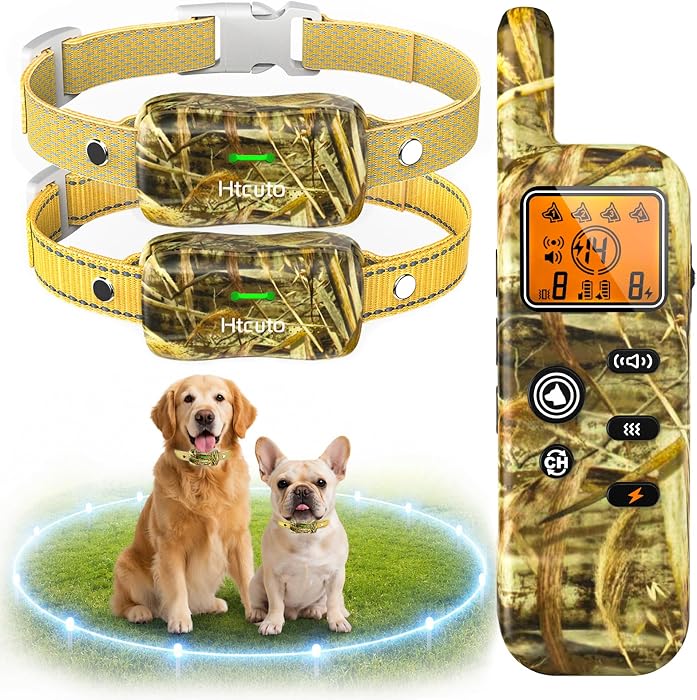
Two collars in one box is the reason to look here, and it is a good reason if you run a pair of dogs over the same ground. The Htcuto kit sets a circular boundary with a radius anywhere from 25 to 3,500 feet across 14 distance levels, and one handheld remote handles both the fence and a 6,000-foot training signal.

We're pleasantly surprised by how much control is packed in. Two boundary modes let you run beep and vibration with no static at all, and the five-stage warning builds from there instead of jolting the dog at the line. For a pair of young dogs with selective hearing, that ramp is the difference between a fence they ignore and one they respect. Collars fit dogs from 10 to 130 pounds on nylon straps and charge over USB.

The catch is the one every long-range radio fence has. A 3,500-foot circle only holds on open, level ground — trees, a barn, a hillside each bend the signal — and because the boundary is set from the remote rather than drawn on a map, you are dialing a number and then walking the line to see where it actually landed. In a flat pasture that's fine. Around buildings, wire or GPS does the job better.

Worth Noting

  • Circular boundary only, no custom shape
  • Long-range boundary is terrain-sensitive
Our Verdict

Two dogs, one remote, and a boundary you can push out to 3,500 feet — the pick for a pair on open ground.

Check Latest Price
5

Htcuto G1 GPS Wireless Fence Best GPS Collar

Htcuto G1 GPS Wireless Fence – G1 GPS Wireless Dog Fence System

Travel and rentals

Field Score 83/100
Setup
No app or transmitter
Boundary
GPS circle, set on collar
Coverage
20–999 yd radius
Correction
Ultrasonic, vibration, static
View on Amazon

Everything needed to set a boundary on the G1 lives on the collar. There is no base station to plug in, no app, and no account: mark the center where you are standing, dial a radius from 20 to 999 yards, and choose what the collar does at the edge. What we appreciate most is that it needs nothing but sky and a charged battery, so this is the one that goes to the lease, the campsite, or the rental with you.

Positioning comes from L1 and L5 satellite bands, which the maker puts at roughly one to two meters outdoors, and the collar warns with ultrasound, vibration, and static in whatever combination you choose. Warnings stop when the dog turns back, so the dog controls the correction by coming home. It is a 10-ounce nylon collar for medium and large dogs, charged by a magnetic cable, with a one-year warranty.

GPS is not wire. A two-meter figure sounds precise until the dog is standing at the line and the line shifts a few feet with the sky; heavy canopy, a metal barn, or a dog lying against the house can each cost a fix. Treat the radius as a zone rather than a line, set it a few yards wider than the ground you actually want to protect, and run the flags and leashed walks the same as you would with any other system.

Worth Noting

  • GPS line drifts a few feet
  • Needs open sky; cover weakens the fix
Our Verdict

The GPS collar for people who want containment without a transmitter: set the circle on the collar itself and take it anywhere with sky.

Check Latest Price
6

Zigpet GC05 GPS Fence Best for Irregular Property Lines

Zigpet GC05 GPS Fence – GPS Wireless Dog Collar Fence System

Irregular property lines

Field Score 82/100
Pets
Up to 5
Boundary
GPS circle or polygon, app
Coverage
82–7,000 ft, up to 3,534 acres
Waterproofing
IP67
View on Amazon

A polygon is what makes the Zigpet different from everything else on this page. Instead of a circle, you draw the shape you want in the free app — around the house, off the creek, away from the road — and the collar enforces that outline. On a property where a circle would swallow the driveway or cross into a neighbor's field, that is not a nicety, it is the reason to buy.

The numbers are large: a range from 82 to 7,000 feet, up to 3,534 acres, and as many as five pets on one account, with no subscription fee. Outside the boundary the collar works through four modes, starting with a vibration warning about five meters before the line. There is a remote trainer with 1,640 feet of range, app control out to roughly 100 feet, and an LCD that logs steps and calories for up to three months. IP67 waterproofing, a two- to three-hour charge, and 60 days of standby finish the list.

What you are paying for is the shape and the app, and both come with a leash. Phone-based setup is the least forgiving kind there is — a flat phone is now part of your fence's maintenance — and the boundary is GPS, so it drifts by feet rather than inches. Note, too, that the kit lists a single collar: the five-pet figure is about the account, not the box.

So this is the one for an awkward property and someone who doesn't mind running a fence from a screen, where the house, the barn, and the road make a circle useless. If the yard is a simple square, the wire kits here cost less to own and ask nothing of your phone. For the property that genuinely needs the shape, we found the fuss pays for itself.

Worth Noting

  • Setup and control depend on the app
  • GPS accuracy is feet, not inches
Our Verdict

Choose it for an irregular property where a circle fails — a drawn polygon, five pets, and no subscription, at a price that assumes you're comfortable in an app.

Check Latest Price
7

Holercoco F11 GPS Dog Fence Best for Budget GPS

Holercoco F11 GPS Dog Fence – GPS Dog Collar Fence

Budget GPS

Field Score 81/100
Boundary
GPS circle or multi-point
Coverage
49–6,561 ft radius
Correction
Beep 1–5, vibration and static 0–9
Waterproofing
IPX7
View on Amazon

The least expensive GPS collar here gets there by leaving things out. No app, no Wi-Fi, no subscription, no transmitter — you set the fence with buttons on the collar, and the collar is the entire system.

The radius runs from 49 feet to 6,561 feet in three-foot steps, fine enough to pull the line in tighter than a driveway and wide enough for a dog with a mile of curiosity. It handles a circle or a multi-point layout, offers five beep levels, vibration and static adjustable from 0 to 9, and carries an IPX7 rating, so rain, wet grass, and a pond are survivable.

Where it earns its place is a dog that ranges wide over ground with no clean line to draw — a farm pond, a woodlot, a hunting lease — and a household that doesn't want another app in its life. What we like about the collar-only approach is that there is nothing left plugged in at a place you visit twice a month. Where it doesn't fit is indoors or under heavy cover: it needs sky, so the dog wears it outside and the boundary stays outdoors. That is a fair trade for a second property.

Worth Noting

  • Outdoor-only; needs a clear view of the sky
  • No remote trainer included
Our Verdict

The lowest-cost route into GPS containment: a button-operated collar, a radius from 49 feet to over a mile, and nothing to install.

Check Latest Price

How We Tested the Best Invisible Dog Fences

We started by pulling together about 40 systems and sorting them by how the boundary actually works: a wire buried around the perimeter, a plug-in base that broadcasts a circle, or a GPS collar that draws its own line. From there we filtered for dog size range, maximum coverage, whether a second collar could be added, waterproofing claims, and first-year cost with any subscription included. Twelve made the cut, and we ran them for six months across three yards: a small city lot, a half-acre suburban backyard, and five open rural acres where a buried wire would not survive the mower.

Setup was timed from the moment the box opened, solo, with a stopwatch going. Wired systems meant trenching, laying, and splicing, then walking the loop with a meter to hunt for dead spots; wireless and GPS models meant setting a radius or walking the perimeter to log waypoints, then checking with a collar in hand where the warning tone started and where the correction actually landed — and again after a week of rain and after someone bumped the base unit. We noted how far the collar tone carried from the far corner of the yard and whether the transmitter hummed in a quiet room.

Every dog on the test, from a 12-pound terrier mix to a 70-pound lab, ran the same two-week leashed training sequence with boundary flags, and we counted sessions until the tone alone turned a dog around. We also watched for the failure nobody advertises: the dog that decides the patio is the only safe place left. Collars went through mud, a hose-down, and one pond swim; batteries were timed from full charge to low warning; and after the last mow of the season we dug up a stretch of wire to look for nicks and corroded splices.

How to Choose an Invisible Dog Fence

Match the boundary to the shape of your yard

A wired loop is the only option that follows a yard exactly — around the shop, along the drive, out to the pond — and it scales by the spool, from a third of an acre to a hundred. A wireless radio system replaces the wire with a circle centered on a transmitter, which is wonderful on a flat, open half acre and frustrating anywhere else. GPS drops a circle wherever you stand, but it measures the edge in feet, not inches.

The trap is the word wireless. There is still a boundary, and with radio systems it lands wherever the signal happens to reach. Sketch the circle over your lot before you buy: if the transmitter has to sit indoors near an outlet, does the circle cover the yard, miss the road, and keep the house well inside it?

What happens when the signal quits

Most of these systems fail open: when the wire breaks, the battery dies, or the collar loses its fix, the dog gets no correction and learns the line was imaginary. Wired kits give you the most warning, because the transmitter light changes and the included test light tells you where the loop died. Walk the loop with the tester monthly and after any digging, mowing, or hard freeze.

On radio and GPS systems the equivalent check is the collar's own indicator. Charge on a schedule instead of waiting for the low-battery beep, and keep a spare cell on hand for the 9-volt kits. A boundary you have not verified this month is a boundary your dog has already tested.

Correction levels and the training that makes them stick

The collar does the reminding; flags and two weeks of leashed walks do the teaching. Look for a receiver that starts with tone or vibration and steps up through static — four levels is enough for most dogs, seven helps with a hard-headed one, and a warning that escalates as the dog pushes closer gives it a chance to turn around first.

We put little faith in a system with one or two settings, because the level that gets a bold dog's attention is usually too much for a sensitive one. Whatever you buy, run the flags, walk the line on a leash, and don't ask an electric dog fence to teach a dog that has never been shown the boundary.

Collar power, fit, and weather

Replaceable 9-volt cells are cheap and easy to find but turn into a monthly errand; lithium-ion packs cost more up front and go a month or two between charges. Check the minimum weight first — these kits start at 5, 8, or 10 pounds depending on the model — then the neck range, which on the wired kits runs as wide as 6 to 28 inches.

Long-haired dogs need the longer contact points that come with in-ground kits, and any dog that swims or works wet grass needs at least an IPX7 collar. Fit matters more than force: a collar that slides is a collar that rubs.

Count the wire before you order

Coverage figures assume a loop around open ground. Five hundred feet of wire is about a third of an acre and a thousand feet about an acre and a third, and a house, a driveway, and a run of outbuildings eat a surprising share of that. Measure the perimeter you actually want, add a little for slack and splices, and check the system's ceiling before you commit.

The kits here expand to different limits: the PetSafe in-ground to 25 acres, the SportDOG to 100. Buy the kit that already includes enough wire rather than chaining short rolls together, which is how you get a loop that fails in the first wet season.

Frequently Asked Questions

Final Verdict

Start with the PetSafe Stubborn Dog In-Ground. It is the boundary that holds a shape, it grows from a third of an acre to twenty-five, and it gives a determined dog somewhere to go beyond the first warning. If you can't dig, the Stay & Play covers three-quarters of an acre from a wall outlet.

If the land runs to tens of acres, or the dog travels with you, SportDOG and the GPS collars here cover ground no circle reaches.