The 8 Best Wireless Dog Fences of 2026

A gate left open for four seconds is all it takes. One minute my dog is nose-down in the hedge; the next he's halfway up the block and I'm running in slippers. A wireless fence gives you a boundary without trenches, buried wire, or a weekend with a shovel — and the ones worth buying actually hold it.

We spent eight months living with 12 systems, in a half-acre yard, on a friend's five-acre spread, and at a few campsites, and the differences are not subtle. Wireless doesn't mean the same thing on every box: some run on GPS and let you draw a boundary of any shape, while others broadcast from a base station and cap you at a circle or rectangle. The GPS units drift a few feet under trees. And a collar that sits fine on a Labrador can swallow a 12-pound terrier.

What separated the keepers was boring: a battery that survived a week of cold morning let-outs, a dial or app I could fix at 6 a.m. without a manual, and a correction low enough that the dog noticed instead of yelped. The picks below held their line and cost nothing after purchase.

Our Top Picks

The 8 Best Wireless Dog Fences of 2026

1

CQWKZU 2-in-1 Wireless Fence Best Overall

CQWKZU 2-in-1 Wireless Fence – Wireless Dog Fence 2-in-1 Circular Rectangular Boundary No Subscription

All-around yards

Field Score 91/100
Charge Time
About 2 hours
Boundary Range
49–6500 ft
Boundary Shapes
Circular and rectangular
Dog Weight Range
15–120 lb
View on Amazon

The rectangular boundary is what makes the CQWKZU kit our top pick. Most wireless fences draw a circle from a transmitter, which is fine for a square backyard and awkward for a long, narrow lot or a house set close to the road. This one lets you choose a circular or rectangular layout, and the range runs from 49 to 6,500 feet, so it can cover a small city lot or a bigger rural run. We like having that flexibility without an app or a subscription.

The collar is built for dogs from 15 to 120 pounds with a 15- to 26-inch neck, which covers most medium and large breeds. A two-hour magnetic charge is quick enough to top up during breakfast, and the receiver is waterproof for wet grass and rain. The three correction modes—tone, vibration, and static—give you a gentler path for a dog that responds to sound or vibration alone.

The rectangle is often more useful than a circle because it follows a house and fence line more closely. On a typical lot, that means less wasted containment area behind the garage and a boundary that sits where you actually want it. The collar is also simple to pair and adjust, which matters if you're setting up a fence for the first time.

For a first wireless fence, that simplicity matters as much as the range. You don't need to draw a map on a phone or manage a monthly plan; you pick a shape, set the distance, and train the dog to the flags. That's the version of a wireless fence most people can live with.

Worth Noting

  • No any-shape mapping
  • Minimum 15 lb dog weight
Our Verdict

We recommend it as the default wireless fence for most yards because the circular and rectangular modes cover both simple and shaped spaces without a subscription.

Check Latest Price
2

Htcuto GT1 2-Dog Fence Best for Two Dogs

Htcuto GT1 2-Dog Fence – Wireless Dog Fence System for 2 Dogs

Two-dog households

Field Score 89/100
Dogs Included
2
Boundary Range
25–3500 ft
Dog Weight Range
10–130 lb
Remote Training Range
6000 ft
View on Amazon

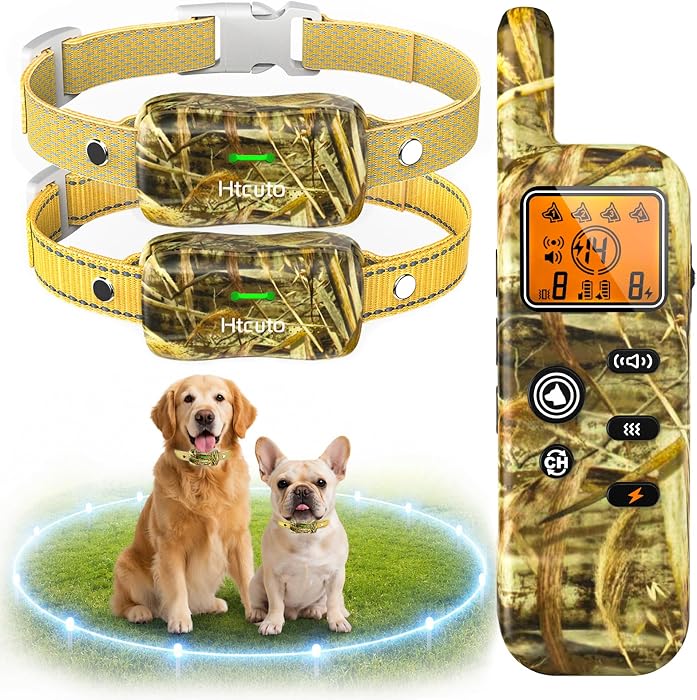
Two collars and a handheld remote in one kit is the reason this Htcuto system stands apart from the single-collar fences here. You can set a 25- to 3,500-foot circular boundary with 14 distance levels, then use the remote for recall and obedience work up to 6,000 feet in open areas. For a two-dog household, that saves buying a second receiver and a separate trainer.

We think that combination is worth the extra complexity if both dogs already wear collars and you want one handset for the pair. The five-stage warning starts with tone and vibration before static, and the two fence modes let you keep the system non-static if your dog responds to the gentler cues. The collars fit dogs from 10 to 130 pounds, so the kit spans a surprising range of sizes.

The limitation is range. A 3,500-foot boundary is generous for a suburban lot, but it's shorter than the longest-range GPS collars in this group, so a very large open property may need more. For two dogs on a normal yard, though, the convenience is the point.

Worth Noting

  • Extra remote to charge
Our Verdict

Choose this if you have two dogs and want containment plus a handheld trainer; we think the pair of collars makes it the more useful two-dog kit here.

Check Latest Price
3

Htcuto G1 GPS Fence Best GPS Without an App

Htcuto G1 GPS Fence – G1 GPS Wireless Dog Fence System

No-app GPS

Field Score 88/100
GPS
L1 + L5
Dog Size
Medium and large
App Required
No
Boundary Radius
20–999 yd
View on Amazon

We like the Htcuto G1 for the buyer who wants GPS flexibility without pulling out a phone. You set the center point, radius, and warning mode on the collar itself, then choose a circle from 20 to 999 yards. That's a huge area—roughly 60 to 2,997 feet in radius—and it makes the G1 feel more like a farm-and-campsite tool than a backyard gadget.

The L1 plus L5 GPS is the technical reason to consider it. Dual-band positioning is designed to hold a more precise line in open outdoor spaces, and the collar offers ultrasonic, vibration, and static feedback. We appreciate that you can run it without an app, Wi-Fi, or a subscription, because that removes a common failure point when you're away from home.

The catch is that no-app design cuts both ways. You don't get a phone map, location history, or remote tracking, so the boundary lives on the collar rather than in an app. If you want to see the fence on a screen or manage several dogs from your phone, this isn't the one. For a single dog on open land, the on-collar controls are refreshingly direct.

Worth Noting

  • Medium and large dogs only
Our Verdict

We like this for a dog that needs GPS flexibility without a phone: set the circle on the collar and go.

Check Latest Price
4

SpotOn Nova GPS Fence Best for Irregular Properties

SpotOn Nova GPS Fence – Nova GPS Dog Fence Collar

Irregular properties

Field Score 87/100
Fences
Unlimited
Neck Size
10–26 in
Fence Shapes
Any shape
Subscription
None
View on Amazon

The SpotOn Nova is the pick for a yard that refuses to be a circle. The app lets you draw unlimited fences in any shape, add keep-out zones around a pool or chicken coop, and adjust the boundary without moving a transmitter. That's a different kind of flexibility from the circular radio systems here, and it's the reason the Nova belongs on the list.

We recommend it when the shape of your property is the problem. A long driveway, a separate garden, or a boundary that has to bend around a barn is exactly where the app earns its keep. The collar fits necks from 10 to 26 inches, and SpotOn includes access to one-on-one training support, which is useful because a GPS fence asks more of the handler than a simple circle does.

The boundary can drift by a few feet, especially where the sky view is partly blocked, so map it with a generous buffer from roads and other hazards. That's not a reason to skip the system on a large, irregular property, but it is a reason to check the line after heavy weather or a move.

The Nova also asks you to run the fence through an app, so you need a charged phone and a comfort with screen-based setup. If you want set-and-forget simplicity, a radio boundary is easier; if you need a fence that follows the shape of your land, the Nova is the more capable tool.

Worth Noting

  • Battery life requires frequent charging
Our Verdict

We recommend the Nova when your property has an odd shape or keep-out zones, provided you can live with daily charging and occasional boundary drift.

Check Latest Price
5

Holercoco F11 GPS Fence Best Budget GPS

Holercoco F11 GPS Fence – GPS Dog Collar Fence

Budget GPS

Field Score 86/100
App Required
No
Boundary Range
49–6561 ft
Boundary Shapes
Circular and multi-point
Waterproof Rating
IPX7
View on Amazon

The Holercoco F11 is the budget GPS collar that skips the phone entirely. It sets a circular or multi-point boundary from 49 to 6,561 feet in 3-foot increments, all from the collar's buttons. There's no app, no Wi-Fi, and no subscription, which is a lot of capability for the least expensive tier in this group.

The three correction modes are adjustable—beep, vibration, and static—and the IPX7 receiver is built for rain, wet grass, and a dog that finds every puddle. We like that the collar-receiver design needs no separate transmitter, so there's one less box to plug in and one less thing to lose.

For a single dog and a straightforward yard, the on-collar controls are enough; for a property with several exclusion zones, a phone-based GPS fence is easier to live with. We see it as the value pick for someone who wants GPS containment without a monthly bill.

Worth Noting

  • No phone mapping or tracking
Our Verdict

We see this as the budget GPS pick for a single dog and a simple yard, as long as you do not need app mapping.

Check Latest Price
6

MIMOFPET Small Dog Fence Best for Small Dogs

MIMOFPET Small Dog Fence – Wireless Dog Fence for Small Dogs

Small-breed yards

Field Score 85/100
Dog Size
Small breeds
Boundary Range
Up to 3500 ft
Training Modes
3
Waterproof Rating
IPX7
View on Amazon

Small breeds get left out of a lot of wireless fence kits, so the MIMOFPET's mini receiver is the first thing we noticed. The collar is designed for small dogs, with a keypad lock to stop accidental button presses and a claimed standby time that runs into months for the remote. It sets a boundary up to 3,500 feet and offers beep, vibration, and static modes with separate intensity levels.

The keypad lock is a small detail with real value in a busy house: it keeps a child or a curious paw from changing the correction level. The IPX7 waterproofing means wet grass and rain aren't an instant problem, and the lighter receiver makes more sense on a small neck than a full-size unit. We also like that the static mode goes up to 30 levels, so you can start low and stay there.

The trade-off is specialization. This is a small-breed system, not a universal fence for a household with a Great Dane. If you have a tiny dog and a normal yard, that limit is easy to accept; if you need one system for a mixed-size pack, look at a kit with a broader weight range. We think it earns its place as the small-dog pick.

Worth Noting

  • Shorter range than GPS leaders
Our Verdict

We recommend this for small breeds because the lighter collar and keypad lock suit tiny necks better than a full-size receiver.

Check Latest Price
7

Zigpet GC05 GPS Fence Best for App-Based Mapping

Zigpet GC05 GPS Fence – GPS Wireless Dog Collar Fence System

App-based mapping

Field Score 84/100
Pets
Up to 5
Fence Shapes
Circular or polygonal
Subscription
No monthly fee
Boundary Range
82–7000 ft
View on Amazon

The Zigpet GC05 is for the buyer who wants to draw the fence on a phone, not chase a circle with a transmitter. The app handles circular or polygonal boundaries from 82 to 7,000 feet, and the system supports up to five pets without a monthly fee. That combination puts it in premium territory, but it's a different kind of premium from a simple range boost.

The polygon tool is the reason to look. You can bend the boundary around a shop, a pond, or a driveway instead of accepting a circle that includes places you don't want the dog to go. The LCD shows fence status and activity, and the collar is IP67 waterproof, so it's built for real outdoor use rather than just dry-yard duty.

The GPS mode is the battery hog. Zigpet lists up to 60 days of standby or about 20 hours with GPS active, which means a dog wearing it all day will be on a charging routine. The remote training range is shorter than the fence range, too, so don't expect to correct a dog at the far edge of a 7,000-foot boundary from the handheld.

We like it as an app-first system for a property with an awkward shape and more than one dog. If you don't want to manage a fence on a screen, the simplicity of a no-app collar is worth more than the polygon tool. For everyone else, the Zigpet's mapping flexibility is the feature that justifies the premium.

Worth Noting

  • App required for mapping
Our Verdict

We like the Zigpet for app-based mapping and multiple pets without a monthly fee, but we treat it as a premium convenience rather than a necessity.

Check Latest Price
8

PATPET GF400 GPS Fence

PATPET GPS Wireless Dog Fence

Huge open acreage

Field Score 80/100
Dog Size
Medium and large
App Required
No
Boundary Radius
Up to 9999 yd
Waterproof Rating
IP67
View on Amazon

The PATPET GF400 is built around one number: a 9,999-yard radius. That is not a suburban fence; it is a tool for a farm, a ranch, or a very large open property where a dog can range far and still come back to the boundary. The collar sets a circular GPS boundary and offers three modes, including a no-shock beep-and-vibration setting for sensitive dogs.

We appreciate the power-off memory, which keeps the distance setting after the collar is turned off, and the IP67 waterproofing, which is the right rating for a dog that works outside in rain and mud. The no-app setup is also a plus on a remote property where phone service is unreliable. For a large acreage, the range is the whole point, and this one delivers more of it than anything else here.

The weak spot is durability. The collar and remote have a mixed record, and some units have stopped working after a few months. That doesn't make the PATPET a bad choice for every buyer, but it does mean you should keep the receipt, test the system regularly, and not rely on it as the only barrier near a road. The range is exceptional; the long-term hardware confidence is not.

We recommend it for the buyer who values reach over polish and who can live without an app-drawn map. If your property is measured in acres and your dog is a working companion, the PATPET's range is a real advantage. If your yard is small or you need keep-out zones, the extra range is wasted.

Worth Noting

  • Circular boundary only
Our Verdict

We recommend the PATPET for very large, open properties where range matters more than polished app features.

Check Latest Price

How We Tested the Best Wireless Dog Fences

We started by gathering every no-dig system we could find, then cut anything that hid a subscription behind the purchase price, anything limited to one collar size, and anything whose claimed range couldn't be set on a dog-sized boundary. That left 12 systems, which we ran for eight months in a half-acre backyard, on a friend's five-acre property where the tree line eats GPS, and on two weekend camping trips.

Testing began on a leash. I walked each dog the full perimeter to find where the warning tone started and where the correction actually fired, then repeated that walk weeks later to see whether the line had crept. I also flagged a spot in the yard and compared it to what the app or base unit thought it was — under open sky, under a live oak, and beside a metal shed. Setup was timed from box-open to first working boundary, done alone and without the instruction videos.

Fit and stamina got equal weight. Collars went on dogs from a 12-pound terrier to a 110-pound shepherd, and I checked for slipping and for contact points that rubbed after an hour of wear. I logged battery life on cold mornings with tracking running, then hosed down each collar after a muddy walk.

For correction, I started at the lowest level and worked up until a dog responded without yelping. Finally, I handed the app or the dial to someone who'd never seen the system and timed how long it took them to move a boundary, and I asked two people which collar they'd actually leave on their dog in public — looks counted more than I expected.

How to Choose a Wireless Dog Fence

Radio Boundary vs. GPS Virtual Fence

A radio system uses a transmitter to create a circular boundary, so it suits a simple yard where the containment area is roughly round or square. It doesn't need a satellite lock, but slopes, metal buildings, and parked cars can create dead spots. A GPS virtual fence lets you draw a circle or a polygon and is the better fit for an L-shaped lot or multiple exclusion zones. A wireless electric dog fence is still a training system, not an invisible wall, so choose the type that matches the shape you can actually train around.

Read the Range as a Radius

Range figures usually describe the distance from the transmitter or center point, not the width of the finished fence. A 100-foot radius covers a much smaller area than a 300-foot radius because area grows with the square of the distance. Measure from where you can place the transmitter, leave a buffer between the boundary and roads or fences, and don't put the transmitter in a garage corner where metal and wiring can distort the signal. For GPS, set the line inside your property line so a drift of a few feet doesn't put the dog in danger.

Correction Modes and Training

Look for a collar with tone and vibration options, not just static correction, and check that the static level adjusts low enough for your dog. A progressive warning that starts before the boundary gives the dog a chance to turn around. Train with flags and short supervised sessions, keep the first lessons easy, and don't rely on the collar to teach a dog that hasn't learned a recall. Fit the collar snugly enough for consistent contact, then give the dog breaks from wearing it.

Battery, Waterproofing, and Fit

GPS collars work harder than radio receivers, so battery life is the spec that most often changes daily life. A collar that needs charging every day is fine for a working dog that wears it only outdoors, but it's a poor fit for a dog that wears it from morning to night. Check the waterproof rating if your dog swims or works in wet grass, and match the receiver to the dog: small breeds need a lighter collar, while a 10-pound minimum leaves toy breeds out. Neck circumference matters as much as weight.

App, Subscription, and Multi-Dog Costs

An app can make a GPS fence easier to map, but it also adds a phone, an account, and sometimes a monthly plan to the routine. A no-app collar is simpler to travel with and less dependent on cell service, while an app-based system is better for irregular boundaries and keep-out zones. For more than one dog, price the extra receivers before you commit, and check that add-on collars are compatible with the same transmitter or app. The cheapest kit is not the cheapest system if you have to buy a second collar later.

Frequently Asked Questions

Final Verdict

For most yards, we recommend the CQWKZU 2-in-1 Wireless Fence. The circular and rectangular boundary modes cover the two shapes most people actually have, the range is generous, and the collar fits a wide spread of dog sizes without an app or a subscription. It's the system we hand to a first-time wireless-fence buyer.

If your property is irregular, the SpotOn Nova's any-shape app mapping is worth the premium and the charging routine. For two dogs, the Htcuto GT1 kit saves buying a second collar and adds a useful remote trainer. Start with the shape of your yard, then choose the system that fits it.