The 6 Best Nail Guns for Fencing of 2026

A fence goes up one picket at a time, and the nail gun in your hand decides whether that's a satisfying Saturday or a long argument with a machine. I've hung pickets with a hammer and a coffee can of nails, and I've babysat a borrowed nailer that jammed every dozen shots — that second experience is what sold me on buying a good one. What you're actually paying for is a tool that drives a ring-shank nail flush in one pull and keeps feeding until the last post.

My team and I have spent the past nine months driving nails with eight framing nailers on a treated-pine fence line, plus deck framing and roof decking. We watched for the things you feel on a real job rather than on a spec sheet: weight at shoulder height, how often a nail hangs up in the magazine, and whether the depth adjustment makes sense without the manual.

One thing first-timers get wrong: the nails pick the gun, not the other way around. Collation angle and nail length have to match the magazine, so decide between 21-degree plastic collated and wire weld before you fall for a body style. The picks below run from all-day fence work to the occasional repair.

Our Top Picks

The 6 Best Nail Guns for Fencing of 2026

1

Bostitch N66C Coil Siding Nailer Best Overall

Bostitch N66C Coil Siding Nailer – Metabo HPT Framing Nailer

Boards and pickets

Field Score 94/100
Weight
4.1 lb
Collation
15° wire or plastic coil
Fastener Range
1-1/4 to 2-1/2 in
View on Amazon

At 4.1 pounds, the N66C is the lightest gun in this group, and on a fence that number does more work than anything printed on the box. The board run is hundreds of repetitions of holding a nailer out at arm's length, up at the top edge of a picket, with your other hand keeping the board tight against the rail. We felt the difference about an hour in, when the gun was still easy to lift and the boards were still going on square.

It fires 15-degree wire and plastic-inserted coil nails from 1-1/4 to 2-1/2 inches, which covers dog-ear pickets onto 2x4 rails, board-on-board, and 2x6 rails driven with 2-1/2-inch ring shanks. The depth guide adjusts without a tool, and we set it once on a cutoff of the same material and left it there — every board after that seated flush instead of dimpling. It also doesn't gulp air the way a framing gun does, so a mid-size compressor keeps up without running nonstop.

Plan for one quirk. Coil guns get fussy at the end of a coil, and this one is no exception — the last few nails are where a jam shows up. Top off before you start a visible run rather than discovering it halfway up a board. Past that, this is the gun we're comfortable handing to someone building a first fence: easy to load, simple to clear, and the least expensive of the coil guns here.

Worth Noting

  • Housing is what fails on hard-used guns
Our Verdict

The coil nailer we reach for first: lightest gun in this group, comfortable with wire or plastic coils, and the least expensive of the three siding guns here.

Check Latest Price
3

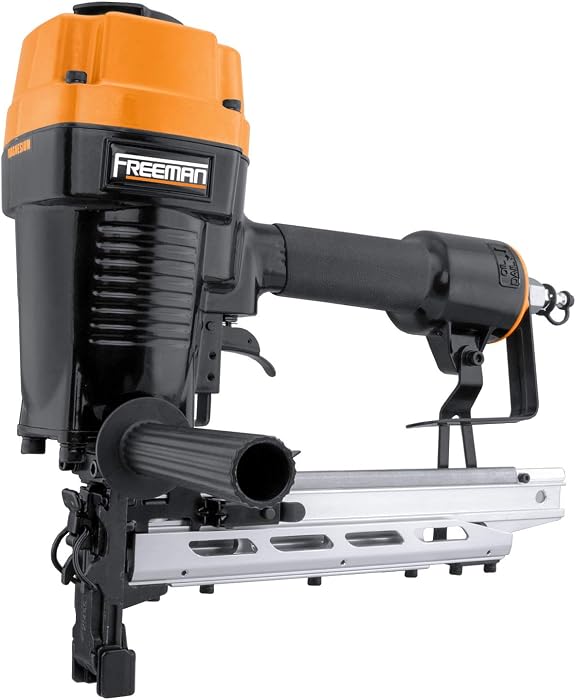
Freeman PFS9 Fencing Stapler Best for Wire Fencing

Freeman Pneumatic 9-Gauge 2" Fencing Stapler
Field Score 92/100
View on Amazon

This is the only pick here that isn't a nail gun, and for wire fencing it's the one that changes the job. The PFS9 drives 9-gauge collated fencing staples from 1-1/2 to 2 inches with a one-piece hardened steel blade — a far heavier fastener than the light crown staples a finish stapler fires. Nine-gauge staples are what hold woven wire, chain link, and an insulated electric strand to a wood post, and they hold through a horse leaning on the fence and a deer hitting it at a run.

Depth is the control that decides whether the job goes well. Set too deep, a staple can pinch woven wire or crush the insulation on an electric strand; set too shallow, the wire works loose the first time something pushes on it. The dial is easy to reach and easy to set, and it took us one scrap post to find the right spot. The T-handle is the other good decision: it gives you a second hand's worth of control at the end of your reach, which matters when you're holding tension on a wire run with one hand and stapling with the other.

What it isn't is a board nailer — it sits alongside a nailer rather than in place of one, and that's the honest limit on it. What comes in the box is what you want on the fence line: belt hook, blow-molded case, air tool oil, adjustment tools, and a seven-year limited warranty on the tool.

Worth Noting

  • Runs only on 9-gauge collated staples
  • Wear parts covered for just 90 days
Our Verdict

For woven wire, chain link, or electric strand on wood posts, this replaces a hammer and a bucket of staples — as long as you already own a compressor.

Check Latest Price
4

3PLUS H2190SP Framing Nailer Best Budget

3PLUS H2190SP 21 Degree Full Round Head Framing Nailer
Field Score 90/100
View on Amazon

The H2190SP is the least expensive way onto a fence line in this group, and it drives the same 2- to 3-1/2-inch 21-degree full-round-head nails as the Metabo above — the same sticks, off the same shelf. That's the argument, and for someone building one fence over a few weekends, it's a good one.

We like what the lower price doesn't take away. The hardened claw tip bites a 2x4 when you toe-nail a rail into a post at an angle — the most common framing shot on a fence, and the one where a slick nose slides off and sends a nail out the side. The dry-fire lockout saves you from hammering an empty magazine, the exhaust rotates a full turn so it isn't blowing dust into your face, and the tool-free depth dial flushes a rail face without a crater.

Where it stops is duty cycle: this is a homeowner's gun, and it makes no secret of it. It will build a fence, a shed, and a deck and then sit on a shelf until the next project. If you nail for a living, the money you save here is money you'll spend again sooner.

Worth Noting

  • Heaviest tool here at 10.69 pounds
  • 21-degree plastic collated nails only
Our Verdict

The budget framing nailer that still drives a full 3-1/2-inch nail: buy it for one fence, not for a season of them.

Check Latest Price
6

Metabo HPT NR90AES1 Framing Nailer

Metabo HPT Framing Nailer 30° Paper Collated Nails Framing Tool
Field Score 89/100
View on Amazon

Rails, gate frames, and the doubled 2x6 that carries a corner are framing work, and the NR90AES1 is the gun we hand over when the fence starts with structure. It drives 2- to 3-1/2-inch 21-degree plastic-collated nails, so a 3-inch ring shank through a 2x4 rail into a 4x4 post is one trigger pull instead of four swings with a hammer. On a 200-foot run, that's the difference between a weekend and three of them.

At 7.5 pounds it's the lightest framing nailer here, and that's the number we kept coming back to. The selective-actuation switch is what makes it a fence tool specifically: leave it in sequential mode when your off hand is holding a rail and a bump-fire double tap would put a nail somewhere you don't want it, then flip to contact mode for open nailing where nothing is in the way. The tool-less depth dial handles wet, heavy treated pine without countersinking a crater into the rail face.

Where it fits is the structure, and that's worth saying plainly: this sets posts, rails, and gate frames, then a coil nailer takes over for boards and pickets, which are thinner stock that wants a shorter fastener and a smaller nose. On a ranch fence — 2x6 rails on 4x4 posts, wire behind — you may never need the second nailer, though the wire still wants a stapler.

Worth Noting

  • Plastic-collated 21-degree nails only
  • Recoil shows up late in a long run
Our Verdict

The framing nailer we hand over first on posts, rails, and gates: lightest framing gun here, rated to 3-1/2-inch nails, and covered for five years.

Check Latest Price
7

Metabo HPT NV65AH2 Coil Siding Nailer

Metabo HPT NV65AH2 Coil Siding Nailer
Field Score 88/100
View on Amazon

Two coil formats in one gun is the reason to look at the NV65AH2: it takes 16-degree wire-collated siding nails from 1-1/2 to 2-1/2 inches and 15-degree plastic-collated coils from 1-1/2 to 2-1/4. When the yard is out of one, you drive the other, and on a fence that runs a few hundred feet that flexibility is worth real money.

At 4.8 pounds it's barely heavier than the Bostitch, and the weight sits well in one hand along the top of a board. The side-load magazine tilts open so a fresh coil drops in without threading, which we appreciated at the fence line rather than at a bench. The no-mar nose cap comes in the box and stays on for stained or cedar boards.

The catch is in the fine print of those two ranges: plastic coil tops out a quarter inch shorter than wire coil. If you want the full length for 2x6 rails, buy wire-collated nails, and check what your supplier actually stocks before you decide the dual format is the reason to buy. Get that right and this is the most capable coil gun here — and the one to reach for on a long, visible run where a stall costs more than a spare coil.

Worth Noting

  • No belt or rafter hook included
  • Most expensive gun in this group
Our Verdict

The most flexible coil nailer here, driving both wire and plastic coils — worth the premium if you want one gun that never gets stranded without fasteners.

Check Latest Price
8

Makita AN613 Coil Siding Nailer

Makita AN613 Pneumatic 15° 2-1/2" Siding Coil Nailer
Field Score 87/100
View on Amazon

Set against the Metabo coil gun above, the AN613 carries nearly three pounds more and asks for less money, which makes it the coil nailer to look at when the price of the Metabo is the thing stopping you.

The depth adjustment is the best-specified control in this group: nine detents on a tool-less dial, so you can move from a cedar picket to a treated 2x6 and back without hunting for the setting you had. It runs 15-degree wire and plastic collated nails, has a two-mode selector for sequential or contact fire, and a belt hook comes in the box. The smooth nose tip is a small thing that matters on finished cedar and stained board.

What gives us pause is the mass. A coil nailer lives at the end of an outstretched arm, and 7.48 pounds sits closer to a framing gun than to the 4.1-pound Bostitch — you feel it at the top of a six-foot picket line and more by the last twenty boards. On a forty-foot side yard that never becomes a problem. On four hundred feet of privacy fence, it will.

Worth Noting

  • 15-degree collated nails only
  • Three-year warranty, versus five on the Metabo
Our Verdict

A coil nailer with the most precise depth control here and a belt hook in the box, provided the extra heft doesn't bother you at board height.

Check Latest Price

How We Tested Framing Nailers for Fencing

We started by pulling every framing nailer we could find that lists a 2- to 3-1/2-inch nail range and either a 21-degree plastic-collated or a wire-weld magazine, then cut the field down by weight, magazine capacity, and what a box of nails for each collation type costs at a local yard. Eight models made it to the driveway, and we ran them for nine months across roughly 300 feet of treated-pine fence, a deck frame, roof decking on a shed, and a subfloor repair. Every gun drove the same fasteners into the same lumber so the comparison stayed honest.

The fence was the real exam. We drove 2-3/8-inch ring-shank galvanized nails through pickets into rails at chest and shoulder height, logged every jam and misfeed by counting nails between them, and reloaded with work gloves on to see whether the magazine latch was fumble-proof. Depth adjustment got tested on soft pickets, where an over-driven nail crushes the wood and a proud one snags a sleeve.

Weight we measured on a kitchen scale, then judged the way a fence builder does — holding each gun at shoulder height through a full rail of pickets and noting which ones we wanted to set down. Reliability showed up as consistency over a long afternoon: guns that fed cleanly for 200 nails and then started skipping, versus guns that never changed behavior. Ease of use came down to small things, like whether the trigger and bump mode sat where a gloved hand expected them and whether the belt hook stayed put on a ladder.

Value wasn't the sticker alone. We factored in nail cost per collation type and whether the tool felt like it would survive a truck bed. The best ones were the boring ones: nails flush, no drama, no stopping to clear the nose.

How to Choose a Nail Gun for Fencing

Match the gun to the stage of the work

A fence is three jobs stacked on one line: posts and rails, then boards, then wire if you're stringing any. Posts and rails take 2- to 3-1/2-inch framing nails, boards and pickets take 1-1/4- to 2-1/2-inch coil siding nails, and wire takes 9-gauge staples. No gun here does all three well, and a two-gun fence build is normal.

The trap is buying a framing nailer as an all-purpose fence gun. The framing guns here won't take anything shorter than 2 inches and carry a nose built for 2x stock, which is not what you want against a 5/8-inch picket. If your fence has boards, plan on a coil nailer for them.

Buy the fastener before the gun

Every gun here locks you to a collation: 21-degree plastic sticks, 15-degree plastic coil, 16-degree wire coil, or 9-gauge staples. That is not a detail you sort out later — a box of the wrong collation is scrap.

Before you commit, confirm what your supplier keeps on the shelf in the length your rails need, and whether you can restock mid-project on a Saturday. Ring-shank nails hold far better than smooth in treated lumber that swells and shrinks, so check that the ring-shank version comes in your collation.

Weight is the spec you feel at hour three

A fence is nailed at arm's length — out to the top of a picket, along a rail, overhead on the top course — and a full magazine adds to whatever the bare tool weighs. Weight you can hold for ten minutes is not the same as weight you can hold for three hours, and fatigue shows up as crooked boards, not just a sore shoulder.

Our preference is the lightest tool that does the job. The coil guns here run 4 to 7.5 pounds and the framing guns 7.5 to 10.7, which is a wide enough spread to decide a long board run.

Depth control and a soft nose save the finish

Overdriving is the most common finish mistake on a fence. A nail set too deep crushes the face of a board, and in treated lumber it leaves a mark that opens up as the wood moves. Every gun here has some form of depth adjustment; a tool-free dial you can nudge in the field is worth more than a number on a page.

Set depth on a cutoff of the same material — not a scrap of pine if the fence is cedar — and leave the no-mar cap or soft rubber foot on the nose.

Trigger mode and safety when someone is helping

Two people build a fence faster than one, and that is exactly when a bump-fired nailer gets dangerous. In contact mode the gun fires on the next trigger pull as long as the nose is depressed, and the nose is depressed a lot when you're working around a helper's hands and feet.

Use sequential mode whenever someone else is holding the board, and leave the contact safety alone — every gun here fires only when the nose is pressed against the work, and defeating that is how nails end up in a boot. Eye protection, always.

Frequently Asked Questions

Final Verdict

The Bostitch N66C is where most fences should start: the lightest coil gun here, comfortable with wire or plastic coils, and the least expensive of the three siding nailers. If your project also has posts, rails, and a gate to frame, add the Metabo NR90AES1; if it has wire, add the Freeman PFS9.

Those three cover a whole fence build, and each one is doing a job the others can't.