The 5 Best Rangefinders with a Ballistic Calculator of 2026

A rangefinder hands you a number. A ballistic calculator decides what that number means — it folds in your load, the angle, the air, then returns a holdover instead of math you'd be doing in your head while the animal walks away. The gap between those two jobs is where these devices separate, and it's wider than the spec sheet suggests.

I've been ranging long enough to be suspicious of maximum-range claims measured off a road sign in full sun; what matters is whether a unit will read a bedded deer at last light. Over eight months my team and I carried seven rangefinders through weekly range sessions, a cold wet stretch of late season, and plenty of glassing with numb fingers.

What we kept coming back to was reliability — a solver you trust beats a solver with more inputs. The picks below run from fast and simple to full environmental correction, and each one earned its place on a particular kind of range day.

Our Top Picks

The 5 Best Rangefinders with a Ballistic Calculator of 2026

1

Leupold RX-1400i TBR/W Gen 2 Best Overall
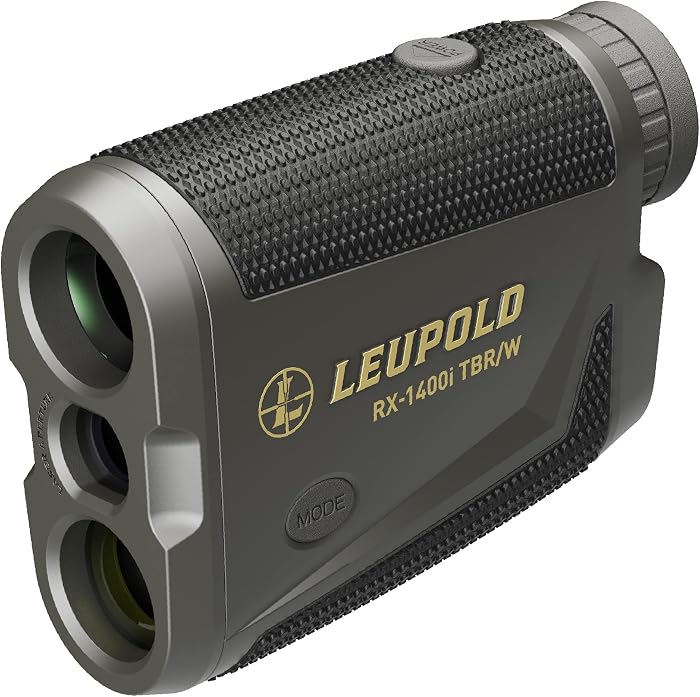
Leupold RX-1400I TBR/W Gen 2 w/Flightpath Rangefinder

Rifle and bow

Field Score 93/100
Weight
5.1 oz
Rated Range
1,200 yards on trees
Water Resistance
IP54
Ballistic Solution
TBR/W and bow Flightpath
View on Amazon

The number this one puts on the glass has already been corrected. Leupold's TBR/W takes the distance and the shot angle and turns them into a range you can treat as level ground, and it folds a wind value into the same solution rather than leaving you to estimate it. That is why it is our pick for most hunters: the calculator does its job inside the unit, with no phone to dig out, no pairing to wait on, and nothing for cold fingers to fumble.

Bow mode is the part we appreciated more than we expected. Flightpath traces the arrow's path in the display so you can see whether a limb or a branch is in the way before you draw, and the archery range comes back angle-compensated instead of raw. Leupold rates the unit at 1,400 yards on reflective targets and 1,200 on trees, which puts it behind the SIG and the Razor on paper — but a rangefinder that reaches farther than you can hit does not buy you much.

At 5.1 ounces and four inches long, it lives in a shirt pocket, and after a few outings we stopped noticing it was there. The red TOLED display is bright and adjustable, and 5x is enough magnification to settle the reticle on an animal at the distances most of us actually shoot. The weak spot is the battery door: the small plastic flap is the part that breaks, and when it goes you are locked out of the compartment. Treat that flap gently and check it before a trip rather than in the truck.

It is also the least expensive of the picks here, which settles a purchase quickly when the ballistic output is already this good.

Worth Noting

  • Splash-rated only, not submersible
Our Verdict

For hunters who want the correction handled inside the unit, this is it — rifle and bow solutions in a 5.1-ounce body that never asks for a phone.

Check Latest Price
2

SIG Sauer KILO3K Best for Long-Range Dialing

SIG SAUER KILO3K 6X22MM Laser Rangefinder

Long-range dialing

Field Score 90/100
Weight
11.8 oz
Rated Range
3,000 yards
Ballistic Output
MOA or MILS
Environmental Sensors
Temperature, pressure, humidity
View on Amazon

The Leupold corrects your range; this one tells you what to do with your turret. SIG's KILO3K carries its own temperature, pressure, and humidity sensors, feeds them into a bullet profile and a G1 or G7 drag curve, and reports the result in MOA or MILS. If you dial elevation rather than hold over, that is the format you actually want, and nothing else in this roundup gives it to you straight from the unit.

We think that makes it the specialist's choice rather than the default one. Three thousand yards of ranging and 6x through a 22 mm objective is a lot of reach, and the five range modes and five target modes — a dedicated archery setting and an extended-range mode among them — cover nearly every situation we put it in. RangeLock holds the last reading on screen so you are not re-ranging while you get set, and paired with a SIG BDX scope the solution arrives as a lit aim point in the reticle, which is the fastest version of this whole idea.

Weight is where it gives ground back: 11.84 ounces against our top pick's 5.1, so it rides in a pack rather than a shirt pocket. It also asks more of you before the first solution is worth anything — a bullet, a drag curve, honest environmental readings. The weight and the setup are the price of the sensors, and for a pack-carried rifle that is a fair trade.

Worth Noting

  • Nearly twice the weight of our top pick
  • Needs a loaded bullet profile first
Our Verdict

The pick for a shooter who dials turrets: it measures the air instead of estimating it and hands back an elevation in the units the scope speaks.

Check Latest Price
3

ATN LaserBallistics 1000 Best App-Connected

ATN Laser Ballistics Range Finder w/Bluetooth

Phone-app solutions

Field Score 89/100
Weight
5.44 oz
Rated Range
1000 meters
Water Resistance
Waterproof
Ballistic Solution
Bluetooth phone app
View on Amazon

This one is for the shooter whose ballistic solution already lives on a phone. It ranges to 1,000 meters, passes the number to ATN's app over Bluetooth, and lets the app handle the trajectory math in the background, so the unit itself stays a simple point-and-read tool.

At 5.44 ounces it is the smallest thing here after the Leupold, and it is sealed waterproof with a two-year limited warranty behind it. It also pairs with an ATN Smart HD scope and pushes real-time point-of-impact adjustments to the reticle — the same trick the ABL module performs, except this one still works on its own.

The link is where we hesitate. The calculator is the app, the app is on your phone, and Bluetooth pairing is the piece of this package with the most room to let you down; a dead phone or a dropped connection leaves you holding a plain rangefinder. Install the app and pair it at home, well before a season, and keep a paper copy of your drop chart in your pack.

Worth Noting

  • Calculator depends on the phone app
  • Shortest rated range of these picks
Our Verdict

Best for the shooter whose ballistic solution already lives on a phone, provided you test the pairing before the season instead of during it.

Check Latest Price
4

Vortex Razor HD 4000

Vortex Razor HD 4000 Laser Rangefinders

Premium optics

Field Score 88/100
Weight
9.9 oz
Rated Range
4,000 yards
Magnification
7x
Water Resistance
IPX7 waterproof
View on Amazon

Start with the version, because it decides everything else. The Geoballistics solver is offered on select models of the Razor HD 4000, and this listing carries the standard model number with no ballistic solver anywhere in its feature set. If the calculator is the reason you are shopping, confirm which version ships before you order. If you already shoot off a drop chart, this is the finest optical instrument in the group.

What it does, it does better than the rest. Seven power through a 25 mm objective with HD glass gives the best view here, and 4,000 yards is more reach than anything else on this page. Four target modes, two range modes, and a scan feature that reads continuously while you pan will pick a return off brush, grass, and rock at distances where the others are still hunting. Rubber armor and IPX7 sealing are built for weather that would send you home, and the unconditional lifetime warranty is the least conditional one here.

The cost is bulk: 9.9 ounces and a body that wants a harness pouch rather than a shirt pocket. For a western hunter ranging rock across a canyon with a chart taped to the stock, none of that matters. For a whitetail hunter who wants the number to come back already corrected, our top pick answers the question this one leaves to you.

Worth Noting

  • Ballistic solver not established for this model
Our Verdict

The best glass and the longest reach here — as long as you confirm you are getting the Geoballistics version, because the calculator is the whole point of this list.

Check Latest Price
5

ATN ABL 1000 Best for ATN Scope Users

ATN Auxiliary Ballistic Smart Laser Rangefinder w/Bluetooth

ATN scope users

Field Score 86/100
Weight
12.7 oz
Rated Range
5-1000 y/m
Compatibility
ATN X-Sight II, X-Sight 4K, ThOR 4
Water Resistance
Waterproof
View on Amazon

Press the button, watch the reticle move. That is the entire experience of shooting with the ABL mounted on an ATN Smart HD scope, and it is the quickest ballistic solution in this roundup — no second screen to read, no number to translate into clicks, no shifting your grip off the rifle. For someone already inside that ecosystem, nothing else here comes close.

The catch is that it is not a rangefinder you can hand to a friend. It ranges to 1,000 yards and pushes the distance and a corrected point of impact into the scope, but it has no display of its own and no confirmation it is awake beyond the Bluetooth icon in the scope turning solid blue. It is listed for the X-Sight II, the X-Sight 4K, and the ThOR 4, and it is sealed waterproof, which matters on a unit that rides a rifle through weather.

One detail we ended up valuing more than we expected: the range gets stamped onto your recorded video, so you can go back and see exactly how far the animal stood when the shot broke. That turns out to be a good coaching tool. The weight is less charming — 12.7 ounces hanging off the front of a scope changes how a rifle balances — and the Bluetooth link is the piece that decides whether the whole setup behaves. Pair it at home, on a fresh battery, before you take it out.

Worth Noting

  • No use without an ATN Smart HD scope
  • Adds 12.7 ounces to the rifle
Our Verdict

The fastest solution here for someone already running an ATN Smart HD scope, and a paperweight for anyone who is not.

Check Latest Price

How We Tested Ballistic Rangefinders

We built the shortlist from spec sheets and a lot of reading: which units ran the solver onboard, which pushed it out to a phone app over Bluetooth, which offered a red or backlit display for low light, and which would sit in a chest rig without fighting a pair of binoculars. Price mattered, but a cheap unit that needs two hands and a rest to read a steel plate isn't a bargain, so anything that couldn't be run one-handed got cut.

Seven rangefinders came out with us over eight months. They rode in jacket pockets through weekly range sessions on steel out to 1,000 yards, sat in a cold truck overnight, got rained on, and went out on early mornings when the light was bad and the targets were dull.

At each session we ranged the same set of objects against known distances and noted when a reading came back wrong or not at all, keeping a running log of how far each unit would read off a non-reflective target before it demanded a rest. I handed every one to a friend who'd never picked it up before and timed how long it took to get from cold to a firing solution with gloves on. Bluetooth units got paired to two different phones, then pocketed and pulled back out to see whether the connection held.

Battery life we tracked by cell changes and by whether a unit woke up after a freezing night. Durability got a less scientific treatment: a drop off the shooting bench onto gravel, dust in the eyepiece, a wet afternoon in a nylon harness.

How to Choose a Rangefinder with a Ballistic Calculator

Where the Math Lives

Three arrangements cover almost everything. The solver can sit inside the unit, as it does in our top pick and the SIG; it can live in a phone app the laser rangefinder feeds over Bluetooth, as with the ATN LaserBallistics; or it can sit in the riflescope itself, with a rangefinder module pushing a correction into the reticle, as the ABL does.

We trust the onboard version in the field — nothing to pair, nothing to unlock, no second battery to think about. Phone systems give you a bigger screen and a solver that can be updated, but the Bluetooth link is a failure point you carry in your pocket. Scope integration is the fastest of the three and the least flexible, because it ties you to one scope family.

The Data You Feed It

A ballistic solution is an opinion built out of your inputs. The SIG carries a bullet database and supports both G1 and G7 drag curves; the Leupold folds the correction into the range number itself; the ATN units hand the math to an app that holds the profile. Different plumbing, same rule: the answer is only as good as the data behind it.

Load your actual bullet and velocity rather than the closest factory preset, and confirm the solution at the longest distance you can really shoot before the season opens. A calculator that is wrong at 600 yards is worse than a dope card that is right.

What the Range Number Really Means

The big number on the box is the reflective-target number, because it is the largest one. The Leupold's 1,400 yards is against something that throws light back; the 1,200-yard tree rating is the figure that survives contact with a hunting season, and an animal is a smaller, duller target than a tree.

Judge a rangefinder by its non-reflective rating, then expect your realistic maximum on game to sit below even that. Long reach still earns its money when you are ranging a rock face to plan a stalk; inside 400 yards on fur, it buys you very little.

Sealing, Weight, and the Display

Sealing is the specification that reads alike and is not. The Leupold is IP54, which is splash resistance; the Vortex is IPX7, and the ATN units and the SIG are listed as waterproof. If your season means rain, snow, or a boat, that difference is worth more than any feature on this page.

Weight is the other quiet one. Five ounces rides in a shirt pocket, ten wants a harness pouch, and twelve hanging off a scope changes how a rifle balances. Then check the readout: illuminated red displays have adjustable brightness for a reason, so learn the setting at dusk rather than at the moment you need it.

If You Shoot a Bow

Archery is where angle compensation stops being a nicety. From a treestand or down a slope, the distance the unit reads is not the distance the arrow flies, and the corrected figure is the one to use. The Leupold goes further with its Flightpath display, tracing the arrow's path so you can see a branch before you draw; the SIG includes a dedicated archery mode among its five.

If you hunt both rifle and bow, a unit with a selectable bow mode saves you carrying and re-zeroing two devices.

Frequently Asked Questions

Final Verdict

The Leupold RX-1400i TBR/W Gen 2 is the one we point most people toward. It corrects the range for angle and wind inside the unit, does the same job for a bow, weighs almost nothing, and costs less than any other pick here — an unusual combination in a category that usually charges separately for every capability.

Buy the SIG if you dial turrets in MOA or MILS and want the air measured rather than estimated. Buy the ABL only if an ATN scope is already on the rifle, because without it there is nothing to talk to.