The 3 Best Soil Moisture Meters of 2026

More houseplants die from too much water than too little, and the finger test lies. Push a finger into a six-inch pot and it feels damp up top while the roots below are still wet. A soil moisture meter checks the soil where it counts — root level — and takes the guesswork out of reaching for the watering can.

One thing nobody tells first-time buyers: these meters don't sense water. They measure how easily current travels between probe and soil, which shifts with moisture but also with fertilizer salts and potting mix. The reading is a relative signal, not a percentage, and probe depth matters more than the dial. We kept 14 of them in rotation for about four months, in houseplant pots, raised beds, and patio containers, and the differences showed up fast.

The ones worth owning survive the same habit: pull the probe, wipe it, put it away. Leave a cheap meter parked in damp soil and the tip corrodes until it reads dry in a soaked pot. The picks below held up to that routine, and they earned their keep.

Our Top Picks

The 3 Best Soil Moisture Meters of 2026

1

apine Soil Moisture Meter Best Overall

apine Soil Moisture Meter

Houseplants and beds

Field Score 90/100
Dial
Large color-coded dial
Probe
Single probe
Battery
None required
Included
1 meter and wiping cloth
View on Amazon

The hardest part of watering is not the watering itself; it is knowing whether the soil two inches down is actually dry. The apine meter answers that question with a single probe, a large analog dial, and no batteries to remember. We like that there is nothing to calibrate or charge before you use it: push the probe into the root zone, give it a few seconds, and read the color zones and numbered scale. The 10.24-inch body gives you enough reach for ordinary houseplant pots and shallow garden beds, and the single probe comes out with less soil clinging to it than a fork-style probe would.

What separates the apine from the other basic meters here is the consistency of its readings in settled soil. It is happiest in fine, compacted potting mix, where the probe can make uninterrupted contact; that is also where most houseplant watering decisions happen. In a chunky bark mix or a very loose raised bed, the needle can be less decisive, so firm the soil around the probe and check a second spot before you water.

The apine is the meter we reach for first for a mixed collection of houseplants, and it is also the one we hand to someone who has never used a moisture meter before. It is not the tool for a deep raised bed or a very large planter; that is a job for a longer stem. For everything from a standard houseplant pot to an ordinary garden bed, it gives you a useful snapshot without turning watering into a project. Wipe the probe clean after each use and store it dry.

Worth Noting

  • Straight-on dial is awkward in low pots
Our Verdict

We recommend the apine for most houseplants and mixed garden beds because its readings are the most consistently useful of the meters we tested, without batteries or a learning curve.

Check Latest Price
2

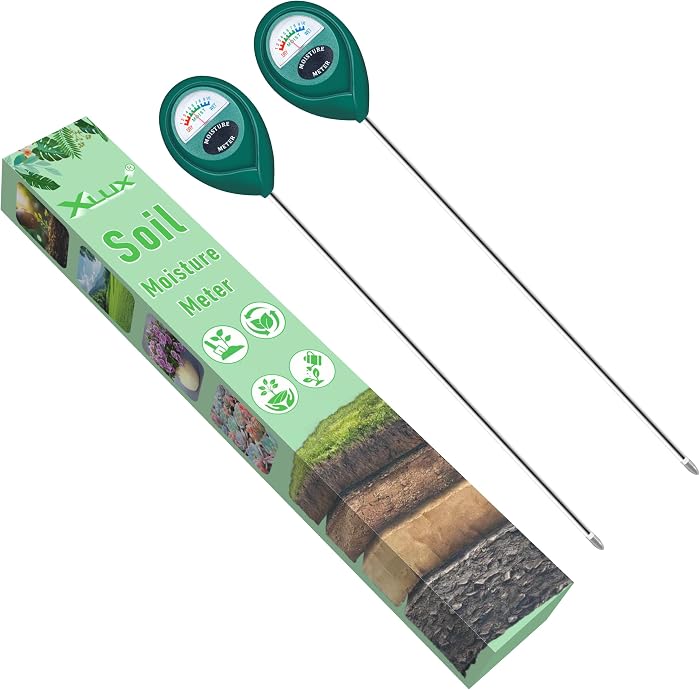
XLUX Long Probe Soil Moisture Meter Best for Deep Pots

XLUX Long Probe Soil Moisture Meter – 2 Pack Long Probe Plant Soil Moisture Meter

Deep containers

Field Score 89/100
Dial
Three zones, ten scales
Pack
2 meters
Probe
Long single probe
Battery
None required
View on Amazon

The first thing you notice about the XLUX long-probe meter is the length. The stem is built to go deeper than a standard houseplant meter, which matters in large containers where the top inch can be dry while the root zone is still wet. You get two meters in the pack, so one can live with the indoor plants and the other can stay in the garden bag. The dial is large, the single probe slides in without digging up much soil, and there are no batteries to replace.

We like this one for deep pots and outdoor shrubs because the extra reach changes the reading, not just the convenience. A short probe tells you about the surface; this one gets closer to where the roots are. The trade-off is that the long stem needs a straight, steady push, and in loose or gritty mix it can give a softer reading. Check two spots and push slowly rather than forcing it. The two-pack also makes it easy to keep one clean for indoor use and one for the messier jobs outside.

Two meters also solve a small practical problem: you can leave one by the potting bench and keep one in the garden without carrying a dirty probe through the house. For a single houseplant, the apine is the more precise choice; for a row of large containers or a shrub bed, the extra length is the reason to pick this one.

Worth Noting

  • Durability is mixed; some units fail after months
Our Verdict

For large pots and deep-rooted plants, the XLUX long-probe two-pack is the practical choice: the extra reach gets below the surface, and the second meter lives in the garden bag.

Check Latest Price
3

Dr.meter S10 Soil Moisture Meter Best for Lawns and Beds

Dr.meter Soil Moisture Meter for Plants

Lawns and beds

Field Score 88/100
Dial
Ten scales, color-coded
Pack
1 meter
Probe
Single probe
Battery
None required
View on Amazon

The Dr.meter S10 looks like the meter people picture when they think of a soil moisture gauge: a green body, a large analog face, and a single metal probe. It uses ten scales and a color-coded reading system instead of a battery or a screen. That old-school approach has real appeal in a garden tool. There is nothing to charge, nothing to pair, and nothing to read in bright sun except a needle and a dial. The compact body is easy to keep in a shed or a garden tote, and the single probe comes out without a lot of soil attached.

For lawns, beds, and a mix of outdoor plants, the ten-scale dial gives you more resolution than a three-zone face. We found it most useful when we were checking several spots in a bed rather than fussing over one finicky houseplant. The needle can read lower than expected in very wet soil, though, so do not treat a single low reading as proof that the bed is dry. Push the probe in another spot, wait a moment, and compare.

Where the Dr.meter earns its keep is simplicity. It is the meter we leave in the garage for quick checks on the vegetable bed, and it is a sensible choice for anyone who wants a familiar dial rather than another app-connected gadget. For a single precious houseplant, the apine's face is easier to read straight on; for a lawn or a mixed bed, the Dr.meter's extra scale marks are enough. Keep the probe clean and dry, and do not leave it standing in the soil between checks.

Worth Noting

  • Not for hard, rocky ground
Our Verdict

The Dr.meter S10 is the straightforward pick for lawns, beds, and anyone who wants a familiar analog dial: no batteries, ten scales, and a single probe that gets the job done.

Check Latest Price

How We Tested the Soil Moisture Meters

We started with a list of roughly 30 meters and cut it down before spending anything: out went short probes, dials with no markings past wet and dry, and the two-pronged units whose reviews were full of bent tips. That left 14, which we lived with for about four months.

Accuracy has no perfect reference, so we used three. We compared each reading against a finger pushed to the same depth, the weight of the pot before and after watering, and every other meter in that pot at that same moment. Reading each pot an inch down and again near the bottom showed which meters repeated themselves and which drifted.

Testing happened where the plants actually grow: a windowsill of pothos and peace lilies, a bathroom shelf with a fern, raised beds of basil and tomatoes, and patio containers that got rained on. We logged readings on watering day, the day after, and a week later as the soil dried, noting which meters flagged dry soil before the leaves drooped.

Every meter got the same handling. We read the dial at 7 a.m. in low light with soil on our hands, wiped the probe after each use, and checked whether the tip stayed clean. Probes went in at the edge of the pot rather than the middle so we weren't spearing roots, and we paid attention to how much force a dense, root-bound pot demanded. One of each style stayed in a wet pot for a week on purpose, which settled the corrosion question faster than any spec sheet could. We also dropped each one from counter height, since these end up in sheds and on greenhouse shelves, and none of the meters here take a battery, so we watched whether readings held steady over months with nothing to swap out. Value got the last word: a cheap meter that gives the same answer twice beats a fancier one that needs a second opinion.

How to Choose a Soil Moisture Meter

Match the probe to the pot

A standard meter reads the top few inches, which is fine for a six-inch houseplant but not for a deep container or a shrub bed. If your pots are large, choose a longer stem; the XLUX long-probe pair is the obvious example here. A single probe is also easier to work around roots than a fork-style sensor. In loose, chunky mixes, firm the soil around the probe and check a second spot, because air pockets can make any meter read drier than the root zone actually is.

Prioritize the moisture reading

A dial with ten scales gives you more to work with than a three-zone face, but the extra marks only help if the needle responds consistently. We pay more attention to moisture accuracy than to pH, light, or temperature add-ons; those features are useful only when they are accurate. A simple battery-free meter that reads the same way twice is a better garden tool than a multi-function gadget you cannot trust.

Treat the probe as the fragile part

These meters are not buy-once tools. The probe is thin, the joint is small, and hard or rocky soil can bend or break it. Wipe the metal clean after each use, store the meter dry, and do not leave it standing in a pot between waterings. If you garden in heavy clay, start the hole with a trowel rather than forcing the probe. A few seconds of care is the difference between a tool that lasts a season and one that lasts several.

Use the reading as a snapshot

A moisture meter measures at the probe, not through the whole pot. Check two or three spots around the root zone, especially in a large container or a mixed bed, and compare the readings before you water. The number is a guide, not a lab result. If the meter says dry but the soil feels moist an inch down, trust your hand and check again later. If it says wet after a week of no water, make sure the pot is draining.

Decide whether you need batteries

Battery-free analog meters are always ready and are the lower-maintenance choice for a tool that lives in a shed. Digital meters can add backlighting and extra functions, but they need batteries and can be harder to read in bright sun. For most houseplants and garden beds, a simple analog dial is enough; spend the difference on a longer probe or a second meter rather than on features you will not use.

Frequently Asked Questions

Final Verdict

Fewer meters than you might expect earn a permanent spot by the potting bench, and the apine is the one we reach for first. It turns a quick probe into a watering decision we trust, without batteries or a screen, and it handles everything from a standard houseplant pot to an ordinary garden bed. If your plants live in deep containers, choose the XLUX long-probe pair for the extra reach. If your watering is mostly lawn and mixed beds, the Dr.meter's ten-scale dial is the simpler tool. Start with the apine unless one of those specific conditions applies.