The 5 Best Windbreakers for Men

A windbreaker has one contradictory job: block the gust on a 50-degree morning without becoming a sauna by the time you reach the office. The bad ones make themselves known — fabric that crackles at every step, a cut so boxy you can't swing your arms. What you're really buying is a layer you'll carry more than you wear, and the good ones make that easy.

I've worn these on dog walks, commutes, and a few windy golf rounds over the past six months, and my team put 12 jackets through the same routine. Fit and sizing got as much scrutiny as fabric, since a jacket that's a size off is a jacket you leave on the hook. Pockets mattered more than I expected, too.

One thing worth knowing before you shop: water-repellent and waterproof are not the same promise. Most windbreakers shrug off a drizzle and wet grass, but none stand in for a real rain shell in a downpour. The picks below are the ones that earned a permanent spot by the door.

Our Top Picks

The 5 Best Windbreakers for Men

1

Champion Stadium Full-Zip Best Overall

Champion Stadium Full-Zip

Everyday wind and drizzle

Field Score 93/100
Sizing
Runs small
Weight
12.8 oz
Closure
Full zip
Weather Resistance
Wind and water resistant
View on Amazon

Champion prints wind resistant and water resistant right in the product name, which is a bold claim for the least expensive jacket in this guide. We put the Stadium up against shells that cost noticeably more and it held its ground: a 12.8-ounce full-zip that stops the wind a hoodie alone won't, beads a passing shower, and never feels like you're wearing a tarp.

What earns it the top spot is how little it asks of you. The fabric has a soft hand instead of the crisp, plasticky feel that gives cheap shells away, so it doesn't crackle every time you move, and it rolls up small enough to live in a daypack or behind a truck seat. Over a flannel on a breezy morning it does the one job a windbreaker exists to do: takes the edge off without leaving you damp on the walk back.

The thing to plan around is the size. This one runs small, so if you're between sizes — or you intend to wear anything thicker than a t-shirt underneath — go up one. Beyond that, remember it's a shell: it blocks wind and holds no warmth of its own, and on a genuinely cold day you'll want a fleece under it.

Worth Noting

  • Runs small
  • No insulation on cold days
Our Verdict

For everyday wind and drizzle — town, trail, barn — this is the one we recommend first: it does the basic job for less than anything else here.

Check Latest Price
2

TACVASEN Lightweight Windbreaker Best in Light Rain

TACVASEN Men's Lightweight Jacket Fall Water-repellent Windbreaker Jackets

Work and light rain

Field Score 91/100
Sizing
Runs roomy
Stated Season
Fall
Weather Resistance
Water-repellent
View on Amazon

Most windbreakers look like windbreakers. The TACVASEN reads a step dressier than anything else in this group — a clean, simple cut that passes at the office as easily as it does on a walk downtown.

That double duty is why it earns a place. This is a lightweight jacket you can wear over a shirt for work and over a hoodie when it turns cold, and the water-repellent finish shrugs off the drizzle that soaks a cotton jacket through. It's light enough that you forget it's on, which is about the highest compliment a shell can get.

The fabric is the compromise. It has a synthetic, slightly plasticky hand that you notice against a bare arm, and there are no inside pockets — the one detail we kept missing when we wanted somewhere to put a phone out of the rain. The cut also runs roomy, so a lean frame may want to size down rather than up.

Worth Noting

  • Plasticky feel against bare arms
  • No interior pockets
Our Verdict

Buy it if you want one jacket that looks presentable at work and still sheds a drizzle; it's the dressiest shell here.

Check Latest Price
3

Under Armour Rival Windbreaker Best for Active Use

Under Armour Rival Woven Windbreaker

Riding and running

Field Score 90/100
Shell
Woven
Sizing
Runs small
Weather Resistance
Wind and light rain
View on Amazon

If your windbreaker is going to meet a headwind at speed — a bike commute, a run, a long walk into weather — the Under Armour Rival is the one from this group we reach for. It's the most breathable jacket here: the woven shell holds the wind off without the clammy, crinkly feel of a cheaper one, and the fabric is soft enough to wear straight over a t-shirt.

It handles the light rain and moderate wind it's built for, which makes it the pick for anyone who'll be moving rather than standing around. Sizing is the catch. The Rival runs small — enough that going up a size is the safe call — and the sleeve openings are snug, which seals out wind nicely but turns into a fight if you have bigger hands. None of that rules it out for riding; it's just worth knowing before you order.

Worth Noting

  • Runs small; go up a size
  • Snug cuffs resist bigger hands
Our Verdict

If you'll be moving — riding, running, a fast commute — this is the shell that breathes best, and the snug cuffs keep the wind where it belongs.

Check Latest Price
4

MAGCOMSEN Full-Zip Windbreaker Best Pocket Layout

MAGCOMSEN Men's Lightweight Jackets Full Zip Up Light Coat Laydown Collar

Polished everyday wear

Field Score 89/100
Collar
Laydown collar
Sizing
Runs small
Closure
Full zip
Pockets
Zip hand pockets plus chest pocket
View on Amazon

There's no hood on the MAGCOMSEN, and that's the point. A laydown collar looks sharper than a hooded shell, sits flat under a rain jacket, and reads like a jacket rather than a piece of gear — exactly what you want if the windbreaker is going to work with jeans and a button-down.

The pockets are the best thought-out part of it: two zippered hand pockets plus an inner chest pocket that swallows a passport or a phone, though the inner one doesn't zip. The cut is trim without being slim, so there's room for a sweater underneath without the jacket looking strained.

Where it gives ground to the picks above is the fabric. It's thin and has a plasticky feel, and it holds warmth in rather than letting it out, so it's happier on a cool evening than on a warm, active afternoon. The chest also runs small, so if you're between sizes, go up.

Worth Noting

  • Thin, plasticky fabric
  • Holds warmth on mild days
Our Verdict

If you want a windbreaker that passes at work and has pockets you can trust, this is our pick — just size up through the chest.

Check Latest Price
5

London Fog Auburn Golf Jacket Best for Dry, Mild Days

London Fog Men's Auburn Zip-Front Golf Jacket

Dry, mild days

Field Score 88/100
Lining
Lightly lined
Sizing
Runs large
Closure
Zip front
Pockets
Multiple, some zippered
View on Amazon

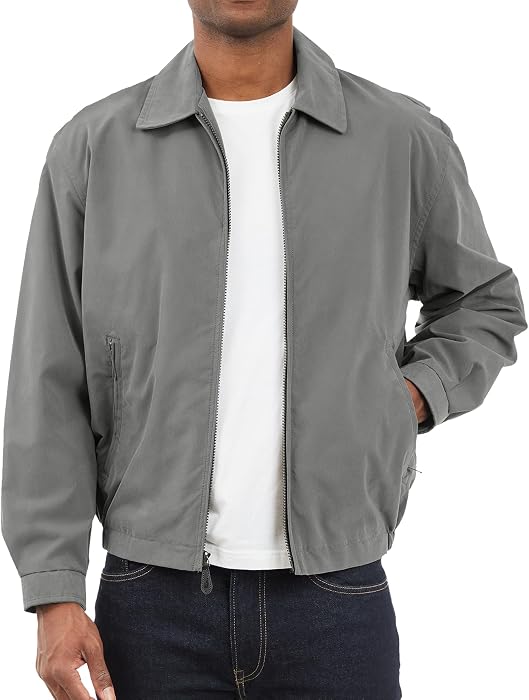
The London Fog Auburn isn't a windbreaker in any technical sense, and we won't pretend otherwise: it's a soft, lightly lined golf jacket with a zip front and a pocket for everything. That's also why it stayed on the list. On a dry, breezy morning it's a nicer thing to wear than any shell here, and it doesn't look like you're headed for a trailhead.

The pockets are the selling point — zippered hand pockets plus open ones, the kind of layout you appreciate when you're carrying keys, a phone, and a glove. The shell is a soft microfiber with a suede-ish hand, pleasant against the skin and a lint magnet on dark colors, and the light lining takes the edge off a cool start without bulk.

The fit runs large, and the body is cut wide rather than long, which flatters a broader build more than a tall, lean one. What it doesn't do is weather: there's no membrane and no rain finish to count on, and a wind-driven drizzle will find its way through. That's the deal, and it's a fair one when your days are mostly dry.

Worth Noting

  • Not built for wind or rain
  • Cut runs wide and large
Our Verdict

For dry, cool mornings and a smarter look, this is the comfortable choice — but if wind and rain are the point, buy one of the shells instead.

Check Latest Price

How We Tested a Dozen Windbreakers in Real Weather

We started by gathering every windbreaker we could find in the middle of the price range most shoppers actually buy in, then filtered on fabric weight, coating, full-zip versus pullover construction, pocket layout, and the size range each maker stocks. Anything that felt like a tarp or listed a chest measurement with no body length got cut before it shipped.

Twelve jackets made the shortlist, and each spent six months in real rotation rather than on a lab bench. That meant morning commutes on foot, dog walks in a steady drizzle, a couple of breezy rounds of golf, and weekend hikes where the jacket got stuffed into a daypack and pulled back out an hour later.

Fit and size came first: we measured every jacket flat, pit to pit and collar to hem, checked those numbers against the maker's own size chart, and wore each one over a T-shirt, a hoodie, and a sweater to see whether the shoulders and sleeves allowed layering without bunching.

Then the material and construction. We held a sleeve under a faucet for a minute to watch whether water beaded and rolled off or soaked straight in, loaded the pockets with a phone, keys, and a wallet to see whether the jacket sagged or the zipper pulls strained, and inspected seams, cuffs, and hardware after a few weeks of daily wear. At the end of six months, we each named the ones we'd pay full price for again.

How to Choose a Windbreaker

What a Windbreaker Can and Can't Do

Two things make a windbreaker work: a tight-woven synthetic shell that blocks moving air, and a durable water-repellent finish that makes drizzle bead and roll off. Neither is the same as waterproof. Seams and fabric soak through in steady rain, so treat this jacket as protection for wind and passing showers, not for a wet day on the mountain.

If you expect to be out in real rain, buy a rain shell and wear the windbreaker under it as a warm, wind-blocking layer. For everything else — a breezy morning, a five-minute shower on the way to the truck — a windbreaker is lighter, cheaper, and far more likely to be with you.

Weight, Fabric Feel, and Breathability

The best shell is the one you'll carry, and that usually means the lightest. The Champion here is 12.8 ounces — the kind of jacket that disappears into a daypack until you want it. Heavier shells feel more substantial and hang better, but they're also the ones that get left behind.

Fabric feel matters just as much. A soft hand moves quietly and doesn't crinkle against bare arms; a plasticky one traps heat and announces every step. If you run hot or move hard for a living, put breathability ahead of extra pockets.

Sizing Is the Biggest Variable Here

Nearly every jacket in this group has a sizing quirk, and they don't lean the same way: the Champion, the Under Armour, and the MAGCOMSEN run small, the TACVASEN runs roomy, and the London Fog runs large. The safe move is to size for the layer you'll actually wear underneath, because a shell that only fits over a t-shirt is a shell you can't wear once it turns cold.

If you're between sizes and you plan to layer a fleece or a hoodie, go up. If you want a trim, athletic fit over a single shirt, take your usual size and accept a little less room.

Hoods, Collars, and Pockets

A hood is what you want when weather is the reason you're wearing the jacket; a collar looks sharper, sits flat under a rain shell, and doesn't flap at speed. Pockets are where inexpensive jackets cut corners — one zippered hand pocket is worth more than two open ones, especially on a bike, an ATV, or a horse.

Check the cuffs, too. Snug openings keep wind out but turn into a wrestling match with gloves or big hands, and a hem that rides up at speed will undo the wind blocking you paid for.

Frequently Asked Questions

Final Verdict

The Champion Stadium is the jacket we point most people to, and the reasoning is plain: it blocks wind, sheds a drizzle, and costs less than anything else we recommend. Just order a size up.

If you want a shell that looks like a jacket at work, the TACVASEN is the step up; if you ride or run, the Under Armour Rival breathes better than any of them. The London Fog is a fine casual jacket for dry days — it simply isn't weather protection, and that's the condition that decides it.