The 8 Best Pull-Through Knife Sharpeners of 2026

A pull-through sharpener is the shortcut I hand to anyone whose knives have gone soft. Two or three strokes through crossed carbide blades shave a fresh edge; a ceramic slot behind them polishes off the burr. No whetstone to soak, no angle to hold, no skill required. What it fixes is a small, daily annoyance: the tomato that squashes instead of slicing, the chicken you saw at instead of cutting.

I keep one in the kitchen drawer and a smaller one in the glovebox. Over the past three months, my team and I tested 16 pull-through sharpeners, from pocket-sized models to suction-base versions, and most of the differences had nothing to do with sharpening. Cheaper units shave off more steel than they need to, a base that slides mid-pull turns a two-second job into a hazard, and serrated knives need a notch most people never notice. A couple of models tuck a fire starter and a whistle into the handle; we checked whether those extras cost you a usable grip.

The picks below are the ones that stayed put, stayed sharp, and didn't chew up a good knife getting there.

Our Top Picks

The 8 Best Pull-Through Knife Sharpeners of 2026

1

AccuSharp Knife Sharpener Best Overall

AccuSharp Knife Sharpener

All-around sharpening

Field Score 95/100
Grit
Coarse
Weight
1.28 oz
Abrasive
Diamond-honed tungsten carbide
Blade Types
Straight and serrated
View on Amazon

The blaze orange is not decoration. It is the reason one of these lives in the truck console and the other sits by the cutting board, and it sums up how the AccuSharp works: find it, pull a blade through it, put it back. The handle is symmetrical, so it behaves the same in a right or left hand, and at 1.28 ounces it disappears into a pack. Of everything here, this is the one we hand to someone who wants a single sharpener for a skinning knife, a pocketknife, and a chef's knife.

The single slot holds diamond-honed tungsten carbide blades, the coarsest abrasive in this group, which is why three or four light pulls bring back a knife that has spent the week smashing tomatoes. The edge it leaves is a working edge, toothy enough to bite into hide, rope, and tomato skin and nothing like the polished bevel a stone produces. That suits a hunting knife and a utility blade down to the ground; for the knife you slice sashimi with, it is the wrong tool.

The carbide blades are reversible and replaceable, and the body carries a two-year warranty, which matters because the abrasive is the part that wears. Serrated edges go through the same slot, something most pull-throughs this size make you handle with a separate notch or rod. We keep one in the truck and one in the kitchen, and that is the highest compliment we can pay a sharpener this inexpensive.

Worth Noting

  • Coarse carbide removes steel fast
Our Verdict

For a drawer of dull kitchen knives and a skinning knife that has seen a season, this is the pull-through we hand people first: fast, ambidextrous, and cheap enough to buy two.

Check Latest Price
2

Smith's Pocket Pal Best for the Field

Smith's PP1 Pocket Pal Knife Sharpener Preset Carbide & Ceramic Stone

Field and EDC

Field Score 94/100
Length
3.24 inches
Stages
Carbide and ceramic
Extra Rod
Fold-out tapered diamond
Blade Types
Straight, serrated, gut hooks
View on Amazon

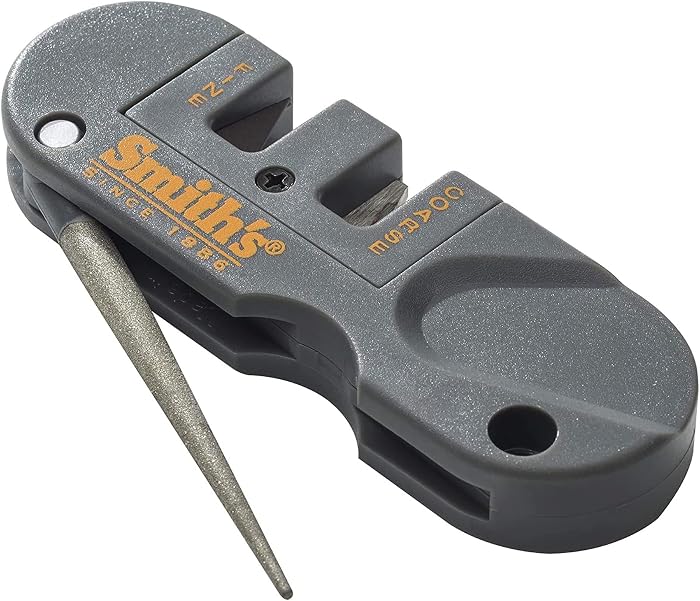
The fold-out diamond rod is what separates the Pocket Pal from a shelf full of two-slot pull-throughs. It is tapered and round, which is the right shape for a serrated hunting blade, a gut hook, or a fish hook, and it folds back into the body when you are done. The other end carries the usual pair: crossed carbide for setting a new edge and ceramic for finishing it.

In a hunting pack that combination covers nearly everything you will meet — a nicked skinning blade, a dull camp knife, the hooks on your tackle. We think it earns its place because it is the smallest tool here that still handles serrations properly, and at 3.24 inches it vanishes into a jacket pocket. Two things to know: the carbide slot is for straight edges only, so keep serrations on the rod, and the plastic body is light rather than armored. Neither has bothered us. The abrasives are reversible and replaceable, and a three-year limited warranty covers the rest.

Worth Noting

  • Carbide slot is for straight edges only
Our Verdict

If the knife you carry is the one that has to work, this is the field sharpener we trust: two preset slots and a diamond rod for serrations, hooks, and gut hooks, in a body you forget about.

Check Latest Price
3

SHARPAL 101N 6-in-1 Best Survival Tool

SHARPAL 101N 6-in-1 Pocket Knife Sharpener & Survival Tool

Survival and camping

Field Score 93/100
Grit
Coarse, medium, fine
Extras
Ferro rod and whistle
Length
3.54 inches
Abrasives
Carbide, ceramic, diamond
View on Amazon

Think of this as the Pocket Pal's more ambitious cousin: the same carbide-and-ceramic V, the same fold-out diamond rod, plus a ferro fire starter, a whistle, and a lanyard hole in a 3.54-inch body that weighs 2.4 ounces.

The sharpening end is preset and straightforward, so a few swipes give you the same toothy working edge as any carbide slot, and the diamond rod handles serrations and fish hooks without complaining. The extras are where it gets interesting. The ferro rod ships with a coating that has to be scraped off before it will throw sparks, so do that the day you buy it rather than the night you need it. The whistle is genuinely loud.

The judgment is easy: in our experience the sharpening alone is worth the price, and the fire starter, whistle, and lanyard are a bonus for a pack or a glovebox. If you want a bare sharpener, the Pocket Pal is lighter and slimmer; if you want one small object that covers a dull blade and a cold night, this is it. Just do not let the ferro rod be your only way to make fire.

Worth Noting

  • Fire starter can fail to spark
Our Verdict

Buy it for the sharpening, keep it for the fire starter: a pocket-size field tool that handles a dull blade, a serrated edge, and a cold wet night in one small package.

Check Latest Price
4

Rada Quick Edge Best for Kitchen and Utility

Rada Cutlery Quick Edge Knife Sharpener (R119)

Kitchen and utility

Field Score 92/100
Grit
Fine
Weight
0.96 oz
Wheels
Stainless steel
Blade Types
Straight edge
View on Amazon

The Rada Quick Edge looks like a plastic handle with two steel wheels set in a V, which is not much next to the multi-stage blocks on this page and is easy to dismiss. Then you pull a knife through it three or four times and the thing is sharp. That is the whole trick, and it is why this is the sharpener we leave sitting out by the cutting board instead of buried in a drawer.

The wheels work at a preset angle, so there is nothing to adjust and nothing much to get wrong, and it handles any straight edge from a paring knife to a pocketknife that has been cutting baling twine. At 27 grams it stores anywhere without complaint, and a lifetime guarantee covers materials and workmanship. The catch is the housing: it is shaped for a right-handed pull. Lefties can absolutely use it, but expect a handful of awkward first passes while the stroke sorts itself out.

Worth Noting

  • Straight edges only, no serration option
Our Verdict

Two steel wheels and a pull are the whole tool, and it is the one we keep by the cutting board because nothing else here gets a working knife working again so quickly.

Check Latest Price
5

AnySharp Best Hands-Free

AnySharp

Hands-free countertop work

Field Score 91/100
Base
PowerGrip suction
Angle
20 degrees
Weight
2.08 oz
Abrasive
Tungsten carbide
View on Amazon

The PowerGrip suction base is the entire argument for the AnySharp. Press it onto a smooth counter, flip the lever, and the sharpener does not move while both hands stay on the knife. It also means the thing lives on the counter rather than in a drawer, which is either the point or the problem depending on your kitchen. Give it a clean, flat, glossy surface and it grips hard enough to be awkward to release; put it on rough tile or butcher block and it will not hold at all.

Where it earns its keep is speed and safety at once: a 20-degree preset slot, tungsten carbide, and two or three light strokes. Light is the operative word, because bearing down on the blade is the usual way to get a poor result. For anyone who has had a handheld sharpener skitter across a counter mid-pull, the small premium over a basic block buys real peace of mind.

It is one coarse stage, so you get a working edge rather than a polished one, and the whole unit is small enough to leave out without cluttering the counter. The listing says it takes serrated blades and scissors too, though we treat any single-slot tool as a straight-edge sharpener first. Where it stops making sense is a kitchen with textured counters, or a hunting pack, where a suction base is dead weight.

Worth Noting

  • One coarse stage, no polishing slot
  • Won't stick to textured or tiled surfaces
Our Verdict

Lock it to the counter, pull the knife through with one hand, and keep your fingers clear: this is the pick when you want the sharpener to hold still instead of skating across the counter.

Check Latest Price
6

KitchenIQ Edge Grip Best for Small Counters

KitchenIQ Edge Grip – 50825

Small kitchens

Field Score 90/100
Base
V edge grip
Stages
Diamond coarse, ceramic fine
Weight
2.08 oz
Dimensions
3.75"L x 2.04"W x 1.63"H
View on Amazon

The patented V notch on the base is the feature worth understanding. It lets the sharpener straddle the lip of a counter or table, which does two jobs at once: the tool stops sliding, and the slot drops low enough that the tip of a long chef's knife clears the countertop instead of dragging across it. If you have ever sharpened a 10-inch blade on a countertop block and felt the tip catch, you will recognize the fix.

The rest is a two-stage block — a diamond-coated coarse slot and a ceramic fine slot, both at preset angles — in a body measuring 3.75 by 2.04 by 1.63 inches and weighing just over two ounces. That is small enough to live in a gadget drawer without rearranging anything, which is why it actually gets used.

This is our pick for a cramped kitchen, an apartment counter, or an RV galley where a full-size block would be in the way. It takes straight and serrated edges, and the second stage leaves a cleaner edge than the single-slot tools here. For a counter that is only a couple of feet wide, that is the whole case.

Worth Noting

  • Little to grip on a very small body
Our Verdict

The smallest sharpener here, and the only one that hangs off the counter edge so a long chef's knife does not bottom out — worth it if your prep space is a couple of feet wide.

Check Latest Price
7

Victorinox Dual-Knife Sharpener Best for Pocket Knives

Victorinox Dual-Knife Sharpener Perfect for Straight Blades

Pocket knives

Field Score 89/100
Grit
Fine
Length
5 inches
Weight
1.44 oz
Abrasives
Honing stone and ceramic
View on Amazon

Some sharpeners are built for the drawer and some for a pocket, and this one is squarely the second kind. It is 5 inches long, weighs 1.44 ounces, and is shaped like a fat pencil with a cap on one end, which is why it ends up in a tackle box or a hunting coat and still works when it comes out.

One end is a pre-sharpening stone for a blade that has gone genuinely blunt; the other is a V of ceramic that refines the edge afterward. Neither is aggressive, so do not expect either to rescue a knife that has been used as a screwdriver. What they will do is keep a good pocketknife good, indefinitely, which we think is the more useful job.

Both ends rely on you holding the blade at a consistent angle rather than dropping it into a preset slot. That is the trade: more skill, a finer edge, and a tool that takes less room than any of the blocks here. The technique is simple enough — a few light passes on the stone, then a few on the ceramic — but a first-timer will get better results from a preset V the first few times out.

Where it earns its spot is in the pocket of someone who owns one good knife. The ceramic notch will also touch up garden tools and small straight blades, and the cap keeps abrasive grit out of your bag's lining. One warning: the honing stone is the fragile part and can crack if the sharpener rides loose in a toolbox, so keep the cap on. Looked after, it is a lifetime tool backed by a lifetime warranty.

Worth Noting

  • Honing stone can crack if carried loose
Our Verdict

If you carry a Swiss Army knife or a small lockback, this is the sharpener that earns pocket space: a stone to reset the bevel and a ceramic notch to finish it, capped so it travels clean.

Check Latest Price
8

Kitchellence 3-Stage Best for First-Time Sharpeners

Kitchellence 3-Stage – 4-in-1 Kitchen Knife Accessories: 3-Stage Knife Sharpener Helps Repair

First-time sharpeners

Field Score 88/100
Base
Non-slip
Stages
Three
Included
Cut-resistant glove
Dimensions
8.3"L x 2.2"W x 3.4"H
View on Amazon

There is a cut-resistant glove in the box, and it tells you who this sharpener is for. Three slots run coarse to fine, with a diamond rod up front for damaged edges, and the glove is there because a beginner hauling a chef's knife through a block is exactly the situation where a hand slips.

The body is 8.3 inches long and 180 grams, with a non-slip base and a handle that works in either hand. It is a substantial thing to hold, which we appreciate on a tool you push a blade into. Expect it to be slower than the packaging suggests: a badly dull blade takes pass after pass through the coarse slot before anything changes.

The caution is that coarse stage. It is aggressive, and on a hard, thin edge it can chip rather than refine; the same appetite is what makes it fast on the soft stainless most everyday kitchen knives are made of. Keep this one for ordinary kitchen steel, use light strokes, and do not hand it a knife you love.

As a first sharpener it makes a lot of sense. We hand it to people who have never sharpened anything and do not want to learn on a good blade, and the glove and the non-slip base mean you can pass it to someone else without a briefing. It is also the tool here that most convincingly turns sharpening into a two-minute habit instead of a project.

Worth Noting

  • Many passes needed on a badly dull edge
Our Verdict

Three stages, a cut-resistant glove, and a non-slip base for about what a single-stage block costs — a sensible first sharpener if you are learning on inexpensive knives.

Check Latest Price

How We Tested 16 Pull-Through Sharpeners

We started with research rather than a shopping cart. I worked through retailer bestseller lists and a few thousand customer reviews, then crossed off anything with a single fixed slot that couldn't handle a serrated edge, anything too short to keep my fingers clear of the blade, and anything that looked like the same generic body under a different name. That left 16 sharpeners, which we tested over three months.

Testing happened where these things actually live: on a kitchen counter beside a drawer of deliberately dulled knives, on a folding table at a campsite, in a garage where a work knife gets abused, and in a jacket pocket on a two-week stretch of daily carry. Every sharpener got the same rotation of blades — a chef's knife I had dulled on purpose, a bread knife, a paring knife, and one cheap stainless blade. We counted strokes to bring each back, sliced tomatoes and printer paper, and checked how much steel came off by looking at the filings and feeling for a burr.

Ease of use was judged with wet, greasy hands: whether the body stayed steady, whether the slot was easy to find without looking, and whether a pull felt controlled or grabbed. We tested suction and non-slip bases twice — once on a clean counter and once on one dusted with flour — and ran 20 passes in a row on a beater knife to see if the carbide grooved, the body cracked, or the slot went out of square. The models with a ferro rod and whistle got struck and blown on a windy afternoon, mostly to see whether the extras made the thing awkward to hold.

Value, in the end, wasn't about what they cost. It was how many strokes it took to get an edge back, and whether that number was still the same after a month of real cooking.

How to Choose a Pull-Through Knife Sharpener

Pick the abrasive for the edge you actually want

Three abrasives do the work here, and they behave differently. Tungsten carbide cuts fast and leaves a coarse, toothy edge that bites into hide, rope, and tomato skin. Ceramic hones and polishes but takes longer to get there. Diamond cuts almost anything, which is why it shows up on tapered rods for serrations and fish hooks.

A two-stage tool with carbide and ceramic covers the most ground in one purchase, which is much of why the AccuSharp and the Pocket Pal are easy to recommend. If your knives are never truly dull, a wheel sharpener or a ceramic-only tool will keep them that way without taking off as much steel.

Decide where it lives before you pick a design

A sharpener that lives on the counter has to stay put, and suction mounts and edge-grip notches are how that happens. Both need a smooth, clean surface. On butcher block, rough tile, or an old farmhouse table, plan on a handheld model instead, because no amount of pressing will make a suction cup grab.

A pack sharpener has the opposite set of requirements: light, capped, and small enough to forget about. Buying a countertop unit for a hunting pack, or a pocket tool for a drawer full of chef's knives, is the mismatch we see most often.

Know what the slots will and will not take

Read the slot labels before you buy. A carbide slot is for straight edges — dragging a serrated blade through one grinds the points down and does nothing for the scallops between them. Serrations, gut hooks, and fish hooks need a ceramic notch or a tapered diamond rod, the kind on the Pocket Pal and the SHARPAL 101N.

Scissors and shears need a dedicated slot built for them, and none of the picks here have one, so shop elsewhere if game shears are a regular job. For everything else, the tool that names its slots honestly is the one to trust.

Use a light hand and stop early

Every pull-through removes steel, and the coarse carbide stage removes the most. Light pressure and three or four passes produce a working edge; leaning into the stroke and grinding away for a minute only shortens the knife's life. On a hard, thin, Japanese-style blade, save the carbide slot for emergencies and finish on ceramic.

Frequent light touch-ups do far less damage than one heavy session a year, and they are what keep a working knife working. If a few passes stop helping, the blade needs real sharpening rather than more of the same.

Frequently Asked Questions

Final Verdict

Buy the AccuSharp if you want one sharpener that covers the kitchen drawer, the pack, and the truck box, and buy two so one is always where you need it. It is the safest default here because it asks nothing of you but a few pulls.

Step up to the Smith's Pocket Pal if serrations, gut hooks, or fish hooks are part of your season, since the fold-out diamond rod is the piece the AccuSharp cannot match. And if your knives live on a smooth counter, the AnySharp's suction base keeps both hands on the blade, which is the safer way to sharpen anything.