The 7 Best Work Boots for Wide Feet of 2026

A boot labeled wide isn't always wide. I've pulled on pairs that were just a half size longer with the same pinched toe box, and by hour six on concrete the difference stops being subtle. What a properly wide work boot buys you is room for your toes to splay, a heel that still locks down, and structure, so the extra volume doesn't go sloppy by Friday.

Over eight months, my team and I wore a dozen pairs through full shifts: warehouse concrete, a muddy jobsite, weekend yard work, and one memorably wet week of rain. We rotated soft toes against steel and composite and tracked how each handled waterproofing, since a damp boot on a cold morning is its own kind of misery.

The letter on the box matters less than the last the boot is built on — a D from one maker can feel roomier than an EE from another, and your socks shift the fit again. So the picks below are judged on how they wore, not on what the chart promised.

Our Top Picks

The 7 Best Work Boots for Wide Feet of 2026

1

CAT Men's Work Boots Best Overall

CAT Men's Work Boots

Daily site work

Field Score 93/100
Widths
Wide sizes available
Toe Box
Roomy
Ankle Support
Supportive
View on Amazon

Room across the toes is the reason this boot leads our list. There's real space over the ball of the foot and at the outside edge, the wide sizes sit in the standard run, and the leather gives just enough for a broad forefoot to settle in rather than press against the stitching. Plenty of work boots come in wide; a toe box this generous on something that still looks like a work boot is the harder find.

Comfort held past the first week, which is where cheaper pairs usually show themselves. Eight hours on concrete didn't leave us with the hot spot under the ball that we expect at this end of the price range, and the collar keeps the heel locked without biting into the ankle. They're no featherweight, but the sole has more spring than the blocky profile suggests, and the stitching is tidy for the money.

Water is where they stop short. Damp grass, a wet truck bed, a hose-down at the end of the day: fine. A shift in standing water or slush, and you'll feel it, because these are leather rather than a membrane boot. Treat them as three-season footwear and keep the Boondock for the wet months.

Worth Noting

  • Outsole and stitching wear faster under daily hard use
Our Verdict

Our default for a wide forefoot: roomy across the toes, comfortable through a full shift, and priced between the bargain boots and the premium ones.

Check Latest Price
2

Ariat Groundbreaker Wide Square Toe Best Western-Style

Ariat Men's Groundbreaker Wide Square Toe Work Boots

Ranch and riding

Field Score 92/100
Upper
Leather
Widths
D and EE
Toe Shape
Wide square toe
View on Amazon

A square toe does more for a wide foot than a width letter does. Instead of tapering to a point, the front of the boot runs flat and broad, so the outside toes rest on leather rather than curl against the edge, and that blunt front slides into a stirrup more easily than a bulky lugged site boot. The Groundbreaker comes in a D and an EE, and the step between them is the difference between a boot you fight and one you wear.

We like them best for standing rather than sprinting. The leather is soft from the box, the footbed hasn't flattened by mid-afternoon, and the western profile is clean enough to wear to dinner without looking like you forgot to change out of work clothes. For ranch work, feed-store runs, and long days that end somewhere better than a job trailer, that's the combination that matters.

The instep is where they get fussy. The throat of the boot is snug, so a high arch or a thick sock turns them into a two-handed job at five in the morning, and the leather there takes a week to relax. Order your usual length in EE, wear them around the house first, and the rest of the boot earns the effort.

Worth Noting

  • Side seams and soles give out under daily heavy use
Our Verdict

The western boot we point wide feet toward: a square toe that spreads the load across the front of the foot, and a width range that fixes a snug fit.

Check Latest Price
3

Irish Setter Ashby 6-Inch Best Lightweight

Irish Setter Ashby 6" Mens Soft Toe Work Boot

Long shifts

Field Score 91/100
Toe
Soft toe
Height
6 inch
Insulation
Uninsulated
Water Resistance
Water resistant
View on Amazon

There's no break-in to plan around here, and that's the pitch. The leather is soft from the box, the boot is among the lightest in this roundup, and a first shift in them felt like a tenth: no hot spots, no thick-sock-and-wait ritual before work. Nothing else here starts this easy.

Fit is where the Ashby asks you to pay attention. The wide width is the one to order if you've been squeezing into a D for years; the extra room across the ball is real, and that's exactly where a wide foot usually gives up. The length runs close to true, so if you're near the top of your size, add width before you add length, because a longer boot just buys heel slip.

The softness has a cost. Seam stitching is the part to watch, and it's the one thing that separates a pair that lasts from one that doesn't, so check the stitching at the flex point and the inside of the heel while you can still exchange them. Otherwise this is the easiest boot on this list to live with: light, comfortable, and water resistant enough for wet grass and a rainy walk to the truck.

Worth Noting

  • Seam stitching fails on some pairs
Our Verdict

If you want a soft-toe boot that feels broken in on the first shift, the Ashby is the lightest, easiest pair here; order the wide width and your normal length.

Check Latest Price
4

NORTIV 8 Paladin Steel Toe Best Budget

NORTIV 8 Men's Waterproof Steel Toe Work Boots

Budget steel toe

Field Score 90/100
Toe
Steel, ASTM certified
Outsole
Slip resistant
Waterproof
Waterproof
View on Amazon

Two things usually go missing when a work boot lands at the bottom of the price range: toe room and a real waterproof membrane. The Paladin has both, plus a steel toe built to the ASTM safety standard, which is why it's the boot we point people toward for weekend projects rather than a career.

The toe box is the surprise. It's cut wide enough that a broad forefoot isn't being rationed, and the steel cap sits far enough forward that your toes aren't stacked against it. For a steel toe it's also light, light enough that the weight doesn't announce itself halfway up a ladder.

Where it stops is the long haul. Seams and padding break down faster than they do on the premium boots here, and grip is the other soft spot: smooth wet concrete is not where this outsole shines, so it's a poor fit for a job that keeps you on a wet shop floor. For a homeowner, a farm, or work that mixes dirt and dry ground, the trade is easy to take.

Worth Noting

  • Grip fades on smooth wet concrete
  • Seams and padding break down under daily use
Our Verdict

The cheapest way into a roomy, waterproof steel toe. We recommend it for projects and mixed outdoor work, not for a career on slick floors.

Check Latest Price
5

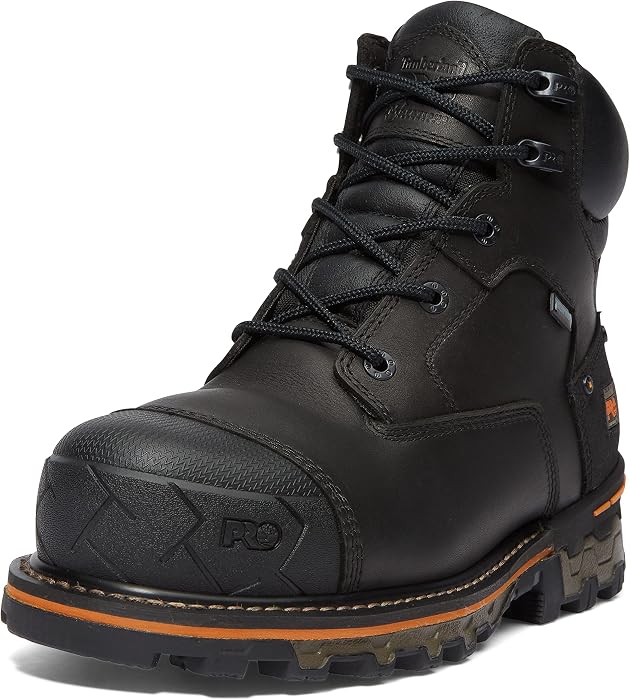
Timberland PRO Boondock 6-Inch Best for Cold, Wet Work

Timberland PRO Men's Boondock 6 Inch Composite Safety Toe Waterproof Industrial

Cold, wet jobs

Field Score 89/100
Toe
Composite safety toe
Height
6 inch
Insulation
Insulated
Waterproof
Waterproof
View on Amazon

There's no hiding what this boot is. The Boondock is big, insulated, and built like equipment, and the first thing you notice pulling it on is how much boot there is around your ankle. That bulk is the point: it's the only pair here that treats a freezing, wet jobsite as the normal case rather than the exception.

We rate it for winter work without much reservation. The build is fully waterproof and insulated, the composite cap is lighter than a steel one, and the last is broad enough that a wide forefoot doesn't jam against the toe box. The footprint is stable, too, which matters more than cushioning when you're standing on a ladder in the cold.

The cost is weight, and it's honest weight. A cold-weather boot carries insulation and a rubber shell, and you feel both by the end of a ten-hour shift. If your winters are mild or you work indoors, you're paying for protection you won't use, and the CAT or the Ashby is the lighter answer.

Worth Noting

  • Insoles pack down before the leather shows wear
Our Verdict

For cold, wet winter work the Boondock is the pick: insulated, fully waterproof, and composite-toed, with a footprint broad enough to keep a wide foot planted.

Check Latest Price
6

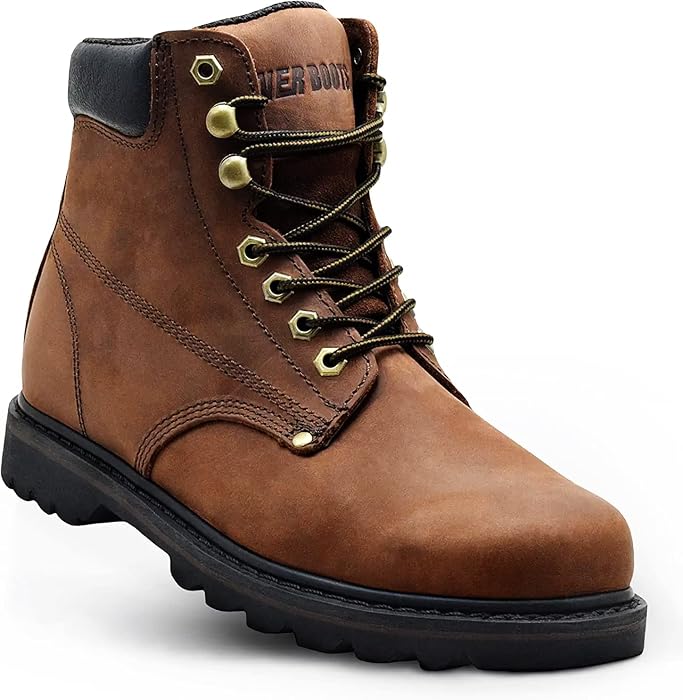
Ever Boots Tank 6-Inch Best for Light-Duty Projects

Ever Boots Tank 6-Inch – Work Boots for Men Soft Toe

Light-duty projects

Field Score 88/100
Toe
Soft toe
Upper
Leather
Height
6 inch
Outsole
Rubber
View on Amazon

Soft toe, leather upper, rubber outsole, six inches tall: the Tank is the plainest boot here and the least expensive, and there's nothing on it trying to be clever. What you get is a leather work boot, an insole, and enough left over for a second pair of wool socks.

Fit is roomy but inconsistent. The toe box has space across the front and plenty of broad feet land in their usual size, but the sizing wanders from pair to pair: some come up a half size long, some run short enough that a full size up is the fix. Some pairs also ship with a thicker padded insole that presses on a high arch, and pulling it out solves that in a minute.

Comfort and construction are the pleasant part. The leather is soft, the stitching is straight, and the finish reads more expensive than it is, a plain oiled-leather look that doesn't advertise a discount. For yard work, a home shop, or a job that has you in and out of a truck all day, they do the job without complaint.

Our read is to buy them for light duty and occasional abuse, not for a daily career on concrete. When a sole separates, and on some pairs it lets go long before the leather is finished, there's no repair worth paying for at this price, so the boot becomes a shop boot and then a yard boot. For a lot of people that's a fair deal.

Worth Noting

  • Soles separate on some pairs
Our Verdict

A plain leather soft-toe boot for well under the price of everything else here. We recommend it for yard work and light duty, with a plan for the fit.

Check Latest Price
7

Carhartt 6-Inch Moc Toe Waterproof Best for Shop Floors

Carhartt Men's 6” Moc Toe Waterproof Work Boots

Shop floors

Field Score 87/100
Upper
Oil-tanned leather
Height
6 inch
Safety
EH rated
Toe Shape
Moc toe
View on Amazon

Where the Boondock is built for weather, this one is built for floors. The wedge sole is flat and wide with a shallow tread, so it sits steady on concrete and doesn't carry half the shop out to the truck, and the EH rating makes it a sensible choice around electrical work.

Comfort is the other reason it's here. The oil-tanned leather takes a shine, the moc toe stitching gives it a look that survives a weekend, and the footbed is flat enough that a wide foot isn't fighting an arch it never asked for. It runs generous, so plan on a half size down, and give the leather a few days to soften before you judge the fit.

The sole is where it gives ground. A soft wedge is comfortable from the first step and wears faster than a lugged outsole, and on abrasive floors the heel and ball go before the leather is anywhere near finished. For a shop, a warehouse aisle, or an electrician's day, the comfort is worth the trade; for a job that chews soles, the CAT or the Boondock lasts longer.

Worth Noting

  • Waterproofing gives out on some pairs
Our Verdict

A waterproof moc toe with a flat wedge sole that's easy on concrete. We like it for shop floors and electrical work, as long as you size down.

Check Latest Price

How We Tested a Dozen Pairs of Wide Work Boots

We started by pulling together every work boot we could find that offers a genuine wide or extra-wide fitting, then narrowed the field by toe construction, waterproof claims, shaft height, and price so the final twelve weren't all the same style of boot. Before anyone wore a pair outside, each tester traced their foot on paper and set the outline inside the boot; if the insole couldn't clear it, that pair never made it to a jobsite.

Weight went on a kitchen scale, first dry and again with a soaked sock, because a heavy boot gets heavier by the end of a shift. Break-in came in two-hour blocks during the first week, with hot spots and pinch points written down in a notepad we kept in the truck. Then came the real wear: eight-hour shifts on concrete, kneeling and ladder work, and Saturday yard chores for the testers who volunteered their weekends.

Waterproofing got its own afternoon — two inches of standing water, a walk through wet grass, and a sock check at the end. Wet, oily concrete earned a deliberate slide test, since that is where most of us nearly went down. We looked at stitching, welt seams, and toe scuffs after month one and again at month eight, noted heel wear, timed how many seconds each pair took to get on and off when we were tired, and asked the blunt question at every check-in: would you wear these off the clock? That last one told us more about appearance and value than any spec sheet.

How to Choose Work Boots for Wide Feet

Start With the Width, Then the Length

Most wide sizes add volume across the ball of the foot and the toes rather than around the heel, which is why a true wide usually fits better than a half size up in a standard width. Sizing up buys length you don't need and heel slip you don't want. Try your usual length in the wide first: if the widest part of your foot lands on the widest part of the boot and your heel stays put when you walk, you have your size.

If the ball of the foot is still pinched in a wide, the last is wrong for you, not the size. Move to a different boot rather than a bigger one.

The Toe Box and the Safety Toe Trade-Off

A steel cap does not stretch. If the cap presses your toes, a larger size won't rescue it, because the rigid shell stays exactly where it is and you'll feel it by the end of the shift. Composite caps are molded thinner and lighter and can buy back some room; a soft toe gives you the most space of all.

Decide which protection the job actually requires before you shop. Most safety toe boots add a shell that eats toe room, and ordering the wide width is how you get that room back.

Weight, Break-In, and the End of the Shift

A boot that needs three weeks of breaking in will feel wonderful in month three and miserable in week one, and if you're on concrete ten hours a day, week one is the part you have to survive. Soft leather and a cushioned midsole get you comfortable fast.

The trade is support and wear. The easiest boots to break in are often the ones that give up first, so we lean toward a boot that's comfortable on day one and honest about how long the sole holds up.

Waterproofing Cuts Both Ways

A waterproof membrane keeps water out and heat in, so a fully waterproof boot in July becomes a footbath from the inside. If you work wet, buy waterproof and accept the warmth; if you work dry, an uninsulated water-resistant leather boot breathes better and dries overnight.

Insulation is a separate decision. It belongs in a winter boot and not in the pair you'll still be wearing in September.

The Outsole Is What Wears Out First

Uppers usually outlive soles. A soft wedge is quiet and stable on smooth concrete but wears at the heel and ball; a lugged rubber outsole handles rock and mud and then tracks some of it indoors. Match the tread to the surface you stand on most.

Before you blame the leather for a boot that's finished, check the outsole at the ball and the lining at the heel. Those two spots decide the useful life of a work boot more often than the upper does.

Frequently Asked Questions

Final Verdict

For most people with a wide forefoot, the CAT Men's Work Boots are the pair to start with: the toe box is genuinely roomy, the wide sizes are ordinary stock, and the comfort lasts past the first week in a way budget boots rarely manage.

Change the requirement and the pick changes. Want a square toe and a western profile for ranch or riding work? The Ariat Groundbreaker. Working outside through a cold, wet winter? The Timberland Boondock, and accept the weight. Shopping on the tightest budget? The NORTIV 8, provided your days don't end on slick concrete.